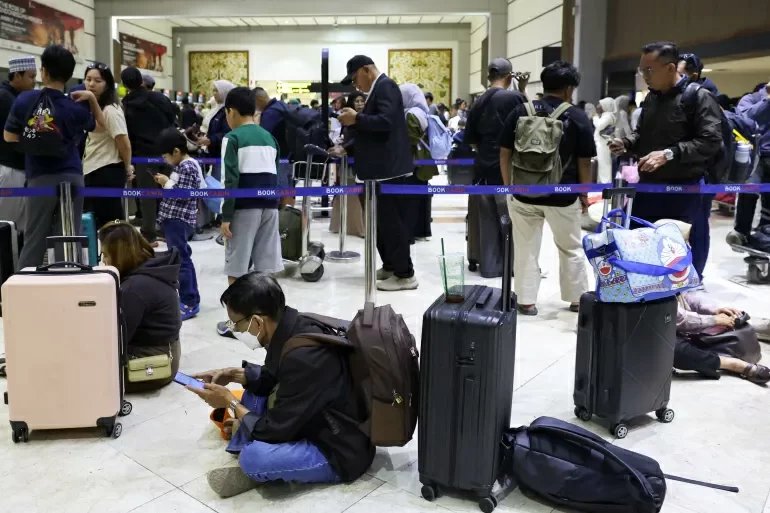
A major ongoing eruption of Indonesia’s Anak Krakatau volcano has triggered widespread disruption across the island nation, forcing the closure of eight airports—including the country’s primary international gateway, Jakarta’s Soekarno-Hatta International Airport. As of early September 2026, the disruption has left roughly 170,000 passengers stranded and delayed or canceled a total of 1,558 flights, with more than 900 of those disruptions concentrated at the busy Jakarta hub, according to official data from Indonesia’s Ministry of Transportation.
Airport operations at the affected sites were extended through 8:59 a.m. local time on Monday, as plumes of volcanic ash spread across Jakarta and surrounding regions. Additional impacted airports include Husein Sastranegara Airport in the West Java city of Bandung and Radin Inten II Airport near Bandar Lampung on the island of Sumatra. To offset the travel backlog, authorities have activated contingency plans, positioning airports in the Javan cities of Semarang and Surabaya to accept diverted flights.
In response to falling ash that poses respiratory risks, Jakarta’s municipal government ordered all schools to close Monday and shift fully to remote online instruction, with no set end date announced for the public health measure.
The eruption cycle began on Friday evening, when Anak Krakatau burst into activity with fountains of superheated lava and deafening explosive blasts loud enough to be detected more than 700 kilometers from the volcano’s vent. Volcanic ash plumes have reached altitudes of up to 6,000 meters above the Java side of the volcano, and as high as 15,000 meters over Sumatra and parts of Banten Province on Java. Two additional powerful eruptions were recorded by monitoring agencies on Sunday, confirming the event remains highly active.
Indonesia’s National Disaster Management Agency (BNPB) has moved to reassure at-risk populations that there is no immediate threat of a tsunami related to the current activity. To speed up the clearing of dangerous ash from air and populated areas, the agency has already begun implementing mitigation measures, including cloud seeding operations designed to trigger artificial rain that will wash ash out of the atmosphere.
Anak Krakatau is located in the Sunda Strait between Java and Sumatra, a busy strategic shipping lane used by global maritime trade. Authorities have issued warnings to all commercial and private vessels transiting the region to exercise increased caution due to hazards from ongoing volcanic activity, and have established a 3-kilometer radius no-go safety zone around the volcano that prohibits all maritime traffic.
The impacts of the eruption are not limited to Indonesia, experts note. Wind currents can carry ash plumes across regional borders, threatening air traffic safety in neighboring countries and potentially causing secondary flight delays and cancellations across Southeast Asia. Volcanic ash poses a severe hazard to aircraft: it can abrade and damage jet engine components, cause catastrophic engine failure, and drastically reduce pilot visibility, forcing full airport closures until atmospheric conditions are confirmed safe for flight operations.
The volcano itself has a well-documented history of major explosive activity. It formed in the 1920s inside the caldera left by the catastrophic 1883 eruption of the parent Krakatoa volcano, one of the deadliest and most destructive volcanic events in recorded human history. Anak Krakatau has experienced regular periodic activity in the decades since its formation. In 2018, a major eruption triggered a partial collapse of the volcanic cone, which in turn generated a tsunami that killed more than 400 people along the coastlines of Java and Sumatra.