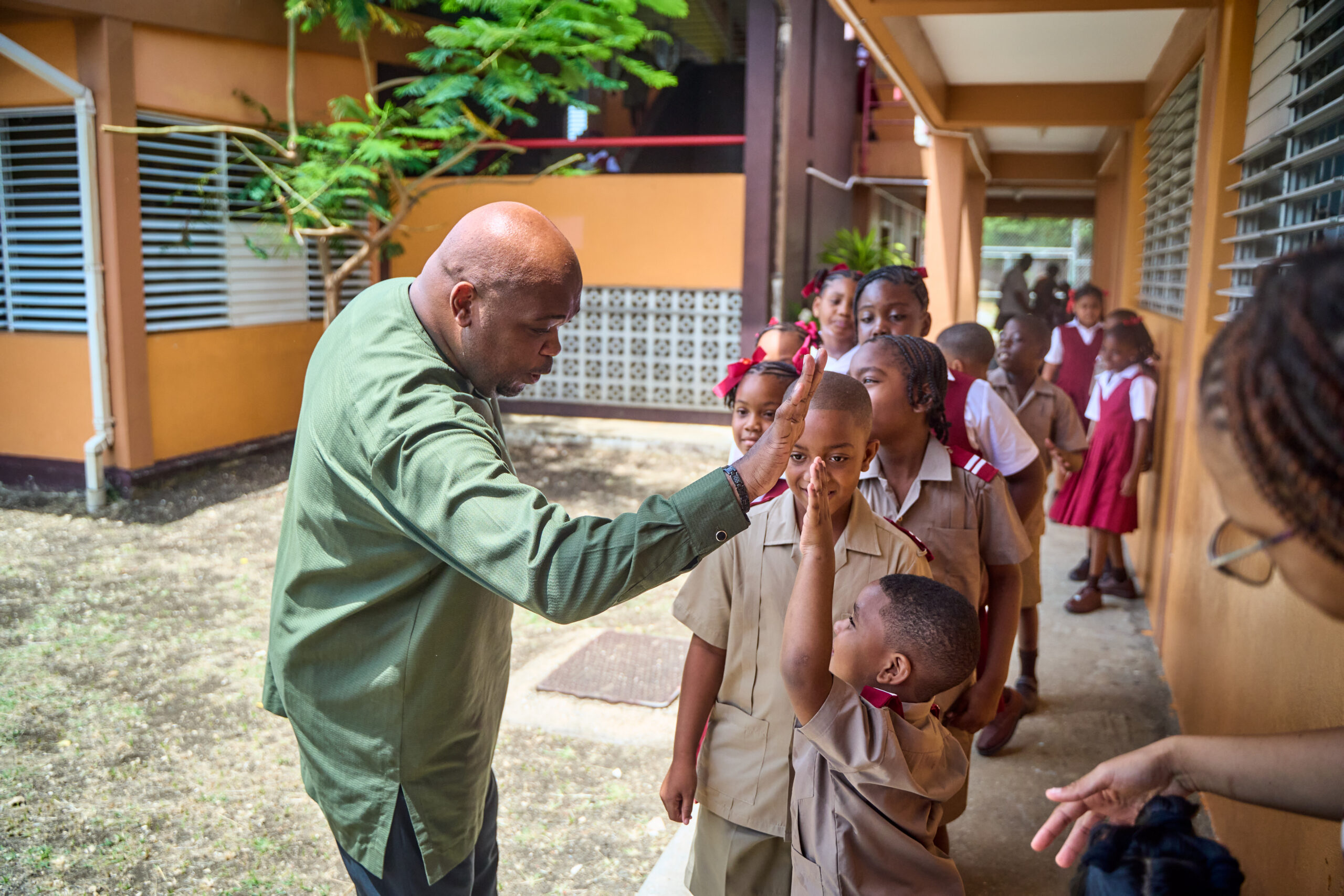
As hundreds of Barbadian students streamed back through school gates on Monday to kick off the 2024 academic year, education authorities launched three transformative initiatives to reshape the nation’s learning landscape: universal free early childhood education, a pilot specialised secondary school academy, and a year-round campus infrastructure upgrade programme.
Led by Minister of Education Transformation Chad Blackman, a delegation of senior education officials including Chief Education Officer Dr Ramona Archer Bradshaw, Deputy Chief Education Officer Julia Beckles, and Permanent Secretary Kim Belle conducted a day-long tour of institutions across the country to mark the start of term, starting with St Mary’s Primary, a flagship site for the new early childhood rollout.
For most returning students, the first day brought the familiar joy of reconnecting with classmates and teachers after summer break. But for the island’s youngest learners, stepping into a pre-primary classroom for the first time marked the start of an entirely new educational journey made accessible at no cost to their families under the new universal programme.
Standing at St Mary’s Primary, Blackman formally announced the nationwide launch, framing the policy as a landmark step for Barbados education equity and evidence-based early learning. “Today we rolled out universal access to early childhood education, and St Mary’s Primary stands as one of the pioneering sites delivering this programme across the island,” Blackman said. “What this means for Barbadian families is that all pre-primary children can now access a play-based early learning curriculum completely free of charge.”
The minister emphasized that the structured play-focused curriculum was developed in line with cutting-edge international research on early childhood cognitive development, drawing on best practices from education systems across Asia, Europe, North America and Africa. “Decades of scientific research confirm that for children aged three to five, guided play-based formal learning builds the foundational cognitive skills that drive long-term success in life and learning,” Blackman explained. “Today we embedded this evidence-based approach into Barbados’ formal education system, and that makes this an incredibly exciting time for our country.”
After wrapping up visits to primary campuses, the delegation moved to secondary education, where Princess Margaret Secondary School has been selected as the pilot site for a new specialised academy offering customised learning pathways for students. Blackman noted that while the school has faced systemic challenges over the years, it has undergone significant recent improvement, making it an ideal test case for education reform.
“We are unveiling this new academy today to offer a different, student-centered approach to learning for high-performing students,” Blackman said. “With a dedicated team of specialised teachers in place, we expect that in two to three years, Princess Margaret Secondary will become a source of national pride and a model we can replicate across the entire secondary education system.”
Alongside curriculum innovation, Blackman outlined a major shift in how the government addresses the island’s aging school infrastructure, many of which range from 50 to 200 years old. For decades, repair and upgrade work was limited to an eight-week window over the summer break, but the minister said that timeline is no longer sufficient to tackle decades of accumulated structural needs.
“We carried out an aggressive infrastructure improvement programme this summer, but we have made a systemic change to how we approach upgrades moving forward,” Blackman said. “Starting last year, we made the decision to shift to year-round refurbishment work. Instead of cramming all projects into eight weeks, we will now carry out upgrades on weekends, public holidays and during the academic term to continuously bring all school facilities up to modern standards.”
Blackman also confirmed that transition arrangements at the temporary satellite campus of Samuel Jackman Prescod Polytechnic are progressing smoothly, as the institution prepares for a new permanent facility scheduled for completion in September 2027. The minister noted that early reports from the campus show students have already settled into their new learning spaces, with construction of the permanent site remaining on track for its 2027 delivery target.