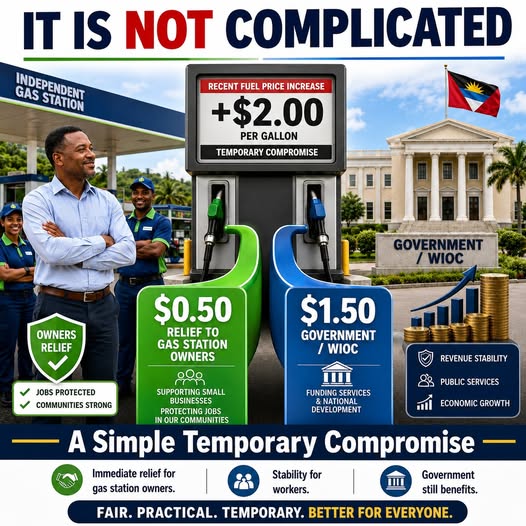
Just days ago, commentator Yves Ephraim offered a framework to resolve the ongoing standoff between independent gas station operators and the government of Antigua and Barbuda, centered on a temporary reallocation of the recently enacted $2 per gallon fuel price increase. Under his proposal, station owners would immediately retain $0.50 of that per-gallon increase, with the arrangement expiring automatically if global crude oil prices fall to a pre-agreed threshold.
Ephraim’s initial proposal was crafted to deliver a rapid, mutually beneficial resolution that addresses pressing financial pressures on independent operators. The urgency of a quick fix stems from growing accumulated losses that, if left unaddressed over multiple months, could force owners to lay off fuel pump attendants. A key driver of these losses is a well-documented dynamic: when fuel prices rise, credit and debit card merchant fees, which are calculated as a percentage of the total transaction value, increase automatically, turning incremental price hikes into direct bottom-line losses for operators.
In the time since Ephraim published his first analysis, the Antigua and Barbuda government announced a new plan: it will lobby local commercial banks to slash merchant fees for gas station transactions down to just 1%. While the policy goal of reducing operators’ costs is welcome, Ephraim argues the approach is riddled with practical and structural obstacles that make it unworkable in the short term.
First, the proposal raises major technical questions about existing banking infrastructure. Can local banks’ core processing systems actually implement tiered merchant fee rates that vary by industry or customer type? Even if the technology can be adjusted, would the cost of reconfiguring these systems make the change uneconomical for the institutions?
Second, the plan sets a problematic precedent that could trigger broader industry demands. If banks grant a reduced rate to gas stations, operators in other sectors facing similar cost pressures would almost certainly demand the same preferential treatment. Opening the door to segmented fee rates would create a wave of requests that could upend the local banking sector’s existing fee structure, with no clear end to the demands.
Most critically, the entire negotiation and approval process is inherently slow. Even if all parties moved forward in good faith, the policy would take months to implement – and every passing day adds more to gas station owners’ mounting losses.
Ephraim emphasizes that he supports lower merchant fees in principle, but a pragmatic look at the local financial ecosystem shows the 1% target is unachievable. The cost of doing business in Antigua and Barbuda is already extremely high, and banks note that existing 3.5% to 4% merchant fees already cover significant costs including chargebacks and fraud losses. What is more, local banks do not keep the entire fee charged to merchants: a large portion is split between third-party payment processors and global card network operators like Visa and Mastercard.
Based on industry knowledge, Ephraim estimates that Visa alone captures roughly 1.15% of every transaction in fees, while local processor Caribbean Credit Card Corporation (4CS) takes at least another 1%. Before accounting for the local bank’s own share of the fee, more than 2.15% is already allocated to outside service providers. This means a mandated 1% total fee is mathematically impossible, and the lowest realistic rate banks could offer would still land above 3% – far too high to meaningfully relieve gas station operators’ financial strain.
The bureaucratic process only adds further delays. Before banks can even respond to the government’s proposal, executive teams would need to run detailed revenue impact simulations, then present the results to their boards of directors for approval. Each step of this process takes weeks at minimum. With gas currently selling for $16.50 per gallon, the cumulative losses will push increasingly cash-strapped operators toward drastic action long before any agreement can be reached.
Ephraim reaffirms that his original proposal delivers immediate, targeted relief that could take effect as early as the day an agreement is reached. By allowing gas station owners to keep $0.50 of the $2 per gallon price increase on a temporary basis, the plan addresses the immediate loss issue while still delivering benefits to the government, which holds a 51% stake in the West Indies Oil Company (WIOC) and will still collect dividend revenue from the remaining portion of the price increase. The framework delivers the urgent win-win outcome that all stakeholders need right now.