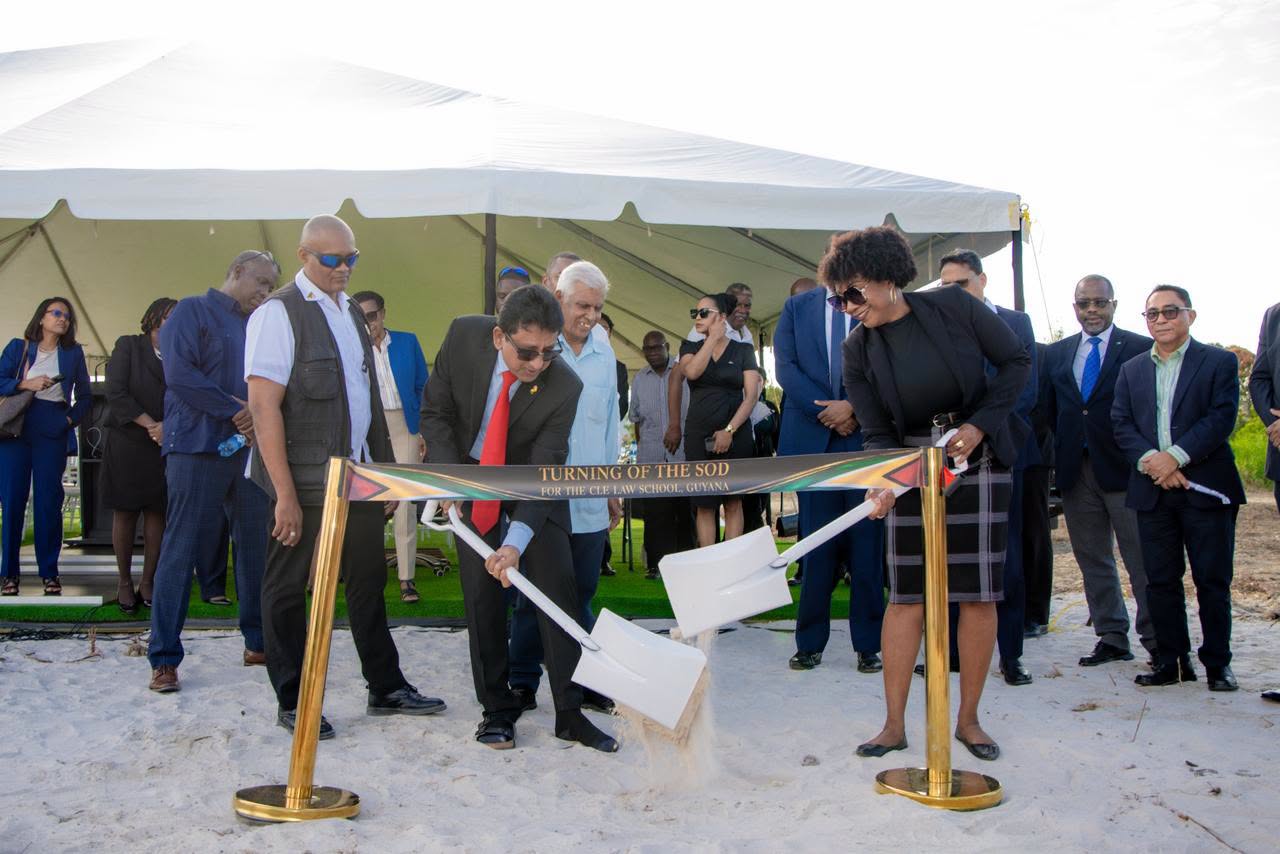
On Thursday, September 3, 2026, a landmark sod-turning ceremony marked the official start of construction for the Caribbean Council of Legal Education (CLE)’s fourth regional law school, hosted on an 8-acre plot at the University of Guyana’s Turkeyen Campus in Greater Georgetown.
More than three decades after the idea was first proposed, the initiative is set to address a decades-long gap in access to specialized legal training across the southern Caribbean. Guyana’s Attorney General Anil Nandlall, who joined CLE Chairperson Liesel Weekes, a Trinidad and Tobago-based attorney, for the ceremony, emphasized that the new facility is a regional asset, not an exclusively national institution.
“While it will be located in Guyana, it is a regional institution to serve the people of the region and to be administered by the regional council administering legal education,” Nandlall explained, noting that organizers intentionally structured the project to serve the entire Caribbean community from its new southern base.
The push for a fourth CLE law school comes as existing regional institutions struggle to meet soaring demand for legal education. Nandlall pointed out that two established CLE-affiliated schools — Jamaica’s Norman Manley Law School and The Bahamas’ Eugene Dupuch Law School — have for years turned away hundreds of qualified prospective students. Currently, the southern Caribbean is only served by Trinidad’s Hugh Wooding Law School, which has long faced capacity constraints. For decades, just 25 spots were reserved annually for Guyanese University of the West Indies Cave Hill Campus graduates seeking entry, creating significant barriers for local aspiring lawyers.
The project’s origins stretch back to 1996, when then-Guyanese President Cheddi Jagan first floated the proposal, and former Attorney General Bernard Dos Santos formally tabled the idea before the CLE. The initiative gained new momentum after a years-long feasibility process, led in part by prominent chartered accountant and University of Guyana law lecturer Christopher Ram, who compiled comprehensive data on regional demand to demonstrate the project’s long-term economic and operational viability. Ram’s work analyzed unmet demand across multiple Caribbean jurisdictions, tracking thousands of qualified candidates who had been locked out of existing programs.
CLE Chairperson Weekes confirmed that after two years of assessments and deliberations, the council formally approved the project following a 2025 meeting, where the feasibility report received unanimous positive feedback. “Guyana ticked all the boxes, and satisfied the Council without a doubt that this school was going to be viable, it was going to be sustainable, and it was long in coming,” Weekes said.
Nandlall noted that final construction costs will not be confirmed until the winning bidder from 15 competing applicants completes the facility’s design and secures government approval. Once operational, the school is projected to accommodate more than 120 students, opening new training pathways for legal professionals across the southern Caribbean, where population density drives the highest regional demand for legal education.
With ground now broken, the project closes a 30-year gap between initial proposal and tangible progress, fulfilling a long-held regional goal to expand access to quality legal training across the Caribbean.