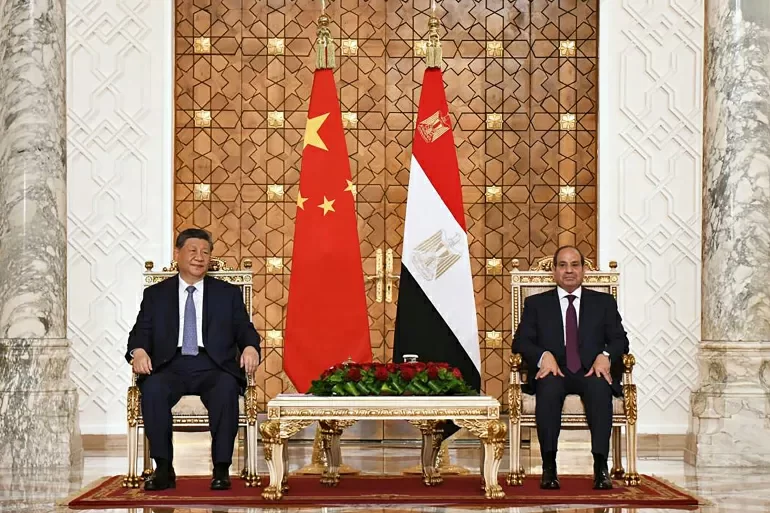
On Wednesday, Chinese President Xi Jinping kicked off his first visit to Cairo, Egypt in a decade, a landmark trip that comes against a backdrop of months of escalating conflict roiling the Middle East and shifting global power dynamics in the region. During high-level talks at the Ittihadiya Presidential Palace, where Xi was welcomed with a ceremonial 21-gun salute, he met one-on-one with Egyptian President Abdel Fattah el-Sisi to discuss critical issues ranging from regional security to bilateral economic cooperation.
Addressing the ongoing instability that has gripped the Middle East for half a year, fueled by open confrontation between Israel and Iran that has drawn in global powers and amplified regional security fears, Xi put forward a vision for a new regional security architecture. According to China’s official state news agency Xinhua, Xi emphasized that Middle Eastern nations must retain primary ownership of their own regional affairs, reject external interference in local matters, and strengthen inclusive dialogue to advance shared peace and security. Both leaders jointly issued a call for diplomatic efforts to negotiate a comprehensive, lasting agreement that can bring an end to ongoing regional conflicts, an official statement from the Egyptian presidency confirmed.
Beyond security discussions, the visit delivered tangible progress on bilateral economic cooperation. The two sides signed a formal agreement to launch the third phase of development for the Egyptian-Chinese Industrial Zone located near the Suez Canal. Already, the zone hosts more than 200 enterprises and holds cumulative investments worth approximately $4 billion. This expansion will further solidify China’s strategic footprint in a region that serves as a critical global trade chokepoint, a development that carries extra weight at a time when ongoing regional conflicts have disrupted shipping traffic through other key maritime passages including the Strait of Hormuz and Bab al-Mandeb. During his remarks, Xi affirmed that China stands ready to collaborate with all regional countries to safeguard the security of international shipping lanes, advance inclusive development cooperation, and pre-empt escalating conflict across the region.
Xi’s visit to Cairo arrives at a moment of profound shift in Middle Eastern geopolitics, as the United States faces growing questions over the consistency and reliability of its long-standing security commitments to the region, with Washington oscillating between calls for disengagement and renewed intervention. Egypt has long been viewed as a key strategic partner for China, serving as a gateway to expand Beijing’s political and economic influence across the broader Middle East. For its part, Egypt has actively sought to diversify its international partnerships in recent years, avoiding overreliance on any single global power as it navigates shifting global alliances.
The trip also follows closely on the heels of the recent establishment of the Mecca Defence Alliance, a new security pact bringing together Saudi Arabia, Turkey, and Pakistan. The agreement marks a clear signal that regional powers are seeking to expand their independent security arrangements outside of U.S.-led frameworks, reflecting growing skepticism among many Middle Eastern nations about the long-term reliability of traditional American security guarantees as Washington pushes its Gulf allies to take greater primary responsibility for their own defense.
In the lead-up to Xi’s visit, the streets of Cairo — a sprawling metropolis home to more than 26 million residents — were decorated with Chinese and Egyptian national flags, alongside large billboards displaying the portraits of the two national leaders. Following the bilateral talks, Xi was scheduled to visit the Grand Egyptian Museum near the Giza Pyramids, a stop highlighting the deep cultural ties between the two ancient civilizations.