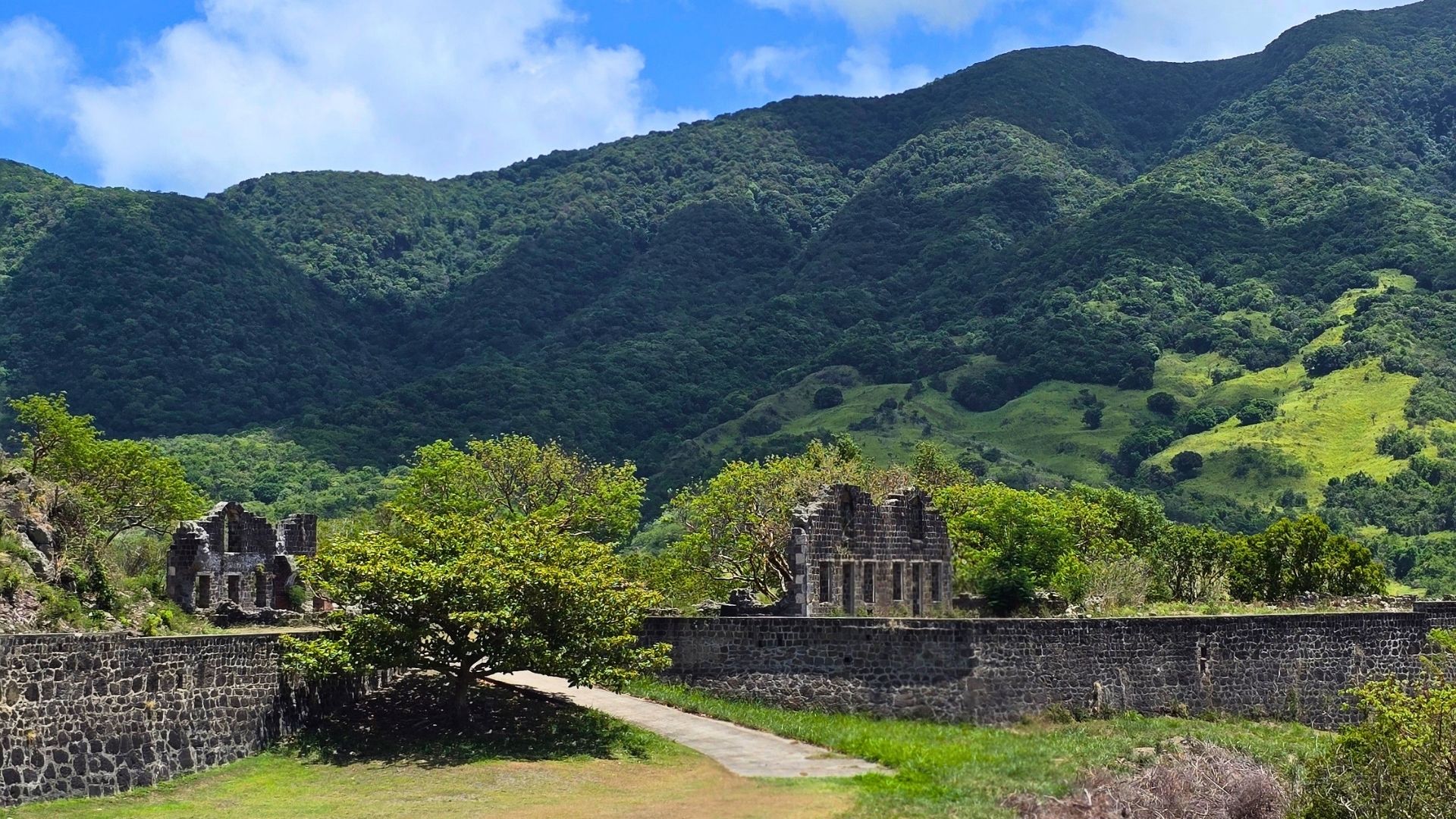
For a first-time visitor from another tropical Caribbean island, stepping foot into the Federation of St. Kitts and Nevis unfolds as a journey far beyond postcard-perfect beach views. It is a destination where centuries of layered history are deliberately preserved, interwoven into every volcanic slope, coastal village, and weathered ruin, inviting travelers to slow down and listen to the stories held in the land.
Dormant volcanic peaks anchor the islands’ dramatic skylines, greeting every traveler who crosses into the federation. Mount Liamuiga rises ethereally from the heart of St. Kitts’ southern terrain, while across the narrow stretch of water called The Narrows, Nevis Peak towers over the smaller sister island that completes the twin-island federation. On a soft August day, wispy clouds drape the summits of both mountains, casting an air of quiet reverence over the bustling, unhurried life that unfolds in the lowland towns below. For a traveler already familiar with rolling tropical hills, the raw, largely untouched beauty of these landscapes and the echoes of the past embedded within them sparked a curiosity unlike any other regional travel experience. This is a place that does not relegate history to museums; instead, it lets the voices of bygone eras resonate alongside modern daily life, grounding visitors firmly in the present while honoring what came before.
The three-day exploration of St. Kitts opened at Timothy Hill in Frigate Bay, a panoramic lookout that stretches out to reveal the island’s Southeast Peninsula, cradled between the contrasting deep blue waters of the Atlantic Ocean to one side and the Caribbean Sea to the other. Below the overlook rests the Great Salt Pond, a body of water where Indigenous communities and later inhabitants harvested naturally crystallized salt for centuries, a practice that has long since ended. With no large cruise ships docked in the harbor that afternoon, the small group of four explorers had the quiet site entirely to themselves.
A slow drive through Basseterre, St. Kitts’ quaint, spotless, and uncrowded capital, reveals centuries-old bricks still holding up centuries-old structures, a quiet contrast to the land’s dark colonial past. What is now named Independence Square was constructed by British colonizers in the mid-1700s, and for decades it served as a central trading hub in the Transatlantic Slave Trade. Even today, the layout of the square’s grassy plots and paved walkways still follows the shape of the British Union Jack, the flag it was originally designed to mirror. Local guide Ni’quan points out a nearby Georgian-style building that once operated as a holding pen: captured Africans were held here temporarily after being brought to the island, and small ground-level window openings, still blocked off with rusted iron bars, remain as a haunting, sobering reminder of the violence that shaped the island’s history.
Leaving the capital behind, the route winds through Challengers, a cozy fishing village where vibrant hand-painted murals line the walls, chronicling the community’s history from the first encounters between the Kalinago people and European colonizers. Further along the coast, Old Road Town holds preserved pieces of pre-colonial history in the form of ancient Carib petroglyphs, etched deep into clusters of volcanic rock. A quick stop at the town’s Wingfield Estate reveals an archaeological treasure trove pulled from the ground over 50 years of excavations, including a rare intact water-powered sugar mill. The estate’s long history traces ownership back first to Carib Chief King Tegreman, then to Samuel Jefferson, an ancestor of Thomas Jefferson, the third president of the United States. The site also holds well-preserved fermenting tanks, copper stills, and furnace structures from a 17th-century rum distillery, widely recognized as the oldest intact rum production facility in the entire Caribbean.
A 15-minute drive from the estate leads along a winding tree-canopied road past preserved brick archways to Brimstone Hill Fortress, a former British military stronghold constructed entirely by forced African labor. Today, it holds status as a UNESCO World Heritage Site, with preserved artifacts and curated exhibits that retell the site’s complex history through text and original relics. Perched high on a bluff, the fortress offers unrivaled panoramic views of rolling green hills, the coastal town of Sandy Point, and neighboring islands from Saba and Sint Eustatius to St. Barts, Sint Maarten, Nevis, and Montserrat, making it a perfect place to linger and absorb the weight of the landscape.
Crossing The Narrows by boat brings visitors to Nevis, which the native Kalinago people called Oualie, meaning “Land of Beautiful Waters.” Where St. Kitts’ historical preservation feels deliberate and structured, Nevis honors its past through the warm, unhurried warmth of its slow-paced community and genuine hospitality, where every visitor is greeted with a wave and a smile. The island is most famously known as the birthplace of Alexander Hamilton, a fact popularized by the hit Broadway musical *Hamilton*, but it holds countless other untold stories waiting for curious travelers to uncover.
Nestled on a green hilltop sit the remains of Cottle Church, the first place of worship in the Caribbean where enslaved Africans and European colonists worshipped side by side. The building was constructed by the enslaved African people who lived on the nearby Round Hill Estate, who also became the church’s first congregation, ranging in age from 4 to 79 years old. Each of their names is etched into a memorial plaque on the building, honoring their legacy decades after the church’s ruins were preserved. Driving through Nevis’ rural parishes passes dozens of historic century-old churches, leading to New River Estate, the last operational sugar plantation on Nevis, which now operates as an open-air historical site with preserved plantation structures and artifacts spread across its 267 acres. Nevis also preserves the mineral-rich geothermal springs that flow from the base of volcanic Nevis Peak; in the 19th century, wealthy planter John Huggins built the Bath Hotel overlooking the springs, recognized as the very first resort hotel built in the Caribbean.
To experience the island’s living local culture, an open-air buggy ride carries visitors to a small farm in New Castle for an immersive farm-to-table cooking experience hosted by local guide Ras Iroy. The experience gives guests a firsthand look at what it means to live off the land’s natural abundance, with Ras Iroy’s warm charm turning a simple cooking lesson into a leisurely, memorable afternoon capped off with a hearty, flavorful meal. This farm experience is just one of countless culinary highlights across the twin-island federation, where local flavors blend traditional Caribbean recipes with creative modern twists. Early in the trip, lunch at the 17-year-old Spice Mill Restaurant serves up generous portions of everything from beloved local staples to inventive new dishes, ending with a hands-on cocktail class where owners Theresa and Carlos share the recipe for the restaurant’s signature Hibiscus Rumtini. For breakfast, Coconut Grove’s Classic Caribbean Breakfast serves up a vibrant medley of local sweet and savory flavors that sustains visitors through a full day of exploration.
By the end of the journey, it becomes clear that St. Kitts and Nevis’ one-of-a-kind identity is stitched into the very landscape of both islands, leaving a lasting impression on every traveler who takes the time to engage with its stories. For visitors willing to set aside a rushed travel itinerary and embrace the islands’ unhurried pace, the reward is unforgettable: rich complex history, warm heartfelt hospitality, bold delicious flavors, and dramatic jaw-dropping scenery that leaves travelers planning their return before they even depart.