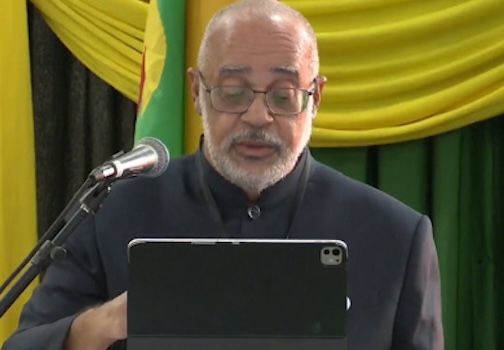
Against a backdrop of a fracturing global order that has left small island developing states increasingly economically vulnerable, the top leader of the Organisation of Eastern Caribbean States (OECS) is calling on sub-regional governments to remove one of the most persistent barriers to agricultural revitalization: unequal access to land.
Speaking at the opening ceremony of the OECS Youth and Women in Agriculture Symposium hosted in Grenada on Tuesday, OECS Director General Dr. Didacus Jules pushed for governments to open up crown lands to emerging farmers through transparent, accessible long-term leasing frameworks. Specifically, he proposed 10-year payment arrangements that would be recognized as valid collateral by lending institutions, arguing that secure land access is the foundational requirement for any other agricultural development intervention to succeed.
“Every other intervention we make is diminished if a young person has nowhere to stand,” Jules told attendees, emphasizing that inclusive agricultural development must be structural, not just ceremonial. He noted that people with disabilities had registered for the symposium in significant numbers, and called on organizers and policymakers to design programming, training and financial tools that accommodate disabled participants from the start, rather than adding them as an afterthought.
The three-day gathering, organized by the Castries-based OECS Commission in partnership with Grenada’s Ministry of Agriculture, Lands and Forestry, is designed to equip participants with actionable skills across key areas: agribusiness development, climate-smart farming practices, digital agricultural innovation, leadership capacity building, and strategies for accessing financing and regional and global markets. Core priority themes for the symposium include climate-resilient production, upskilling for agri-entrepreneurs, removing barriers to capital and market access, and strengthening regional networking and policy alignment.
Jules challenged attendees not to let the event end with only vague goodwill, calling for concrete progress on long-stalled initiatives. Most notably, he pushed for the proposed OECS Agriculture Forum for Youth to transition from a planning document to a formal, fully functional institution that is owned and led by youth stakeholders, even as it receives institutional support from the OECS Commission and the Inter-American Institute for Cooperation on Agriculture (IICA). He also called for delegates to agree on a firm target launch date for a new centralized agricultural information portal, which will be co-managed by the OECS and IICA to connect farmers with resources.
In his opening address, Jules laid out the urgent context driving the push for agricultural reform in the Caribbean: the sub-region is facing accelerating global instability that is eroding the security of small states. The post-WWII global order that Caribbean nations relied on for trade, development assistance and multilateral arbitration is unraveling faster than new inclusive frameworks can be built. Unilateral trade rule rewrites, escalating trade disputes, the use of tariffs as political coercion, and cuts and politicization of development assistance have all compounded existing challenges for small island economies, where shipping and insurance costs rise with every more intense hurricane season, and core multilateral institutions are facing unprecedented strain.
This unstable environment has left the Caribbean heavily dependent on food imports, which cost the region $658 million annually. Every dollar spent on imported food leaves the regional economy permanently, Jules explained, increasing national vulnerability and diverting funds that could be invested in domestic public services like education while giving foreign actors undue leverage over regional food systems.
“We are not here because agriculture is a nice idea for young people,” Jules said. “We are here because in a fracturing world, the capacity to feed ourselves is the most concrete expression of sovereignty available to a small state. If you cannot feed yourself, you’re dead.”
Compounding this urgency is the region’s aging farming population: Jules warned that domestic food production capacity is just one generation away from being lost entirely without intentional investment in new, young farmers. He highlighted a landmark decision taken by OECS agricultural ministers at a special October 2024 council meeting in St. Vincent and the Grenadines, which folded women into the sub-region’s youth in agriculture program on the grounds that women and young farmers face the same systemic barriers: lack of access to land, limited access to financing, lack of professional recognition, and exclusion from decision-making tables. That policy shift is what enabled the joint focus on youth and women at this symposium, a change Jules said deserves formal recognition.
He also commended the active participation of organizations representing people with disabilities, pointing to a successful aquaponics venture in St. Lucia run entirely by three disabled entrepreneurs: one wheelchair user, one person who is blind, and one paraplegic, as proof that disabled producers can drive thriving agricultural enterprises when given access to resources and opportunity.
The symposium is the culmination of more than a year of targeted regional planning and capacity building. In May 2025, OECS agriculture ministers gathered in Costa Rica with support from IICA and the European Union to finalize a strategic roadmap for sub-regional agricultural development. Since that meeting, the OECS has hosted workshops in St. Lucia on climate-smart agriculture and sustainable entrepreneurship, covering emerging tools including artificial intelligence, data analytics, drone technology, small-scale mechanization, soil and water management, business planning, and financial literacy. In October 2024, an OECS delegation traveled to Spain to study cooperative and social economy models for agri-food and fisheries sectors, a knowledge-sharing trip that has already delivered tangible benefits for small producers in Dominica and Montserrat.
Even with these early wins, Jules acknowledged that key barriers remain. Securing affordable access to land is still the biggest unmet demand for emerging farmers, and high interest rates at regional financial institutions remain largely unaddressed. The centralized one-stop information portal that farmers have requested, which would combine access to grants, land listings, market connections and technical guidance in one place, is still under development. A planned agricultural scholarship program and an agribusiness diploma for youth and women are still being finalized, with talks scheduled between OECS and IICA next month to wrap up the diploma program design.
Judes closed by urging delegates to deliver tangible outcomes from the symposium, reminding attendees that food sovereignty cannot be achieved by official declaration alone. “It becomes secure, food secure, one farm, one cooperative, one young woman, one differently-abled entrepreneur with a business plan at a time,” he said.