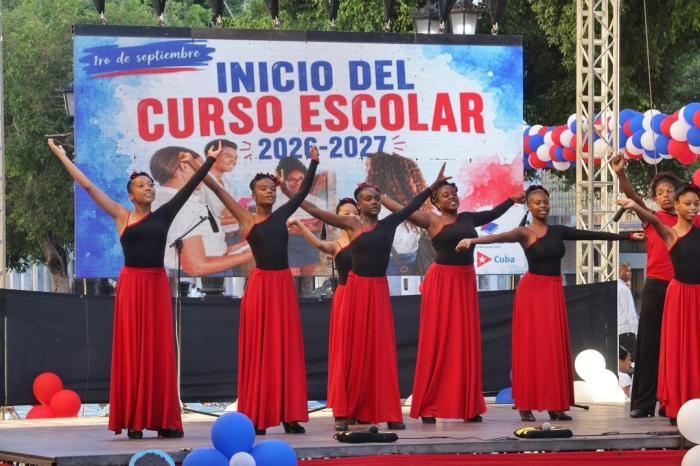
On September 2, 2026, Cuba held its national opening ceremony for the 2026-2027 academic year at the historic Paseo del Prado in Old Havana, a location deeply tied to the island nation’s educational legacy — the very spot where teacher Mendive once taught the iconic Cuban independence leader José Martí. Speaking after the ceremony, Miguel Díaz-Canel Bermúdez, First Secretary of the Central Committee of the Communist Party of Cuba and President of the Republic, framed the opening of the new school term as an act of national resistance against external pressure, while outlining three core takeaways from this milestone.
Against the backdrop of intensified U.S. economic blockade and energy restrictions that have created widespread logistical challenges across the country, Díaz-Canel emphasized that opening classrooms to students across the nation is itself a victory. This year’s school launch coincides with the centennial of the birth of Fidel Castro, founding father of modern revolutionary Cuba, adding historic weight to the occasion.
“As long as there are classrooms with students and schools with teachers in Cuba, there is a nation, there is a homeland, there is a Revolution, and there is socialism,” Díaz-Canel told reporters. He described opening the school year in current conditions as an enormous shared responsibility for all Cubans, noting that the successful launch defies efforts by the blockade to undermine the country’s social fabric.
“It means having started the school year in the middle of a complex situation that we cannot deny, neither to our teachers, nor to our students, nor to our children, nor to our adolescents,” the president said. “This beginning is also to show the capacity of a country, a nation, a Revolution, where the passion for knowledge and love for the Homeland are imposed on all restrictions, imposed on that genocidal policy of blockade that seeks to drag a country into barbarism.” He added that opening the term despite hardship is a deliberate act of resistance against colonial interference, proving that the Cuban people’s commitment to learning outweighs any adversity.
Díaz-Canel went on to credit the successful opening to widespread collective effort across all sectors of Cuban society. In the months leading up to the term, he explained, education leaders, government agencies at the local, provincial and national levels, families and community groups all joined forces to upgrade school infrastructure and prepare learning environments despite resource shortages. When Díaz-Canel tasked education leaders with developing a viable academic plan amid the energy and economic blockade, he said, they delivered an innovative, creative proposal in just two weeks — a result he said could only come from deep commitment to revolutionary ideals.
“It is worthwhile to express our gratitude and recognition to all our teachers, all our professors, all our institutions, parents, families, and communities for what they have accomplished,” the president stated.
The third core point Díaz-Canel highlighted is the ongoing challenge of delivering high-quality education amid national transformation. Beyond simply opening classrooms, the country’s priority this year is raising educational standards, with every classroom designated a “workshop for solutions” to overcome emerging challenges. He called this year’s term a difficult but dignified undertaking, framing it as a reaffirmation of Cuba’s commitment to protecting education as a fundamental social right.
“This start of the school year is an embrace of optimism and an expression of the Revolution’s and the country’s determination to continue defending such a sublime and paradigmatic social achievement as the nation itself,” Díaz-Canel said. “It is about giving our children, our grandchildren, our youth the right to an education; and it is also about giving them the right to dream and allowing us to share those dreams.”
The president also extended targeted calls to key groups involved in the school year. He acknowledged the economic hardships that Cuban teachers face, noting that salaries do not yet match the enormous effort educators put into their work, but emphasized that teachers are the backbone of the country’s cultural resilience. “Our teachers, our professors, our teaching staff, are above all builders of the resilience that distinguishes us as a nation and that distinguishes us as a people,” he said, calling on educators to bring innovation and dedication to supporting vulnerable students.
To students, Díaz-Canel emphasized that the entire country’s collective effort to open schools is for their benefit, and urged them not to use resource shortages as an excuse to disengage from learning. “On the contrary: dedicate yourselves passionately to your studies, dedicate yourselves passionately to learning, and let that also be part of your contribution to this daily effort and to the great effort that the entire country has made so that the school year could begin today,” he said. He also called on families to partner with schools, noting that successful education requires shared commitment from both household and school communities.
The opening ceremony, which opened with a tribute to Fidel Castro, featured performances from child, adolescent and young adult artists, drawing emotional responses from attendees in a reminder of what the nation is working to protect. The event was also attended by Cuban Prime Minister Manuel Marrero Cruz, other party and government leaders, and representatives of youth and student organizations.
Speaking at the ceremony, Education Minister Naima Ariatne Trujillo Barreto noted that the bell signaling the start of the 2026-2027 term is no ordinary bell. “It is the heartbeat of a nation that decides, once again, to invest in its future. It is the sound of resistance, of tenderness, and of hope. It is heard with the strength of those of us who know that educating is the noblest and most just thing we can do,” Trujillo said.
She reaffirmed that access to free education in Cuba is non-negotiable, noting that while the country continues to work toward better infrastructure, materials and uniforms, the value of Cuban education is measured not by physical resources but by its commitment to leaving no student behind. “Even if one resource is lacking, there will be an abundance of creativity, solidarity, and love from our teachers,” Trujillo said.
Trujillo tied this year’s effort back to the 1961 Cuban Literacy Campaign, a landmark initiative that eradicated illiteracy across the island 65 years earlier, noting that while current challenges are different, the same spirit of determination remains. She added that this year’s academic calendar is designed with flexible, localized decision-making to adapt to varying conditions across different regions and communities, with the core goal of making daily learning sustainable for all students. Closing her remarks, Trujillo thanked teachers for their heroic preparation work, called for continued family partnership, and noted that students’ curiosity and joy of learning are the core motivation for all the effort put into opening the term.