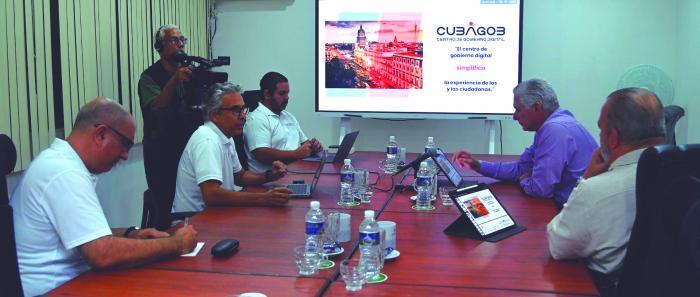
On August 31, 2026, Cuban President Miguel Díaz-Canel Bermúdez, who also serves as First Secretary of the Central Committee of the Party, made an official visit to the Digital Government Center alongside Prime Minister Manuel Marrero Cruz. This state-run entity under the Council of Ministers is the architect of the Sovereignty Platform, Cuba’s flagship digital initiative designed to modernize public administration and bring citizen-government interactions into the digital age. The trip comes as the Cuban government maintains its focus on upgrading public services even amid persistent complex economic challenges, prioritizing efficiency, transparency, data-driven management, and expanded public participation.
During the visit, Digital Government Center director Wilfredo González Vidal walked the leadership through the ongoing work to expand digital procedural services and strengthen connections between the public, government agencies, and civic institutions. One year after the platform’s official launch, 18 distinct online services are currently available to Cuban citizens, accessible via smartphones and any other internet-connected personal devices. To date, the initiative has verified more than 43,000 digital identities for platform users, processed over 24,000 adult passport applications, and completed nearly 40,000 civil registry requests through the digital system. Despite these early milestones, González emphasized that the current volume of usage and service delivery falls short of the project’s long-term goals.
President Díaz-Canel echoed that assessment, noting that public trust in the Sovereignty Platform is directly tied to the speed at which citizen requests are resolved. “As people see that their procedures are completed faster and deliver tangible results through this tool, their confidence in the platform will grow,” he stated during the inspection.
The update also outlined the key challenges the initiative currently faces. Foremost among these is building widespread recognition and legal acceptance of digital documents across all levels of government. Under Cuba’s Ministry of Justice Resolution 284, any digital document that matches records held in the National Central Registry holds the same legal standing as a traditional physical printed document. “First, this requires that all public officials understand and uphold this right held by citizens,” González explained. “We also need widespread training and a cultural shift that acknowledges the Sovereignty Platform offers a valid, modern alternative to in-person service access.”
Beyond the core procedural services already live, the platform currently hosts 12 civil registry application tools, five services related to citizen identity management and electoral address changes, along with the recently launched adult passport processing and targeted social services for vulnerable populations. González stressed that digital transformation is a critical tool to cut red tape for Cuban people: “Public administrations must become more agile, simplify outdated processes, and embrace broader technology adoption to eliminate the need for unnecessary in-person travel and cut avoidable financial costs for citizens.”
Looking ahead, the Digital Government Center has two major expansion projects already in development. The first will create new channels for public engagement with the 176 recently approved economic and social policy reforms, allowing citizens to submit feedback that can refine policy content and deepen grassroots participation in national decision-making. The second project will build a centralized portal connecting job seekers to open positions across both the state and non-state economic sectors. President Díaz-Canel highlighted the unique value this digital channel brings to both of these expansion priorities, underscoring the government’s continued commitment to digital transformation as a core pillar of better public governance.