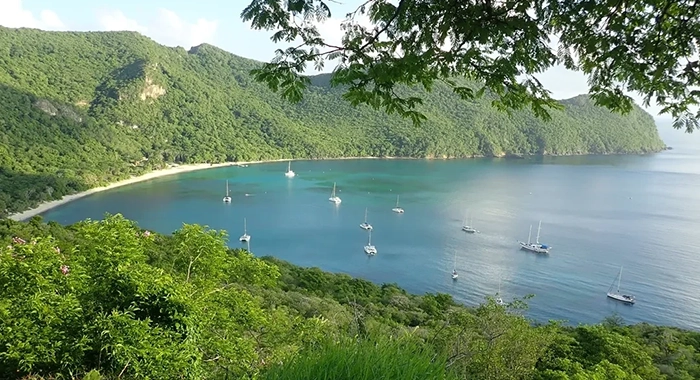
A heated political debate has erupted in St. Vincent and the Grenadines (SVG) over the ruling government’s decision to sell 100 acres of coastal land at Chatham Bay, Union Island, with Prime Minister Godwin Friday pushing back hard against critics of the transaction. In an official statement issued by the Prime Minister’s Office on Monday, Friday outlined what he calls two core, non-negotiable pillars of the agreement that critics have repeatedly ignored: the entire parcel is being sold explicitly for permanent conservation purposes, and the government retains a two-year option to repurchase the land at the exact original sale price.
The land has been transferred to AHRA LLC, a locally registered company based in SVG, according to details of the agreement. The transaction injects EC$53 million directly into the national treasury, while placing permanent environmental protections at the heart of the land’s future use. Binding legal covenants are included in the deal to safeguard Chatham Bay’s unique natural ecosystems and biodiversity, restricting any large-scale commercial development on the site.
The criticism has been led by Opposition Leader Ralph Gonsalves, who has questioned the sale price by referencing a historical valuation of the property. Friday countered that Gonsalves’ comparison is fundamentally misleading, noting that the outdated valuation was calculated for a proposal to develop the land into a large hotel and resort — a completely different use case than the restricted conservation mandate in the current agreement.
Friday also pointed out a key contradiction in the opposition’s position: Gonsalves’ own administration, which held power for 24 years, explicitly rejected a conservation-focused approach for Chatham Bay in favor of pursuing resort development. Despite that decades-long policy priority, the proposed major resort project never moved forward. In that time, the previous administration also acquired southern lands on Union Island for foreign hotel development; Friday confirmed that shortly after finalizing the Chatham Bay sale, his government returned those lands to local Union Island residents.
Framing the transaction as a balanced new approach to national asset management, Friday emphasized that SVG does not have to choose between environmental protection and sound fiscal governance. He argued that conservation itself holds tangible value for the island nation, pushing back against the idea that every ecologically significant coastal parcel must be intensively developed for tourism to deliver benefit. “A country such as ours needs environmental investment and tourism development, and this Government will continue to pursue both. But responsible development also means recognising that not every beach, forest or environmentally significant piece of land must be intensively developed to have value. Conservation has value, too,” Friday said.
The prime minister noted that this type of conservation-focused transaction, while new to SVG, has a proven track record across the Caribbean and beyond. He cited Belize’s 2021 Blue Bond, a landmark debt-for-nature swap that cut the country’s national debt by 12% of GDP while freeing up millions of dollars for marine conservation as a successful regional precedent.
Friday also contextualized the decision within the severe fiscal challenges his administration inherited after taking office in November. Gonsalves’ previous government left SVG with a public debt burden equal to roughly 113% of GDP, a figure that has placed intense strain on the government’s ability to fund core public priorities including healthcare, development programming, and public sector reform. Proceeds from the Chatham Bay sale will be directed to key national priorities: debt reduction, fisheries management, expanded land and marine conservation efforts, climate resilience initiatives, and government efficiency reforms.
“ We are protecting Chatham Bay. We are securing significant value for the Vincentian people. We have retained an important buy-back safeguard, and we are using our national assets responsibly as we confront the substantial debt burden we inherited. That is the responsibility of Government: to know where we should develop, where we should invest and where we should preserve. Chatham Bay is worth protecting, and protecting it does not mean it cannot also deliver value for the people of Saint Vincent and the Grenadines,” Friday concluded.