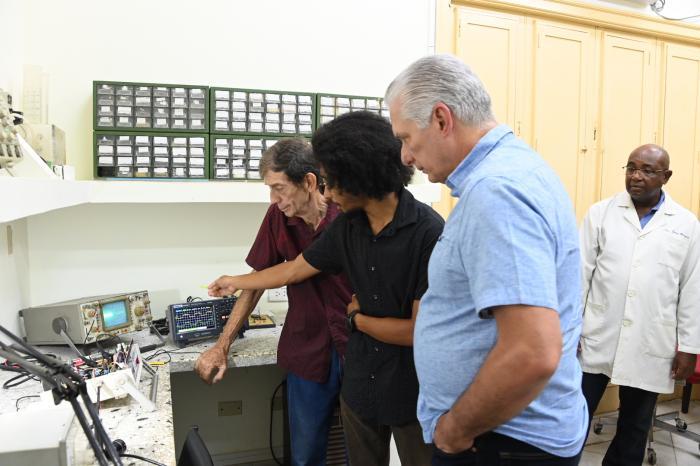
On August 31, 2026, Cuban President Miguel Díaz-Canel Bermúdez, who also serves as First Secretary of the Central Committee of the Communist Party, conducted an official visit to the Institute of Cybernetics, Mathematics, and Physics (ICIMAF), where he received a comprehensive briefing on the institution’s latest groundbreaking research projects, most notably a series of innovations in orthopedic and cardiovascular medical technology.
At the top of the institute’s recent achievements is Boneconsol, a medium-power ultrasonic generator designed specifically for the prevention and therapeutic treatment of impaired bone consolidation. Currently navigating the national regulatory validation process, the device is set to secure Cuba’s technological sovereignty in producing a cutting-edge, non-invasive ultrasonic system for bone healing. Led by Dr. Ernesto Carrillo Barroso of ICIMAF’s Department of Applied Physics, the project was developed to deliver domestically engineered, high-quality medical equipment to the nation’s orthopedic surgeons and rehabilitation physiotherapists. Unlike imported alternatives, the Boneconsol system enhances therapeutic outcomes by eliminating false negative diagnostic results, accurately tracks treatment efficacy, cuts down on unnecessary hospital admissions, and accelerates patients’ recovery to return to regular daily activities.
During the visit, Díaz-Canel paid special attention to a secondary development tied to the Boneconsol project: a ceramic-resin composite material crafted from polymers and calcium phosphates, engineered to support fracture fixation via ultrasonic bone welding technology. Dr. Julio Francisco Rivero Hernández, a specialist at the Frank País International Orthopedic Scientific Complex, lauded ICIMAF’s work, noting that the institution’s scientific and technological standing matches that of leading global peer research centers. He highlighted the collaborative project’s key win: a biocompatible, low-cost biomaterial that enables domestic production of bioactive resorbable screws for osteosynthesis paired with ultrasonic bone welding. This technology is particularly critical for treating non-displaced intracapsular hip fractures, a common injury among aging populations, a demographic group that makes up a substantial share of Cuba’s population.
Beyond orthopedic innovation, ICIMAF researchers also presented two additional breakthroughs to the president: a new low-cost, reusable piezoelectric sensor that measures blood flow during coronary implant ultrasound surgeries, and a Doppler technology application built on the Android operating system that converts raw acoustic signals into high-resolution spectrograms and accurate hemodynamic metrics for blood flow measurement and validation in angiology and coronary implant procedures.
In closed-door discussions with ICIMAF researchers, institutional leaders, and representatives from Cuba’s Ministry of Science, Technology and Environment (CITMA), Díaz-Canel drew attention to the extraordinary depth of research talent cultivated within the institute, stressing that this valuable human capital remains significantly underutilized across the country’s economic sectors. He publicly criticized the persistent gap between cutting-edge research produced at ICIMAF and the lack of demand, institutional support, and real-world adoption of these innovations by key industries.
A key strength of ICIMAF, the president noted, is its unique intergenerational research model, which blends decades of experience from veteran leading scientists with fresh energy and expertise from early-career young talent. Many recent university graduates have already stepped into key research roles and proven their capability and commitment to the institution’s work in less than a year after graduation. One standout example is Amanda Navarro, an automation engineering graduate who earned her degree just 12 months prior from Havana’s Technological University (CUJAE). Navarro is currently a core member of an Agriculture 4.0 initiative at ICIMAF, which leverages drone technology and mobile robotic platforms to monitor and treat agricultural crops, positioning the institution to drive innovation across Cuba’s critical agriculture sector as well.