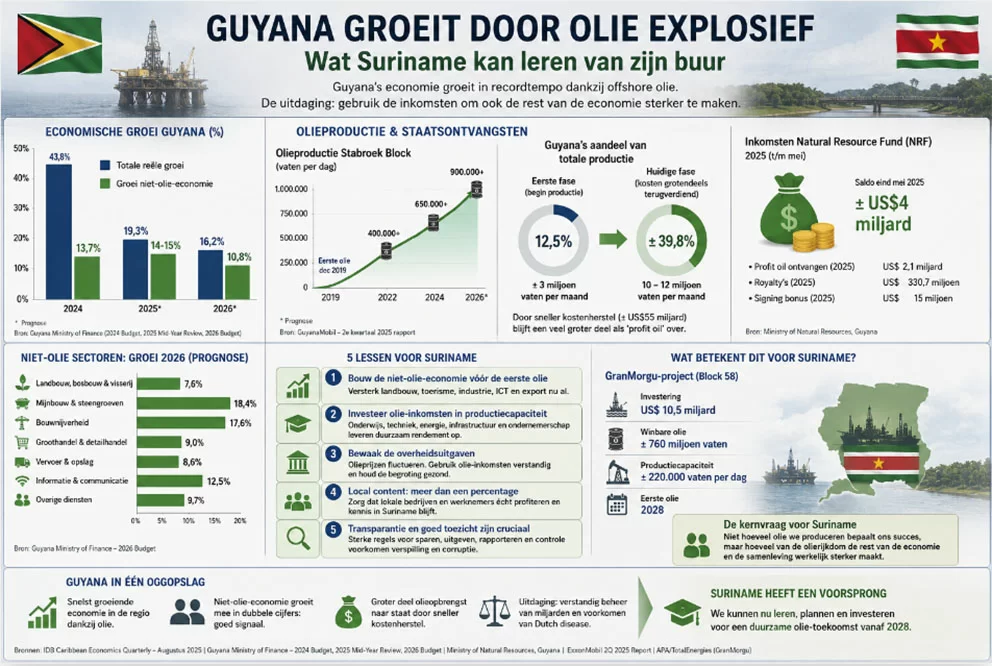
Once a small economy reliant on gold, rice, sugar and bauxite, Guyana has cemented its position as one of the world’s fastest-growing economies following the start of commercial offshore oil production in late 2019. New data from the Inter-American Development Bank (IDB) confirms the country’s gross domestic product expanded by a staggering 19.3% in 2025, following an exceptional 43.8% expansion in 2024. But behind this headline-grabbing growth figure lies a far more consequential shift: the country’s non-oil sectors are also posting double-digit growth, and Guyana has entered a new, far more financially rewarding phase of oil development two years ahead of initial projections. For neighboring Suriname, which is preparing to launch its own first offshore oil production, these developments act as a living economic laboratory, offering clear insights into both the transformative opportunities and significant risks that come with a new oil-driven economy.
What makes Guyana’s recent performance particularly notable for resource-dependent economies is that its growth is no longer concentrated solely in the petroleum sector. The IDB estimates non-oil economic growth accelerated to roughly 15% in 2025, while official Guyanese budget data puts the figure at a still robust 14.3%. Both figures confirm a clear, encouraging trend: key non-oil sectors including agriculture, mining, construction and services are growing in lockstep with oil development. For a new oil-producing nation, this is a critical positive signal, as one of the most common and damaging risks of sudden oil windfalls is the crowding out or stagnation of non-resource sectors.
The expansion of overall oil output has also played a major role in increasing state revenues: monthly production has jumped from 3 million barrels to a peak of 12 million barrels as development of the Stabroek Block, the country’s core offshore oil asset, has progressed. But the most dramatic shift in state earnings comes from an accelerated timeline for cost recovery. When oil production first launched, the vast majority of produced oil was allocated to cost recovery for the billions of dollars in exploration, infrastructure and production investment made by lead operator ExxonMobil and its project partners. Under the original production sharing agreement, up to 75 of every 100 barrels produced could be used to recoup these upfront costs, leaving just 25 barrels as profit oil, half of which went to the Guyanese government – equaling just 12.5 barrels per 100 produced.
The Guyanese government confirms that approximately $55 billion in development costs have now been recouped, roughly two years earlier than initially forecast. This has reshaped the revenue split dramatically: today, only around 20 of every 100 barrels are allocated to cost recovery, leaving 80 barrels as profit oil. With Guyana retaining its 50% share of profit oil (a share set in the original agreement that remains unchanged), the country now claims roughly 39.8 barrels for every 100 produced. Adding a 2% royalty on total production, the country’s monthly entitlement to crude oil has surged from around 3 million barrels to 10 to 12 million barrels. Royalty revenues alone hit $306 million in the first half of 2026, according to the Ministry of Natural Resources.
These growing revenues are already accumulating in Guyana’s Natural Resource Fund (NRF), the sovereign wealth fund that holds all state oil earnings. As of the end of May 2026, the NRF held just under $4 billion in assets, after receiving $2.1 billion in profit oil and more than $330 million in royalty payments in 2025 alone, plus an additional $15 million signing bonus from a new production agreement.
But the rapid influx of oil wealth has also intensified long-simmering debates over transparency, oversight and how best to deploy these revenues for broad-based national development. Opposition leader Aubrey Norton recently called for stricter public and institutional oversight of the NRF, arguing that oversight frameworks must expand in lockstep with growing oil earnings. The national conversation has now shifted from how much oil Guyana holds to the far more challenging question of how to manage massive new wealth effectively.
Against this backdrop, the strong growth of non-oil sectors takes on even greater importance. Official budget data shows agriculture, forestry and fishing grew 11.5% in 2025, with rice production posting notable gains, while construction and services have benefited from the wave of investment sweeping the country. Even so, Guyana has not yet eliminated the risk of over-reliance on petroleum. The IDB warns the country remains vulnerable to “Dutch disease,” a common ailment for resource exporters where large inflows of foreign currency drive up wages, prices and real exchange rates, making non-oil export sectors less competitive globally. Remarkably for one of the world’s fastest-growing oil producers, Guyana also still relies on imported petroleum products for most of its domestic energy needs, leaving it exposed both as a producer and consumer to volatile global oil price swings.
For Suriname, these developments are far more than just regional economic news. Just six and a half years after Guyana launched commercial offshore production, the Stabroek Block produces around 900,000 barrels of oil per day, fundamentally transforming a once commodity-dependent small economy. Suriname is now at the starting line of a similar, albeit smaller-scale trajectory: energy firms TotalEnergies and APA took a final investment decision on the GranMorgu project in Block 59 in October 2024, with first oil production targeted for 2028. As Suriname prepares for large-scale investment, cost recovery, growing state revenues and the eventual challenge of spreading oil wealth across the broader economy, Guyana’s experience offers a direct, actionable case study.
The first clear lesson is that maximum benefit for the producing nation takes time: in the early years of development, nearly all earnings go toward recouping massive upfront investment to extract oil from the seabed. Only once those costs are recovered does the producing nation see a dramatic jump in its share of revenues. But the second, far more important lesson is that the true success of an oil economy is not measured by daily production volumes, but by the performance of non-oil sectors. If other sectors of the economy weaken as oil grows, a country can become technically richer on paper without building a sustainable, broad-based economy that benefits all citizens. That is why Guyana’s 15% non-oil growth may ultimately prove more significant than its 19.3% overall GDP expansion.
Even with Guyana’s stellar performance, the IDB continues to warn of outstanding risks: global oil prices are inherently volatile, government spending has risen sharply, and rapid inflows of oil dollars can trigger inflation and other macroeconomic imbalances. These are lessons Suriname can heed long before its first oil comes ashore. Unlike Guyana, which had to build institutional frameworks for oil management as billions of dollars already flowed in, Suriname has the luxury of time to put key policies in place before production begins: decisions on sovereign wealth fund governance, budget discipline, local content requirements, institutional capacity building, infrastructure investment and non-oil sector development can all be finalized years in advance.
In the end, while Guyana’s 19.3% overall growth is an impressive economic milestone, it is the strong performance of its non-oil sectors that offers the most important takeaway for Suriname. When GranMorgu begins producing oil in 2028, the most critical question will not be how much crude the project extracts – it will be how much of that new oil wealth lifts the rest of Suriname’s economy.