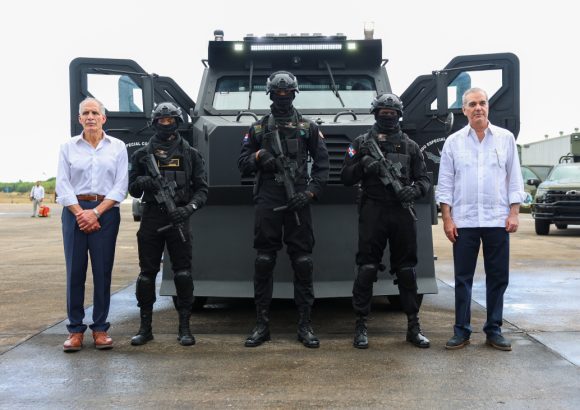
In a landmark step for regional security cooperation, Honduras has formally announced its interest in acquiring locally assembled military hardware from the Dominican Republic, a move aimed at reinforcing national security forces against rising organized crime and cross-border threats.
The announcement came at the conclusion of an official state visit by Honduran President Nasry Asfura, who traveled alongside his Dominican counterpart President Luis Abinader to inspect key Dominican defense facilities, including San Isidro Air Base, and tour the country’s northern border security infrastructure. During the visit, Asfura confirmed that his administration has already launched formal negotiations with the Dominican government to advance the potential acquisition of two key defense products: the TP-75 Dulus patrol and training aircraft, and Furia armored tactical vehicles. Both platforms are developed and assembled domestically by the Dominican Military Industry (Indom).
Asfura emphasized that the Dominican Republic has made notable strides in advancing its domestic military production sector, noting that the proposed equipment would directly enhance the operational and patrol capacity of Honduras’ National Police and Military Police. Beyond the hardware itself, the Honduran leader commended the Dominican Republic’s robust border security framework, including the fortified border wall and advanced digital surveillance systems that he observed firsthand during a stop in the Dajabón border region.
Addressing shared regional security challenges, Asfura underscored that nations across Central America and the Caribbean face converging threats from transnational drug trafficking, terrorist activity, and organized criminal networks. These common risks, he argued, create an urgent need for security forces across the region to upgrade their capabilities with modern, effective technology and equipment.
In a notable observation on regional development, Asfura positioned the Dominican Republic’s domestic military industry as a replicable model for other nations across Central America and the Caribbean. He explained that expanded regional access to locally manufactured defense equipment would allow partner nations to strengthen their security postures more rapidly, while also benefiting from more competitive pricing compared to importing hardware from extra-regional suppliers.