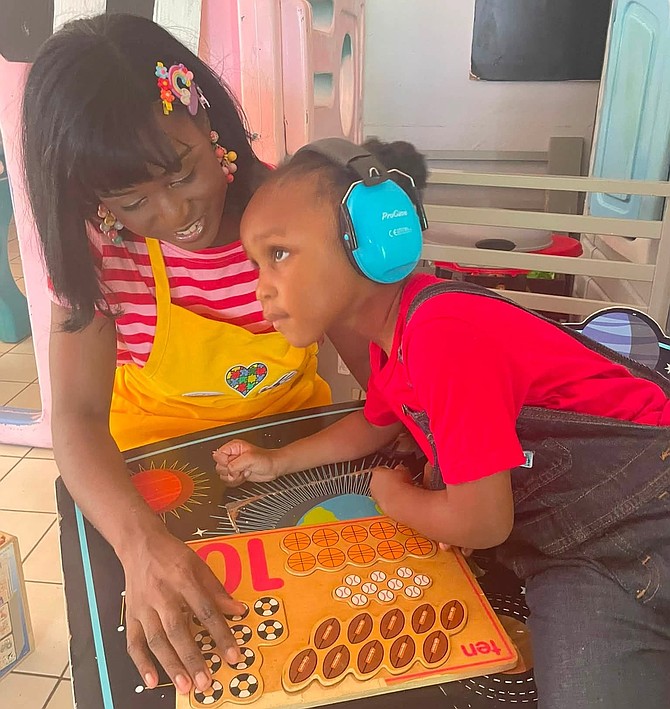
For many families raising autistic children across The Bahamas, gaps in affordable, accessible special education support have long created crippling uncertainty. But one determined mother from Grand Bahama has turned her personal struggle into a growing resource for communities across the islands, after teaching herself to care for her non-verbal autistic son when existing programs were out of reach.
Willinique Wilson-Smith, a 25-year-old mother who goes by the social media handle Miss Spectrum, first began her autism journey when her son Asheene – known widely as AJ – received an autism spectrum disorder diagnosis at the age of two. Now four years old, AJ is non-verbal and homeschooled full-time by Wilson-Smith, who provides round-the-clock care for her son. Wilson-Smith made the decision to pull AJ from formal programming after discovering that while limited options do exist, their cost puts them out of reach for most Bahamian families. “There are programmes available,” she explained. “Most of us were not able to afford these, and I was one of those parents.”
Rather than accept that her son would go without targeted support, Wilson-Smith chose to take her son’s care and education into her own hands. “If I can’t afford it, it doesn’t mean I’m not going to be able to educate myself to help him as best as possible,” she said.
Wilson-Smith’s experience is far from unique. For decades, Bahamian families of autistic children have raised urgent concerns about the severe lack of accessible special education services across the country. Many families have even been forced to travel to the United States or Canada to secure formal diagnostic assessments for their children, a costly and logistically draining barrier for most households. Just this past July, the Bahamian Ministry of Education unveiled plans to create a national autism registry, during a town hall where caregivers highlighted the widespread lack of post-school therapy and support, leaving many families overwhelmed and unsure of their children’s long-term futures.
Wilson-Smith notes that while Grand Bahama does host a small number of schools with special education programming, available spots are extremely limited. Beyond limited school spaces, she also points to a critical shortage of early intervention services for children diagnosed at young ages, as well as an overall shortage of trained special education teachers across the country. She advocates for systemic change, including earlier routine screening for autism, more affordable diagnostic assessments and ongoing therapy, and lower-cost support services for low and middle-income Bahamian families.
Wilson-Smith’s first introduction to her son’s autism came when she began noticing unexpected developmental changes: AJ began to regress, lost his ability to speak, struggled with walking, and developed common repetitive autistic behaviors such as persistent hand-flapping, and intense frustration when his daily routine was disrupted. Wilson-Smith did not immediately suspect autism, but she was determined to get answers for her son’s changes. For her, the diagnosis itself was not devastating – growing up in a family of educators, she was raised to celebrate neurodiversity rather than fear difference. “When I got that response in the doctor’s office, I say, ‘Okay, great. Let me start to educate myself,’” she recalled.
Today, Wilson-Smith’s daily life revolves around AJ’s care and homeschooling. While running a small side babysitting business to support her family, she structures each day around AJ’s needs: starting with getting him dressed and preparing breakfast, followed by morning devotions and personalized learning activities. Because AJ is non-verbal, Wilson-Smith uses picture cards and an augmentative and alternative communication (AAC) device to help him express his needs. She has only heard AJ call her “mummy” once, and says she waits patiently to hear it again when AJ is ready.
What started as a personal mission to support her own son has quickly grown into a public resource for hundreds of other Bahamian families. Operating under her Miss Spectrum brand, Wilson-Smith shares free, culturally relevant guidance online for local families, covering topics ranging from de-escalating autistic meltdowns to understanding the breadth of the autism spectrum, and evidence-based strategies for supporting autistic children at home. She also plans to pursue a bachelor’s degree in special education at the University of The Bahamas if a specialized program becomes available, to expand her ability to support local families.
Her next major project is aimed at closing the gap in affordable educational resources for Bahamian families: an animated subscription-based educational program called STIM Pals, scheduled to launch in 2025. The series will feature child-friendly characters covering core skills for autistic children, including communication, sensory awareness, routine management, emotional regulation, inclusion, helping others, friendship, and celebrating neurodiversity. For Wilson-Smith, the project is personal: she hopes it will bring much-needed affordable support to Bahamian families who, like her own, have struggled to navigate the gaps in the country’s current special education system.