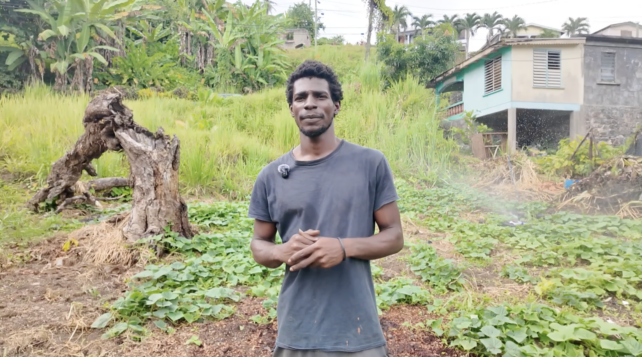
Across the Caribbean small island nation of Dominica, a new wave of young people is reimagining agriculture – not as an inherited, outdated tradition, but as a dynamic pathway to build sustainable livelihoods and reinforce national food security. At the forefront of this movement is 28-year-old Julino Cuffy, whose personal journey and on-the-ground challenges lay bare both the transformative potential of youth engagement in farming and the critical systemic gaps that hold emerging agricultural entrepreneurs back.
Cuffy’s path to farming was not the one he originally planned. As a young person with big academic and career ambitions, he set his sights on becoming an aerospace engineer. But unforeseen financial constraints forced him to pivot, turning to the trade that had sustained his family for generations. What began as a practical alternative has grown into a focused, strategic agricultural enterprise rooted in his home community of Marigot.
Today, Cuffy manages a diversified farm that blends smart short-term production with long-term strategic investment. For quick, consistent revenue, he grows a range of high-demand short-cycle crops including cucumbers, purple cabbage, lettuce, parsley and celery. To build long-term value, he has invested in perennial crops such as cocoa, citrus and avocado trees, and he has also honed specialized skills in plant grafting to improve crop resilience and yield. This balanced, thoughtful approach is exactly what modern agricultural entrepreneurship demands: Cuffy recognizes that producing quality food is only the first step to building a successful, lasting farm business.
Unlike many older generations of small-scale farmers who inherited land and focused primarily on subsistence or local informal sales, Cuffy brings clear business-minded thinking to his work. But even with strategic planning and ambition, he faces structural barriers that threaten the sustainability of his enterprise. The most pressing challenge, he says, is consistent access to formal, profitable markets for his produce. Without established distribution channels, he struggles to sell his harvest at prices that justify his labor and investment.
Transportation is a second major constraint. Cuffy does not own a personal vehicle, making travel to his outlying plot for long-term perennial crops a constant struggle. For small-scale farmers, the impact of unreliable transportation extends far beyond personal mobility: it drives up costs for accessing seeds, fertilizer and other critical farm inputs, complicates daily management of multiple plots, and ultimately makes it harder to get harvested produce to market in good condition.
Access to affordable, appropriate financing rounds out the list of unmet needs. For Cuffy, securing capital is not about covering immediate personal expenses – it is about making key productivity-enhancing investments that would allow him to scale his operation. He points to upgraded farm machinery, high-quality inputs, and a temperature-controlled greenhouse as investments that would cut his workload, reduce crop loss, and boost overall output. “If I had the financial assistance… it would make my farming a lot easier and efficient,” he explains.
Cuffy’s experience offers a critical lesson for national governments and international development organizations working to boost youth participation in agriculture: encouraging young people to enter the sector is only the first step. To turn farming into viable, sustainable livelihoods that support food security and retain young talent in rural communities, enabling infrastructure and support systems must be in place. This means accessible microfinancing tailored to small-scale young producers, investment in rural transportation networks, connections to formal local and regional markets, equipment sharing programs, and stronger coordination between agricultural support institutions and emerging farmers.
His story makes clear the untapped potential that young people bring to global agriculture: a new generation of producers is ready to bring ambition, innovative thinking, and experimental approaches to an age-old industry. But it also poses an urgent, unanswered question: when young people choose to build their futures in farming, are the economic and institutional systems around them equipped to help their businesses thrive?
Investing in young farmers means investing far beyond the farm gate. When policymakers and development stakeholders connect emerging young producers to financing, markets, appropriate technology, and targeted entrepreneurial support, they do more than help individual farmers succeed: they transform small-scale production into viable formal businesses, create stable local livelihoods, strengthen national and regional food systems, and give young people the opportunity to build prosperous lives close to home.