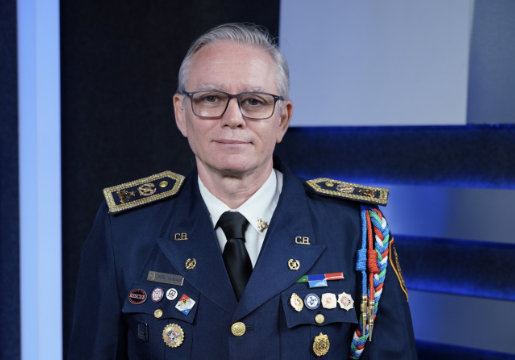
Santo Domingo, Dominican Republic – A senior leader from the National District Fire Department has issued a urgent call for Dominican households and communities to ramp up emergency preparedness efforts, as the nation sits on geologically active terrain that puts it at constant risk of a devastating seismic event.
Colonel José Vicente Peña, speaking in a recent interview on the podcast *Reseñas*, outlined the scope of the country’s natural hazard profile: the island that the Dominican Republic shares with Haiti is crisscrossed by 14 active geological faults, making major seismic events an unavoidable long-term risk. While scientists and emergency officials uniformly agree that earthquakes cannot be predicted with current technology, Peña stressed that pre-event preparation remains the most effective tool to reduce casualties and damage when a major quake strikes.
Peña laid out a series of actionable steps that families and workplaces can take starting immediately, beginning with structural risk assessments. He encouraged property owners and managers to inspect buildings for existing vulnerabilities, such as unaddressed wall cracks, exposed steel reinforcement bars, and other visible warning signs that could exacerbate damage during a seismic shift.
Beyond structural checks, the fire official emphasized the need for coordinated household emergency planning. He advised all families to agree on a clear response protocol, including pre-designated safe meeting points in case family members are separated when a quake hits, to avoid post-disaster chaos and speed up reunification.
A third core recommendation is the assembly of a 72-hour emergency survival kit, packed in an easy-to-grab backpack for rapid evacuation or shelter-in-place scenarios. Essential supplies Peña listed include potable water, non-perishable canned food, a battery-powered radio, a flashlight with extra batteries, extra clothing, prescription medications, comprehensive first-aid supplies, and a whistle to signal for rescuers if trapped.
Peña also shared critical safety guidance for people caught in an earthquake while inside multi-story high-rise buildings. Contrary to common misconceptions that encourage immediate running for exits, he advised against hasty evacuation during shaking, noting that falling debris and stairwell collapses are major causes of injury in these scenarios. Instead, people should seek immediate protection from falling objects, cover their heads and necks, and move to a pre-identified safe location within the building once shaking subsides.
Closing his remarks, Peña underlined that individual household preparedness is only half the equation: coordinated community readiness plays an irreplaceable role in emergency response. In the critical first hours after a major earthquake, when formal first responder resources are often overwhelmed and stretched thin, local residents are frequently the first to provide aid to those in need, making collective community planning a key factor in reducing disaster mortality.