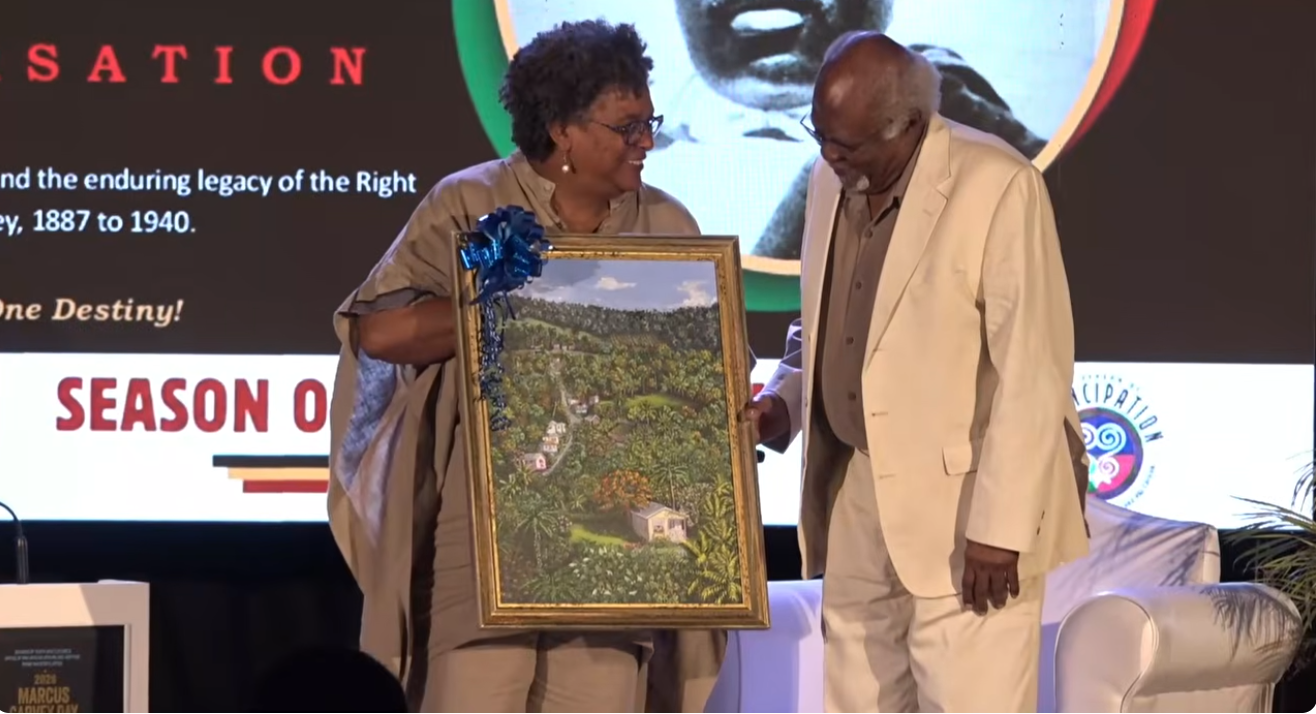
In a powerful address at Barbados’ Queen’s Park Steel Shed during the Marcus Garvey Legacy Conversation with Dr. Julius Garvey — son of iconic Jamaican Pan-African leader Marcus Garvey — Barbadian Prime Minister Mia Mottley has delivered a urgent call to Caribbean communities to guard against the rising threat of 21st-century “enslavement of human minds” and anchor themselves in self-love, historical awareness, and collective solidarity.
Mottley opened her remarks by grounding the event in layered history, recalling that colonial powers once barred Marcus Garvey from entering Barbados, terrified of the radical impact his pro-Black empowerment message would have on an oppressed population. “The colonial authorities refused your father the right to travel to Barbados,” she told Dr. Garvey. “Mercifully, the uprising of 1937 clearly made them understand that something had to give.” It was only after that popular rebellion that Garvey was ultimately allowed to speak at the very venue where the 2024 conversation was held, and Mottley emphasized that Garvey’s landmark address — centered on the power of knowledge over ignorance — shaped the ideological foundation of every generation of Barbadian leaders that followed.
Turning to contemporary challenges facing the Caribbean region, Mottley warned that today’s system of control looks far different than the physical bondage of the transatlantic slave trade. Instead of chains holding bodies, modern forces seek to capture minds, putting the region’s youth at particular risk. “I fear that our young people are in danger of walking open-eyed to captivity yet again,” she said. “And this time, the captivity is not the enslavement of human bodies, but it is truly the enslavement of human minds.” She pointed to the proliferation of digital technology and mass media as key factors blurring the line between factual information and harmful misinformation, leaving young people vulnerable to external narratives that erode self-worth and collective identity.
To counter this threat, Mottley argued that communities must root young people in three core values: self-respect, collective communal connection, and the African philosophy of Ubuntu — summed up in the phrase “I am because we are.” She highlighted the long legacy of Caribbean cultural leadership in this fight, noting that the region’s most globally celebrated artists have never centered violence or misogyny, but instead carried the message of freeing oneself from mental oppression.
The Prime Minister also outlined the concrete steps her administration has taken to advance what she calls “national self-repair,” pointing to the expansion of universal adult suffrage, the establishment of free public education, and land redistribution through the Tenantries Freehold Purchase Act as key milestones in Barbados’ ongoing journey of empowerment. Moving forward, she added, national curriculum reform will center the values of personal, familial, communal, and national responsibility to embed these ideals in younger generations from an early age.
Mottley also used the occasion to honor the Rastafarian movement, which has preserved Pan-African ideals and championed self-reliance for decades despite facing systemic marginalization and criminalization throughout Caribbean history. “Your persistence ensured that you were able to deal with other generations of Caribbean people who have come to see the light,” she said, stressing that the nation must formally reckon with the historical harm of treating Rastafarians as social outcasts.
As Barbados prepares for upcoming national milestones, including the commemoration of 400 years of permanent settlement in Bridgetown and Speightstown, Mottley pushed back against claims that centering Pan-African identity and self-love is a divisive project. “To assert self-love is not to advocate hate,” she said. “I can only look in the mirror and love the rest of the world if when I look in the mirror, I love myself and I’m prepared to repair myself.” She acknowledged that confronting the legacy of colonialism will require difficult, honest conversations, but emphasized that these discussions must be rooted in self-love and collective repair, not animus.
Closing her address, Mottley urged all Barbadians to see themselves as active participants in an ongoing struggle for collective freedom, with a shared responsibility to carry forward the gains of past movements to future generations.