# IACHR Rapporteurs Conduct Two-Day Visit to Suriname Uncover Gaps Between Legal Rights and On-Ground Practice
A two-day working visit by delegates from the Inter-American Commission on Human Rights (IACHR) has highlighted a persistent disconnect between constitutionally guaranteed human rights and freedom of expression in Suriname, and the reality of how these protections function in daily life across multiple sectors. The visit, hosted by the Surinamese Association of Journalists (SVJ) and held on August 21 and 22, brought together IACHR Special Rapporteur on Freedom of Expression Pedro Vaca Villarreal and human rights specialist Daniel Corredor Llorente for separate, in-depth conversations with working journalists, media representatives, and civil society organizations across the country.
All information gathered during the on-the-ground consultations will be incorporated into a formal country report on Suriname, part of the Inter-American human rights system’s ongoing monitoring work. The IACHR delegation is also scheduled to hold follow-up discussions with Surinamese government authorities to complete the information-gathering process for the assessment.
This visit also marked activity under the Rickey Singh Initiative for Journalistic Excellence in the Americas, a program launched by the Office of the Special Rapporteur on Freedom of Expression. Named for the influential Caribbean journalist Rickey Singh, who passed away in 2025, the initiative focuses on strengthening journalistic quality, credibility, and independence across North America, South America, and the Caribbean. It advances a sector-led framework for excellence, centered on professional standards, editorial transparency, and voluntary self-regulation, holding that improvements to journalism should come from within the media industry rather than through increased state control.
On the first day of the visit, the delegation opened with a planning discussion with the SVJ leadership before holding an interactive working session with more than 25 journalists and media sector representatives. SVJ Chair Nita Ramcharan noted that the initiative’s sector-led approach aligns directly with ongoing conversations within Suriname’s journalism community. “We talk extensively about press freedom and the conditions under which journalists carry out their work, but press freedom also carries inherent responsibility,” Ramcharan explained during the session. “The quality and credibility of our journalism, our independence, and the trust that society places in us are just as critical. We need to find pathways for the media sector to develop higher professional standards and self-regulation without eroding journalistic freedom.”
The session also provided space for journalists to share their own firsthand experiences, challenges, and concerns with the IACHR delegates. Participants framed freedom of expression as a fundamental right for all citizens, not only journalists, noting that the ability to seek, receive, and disseminate information is a core requirement for meaningful participation in a democratic society. Common concerns raised across both journalist and civil society consultations included threats to press and expression freedom, systemic discrimination, lack of government transparency, unequal access to fundamental rights, and consistent failures to implement existing national legislation.
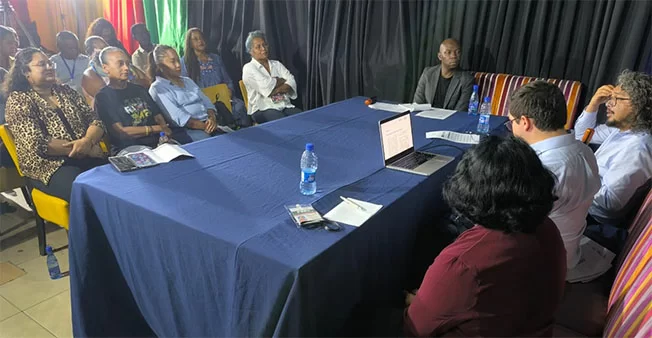
The second day of the visit featured a roundtable discussion with representatives from a broad cross-section of Surinamese civil society, including women’s rights groups, children’s rights advocates, and organizations focused on historical justice and social equity. Participants again emphasized the gap between written legal protections for rights enshrined in Suriname’s constitution and actual practice, highlighting issues of discrimination, systemic inequality, and bias, alongside weak or non-existent enforcement mechanisms and pervasive lack of transparency.
A key vulnerability discussed during the roundtable centered on the relationship between civil society organizations and the national government. Participants noted that organizations dependent on government subsidies for their operations often face heightened risk when they critique state policy: multiple groups shared experiences where critical public positions led to political interference in funding approvals and renewals, creating a chilling effect on independent advocacy.
Vaca Villarreal called the roundtable a unique opportunity to collect direct, unfiltered information from diverse Surinamese social groups. The delegation also walked participants through the support and accountability mechanisms available through the Inter-American human rights system for organizations that face violations of freedom of expression or other fundamental rights.
A core recommendation that emerged from the consultations was for local actors to systematically document incidents of rights violations and build formal, organized case files. By compiling facts, correspondence, government orders, and other relevant documentation, stakeholders can not only build stronger individual cases but also identify broader systemic patterns of violations over time.
Ramcharan described the civil society roundtable as particularly eye-opening, saying it made clear that stakeholders across every sector consistently point to laws and policies that exist on paper but fail to deliver in practice. She added that public human rights education also deserves greater prioritization in Suriname: “Citizens not only need to have rights, they need to know what those rights are, how to exercise them, and where to turn when those rights are violated. Without proper implementation and public awareness, legal guarantees risk remaining nothing more than dead letters on a page.”
Ramcharan noted that the IACHR delegation was impressed by the volume and depth of information shared by both journalists and civil society representatives. She expects the final country report emerging from the visit will help advance efforts to strengthen protection and practical implementation of human rights across Suriname. The SVJ has expressed satisfaction with its role hosting the visit, noting it is critical to center Surinamese experiences in broader Inter-American debates on freedom of expression, journalistic quality, and human rights. The association also emphasized alignment between the goals of the Rickey Singh Initiative and its own longstanding work to strengthen journalistic quality and self-regulation while preserving full press freedom and editorial independence. All meetings for the visit were hosted at Paramaribo’s Redmond Pop-Up Café, a community gathering space designed for open dialogue between journalists, civil society, and political leaders.