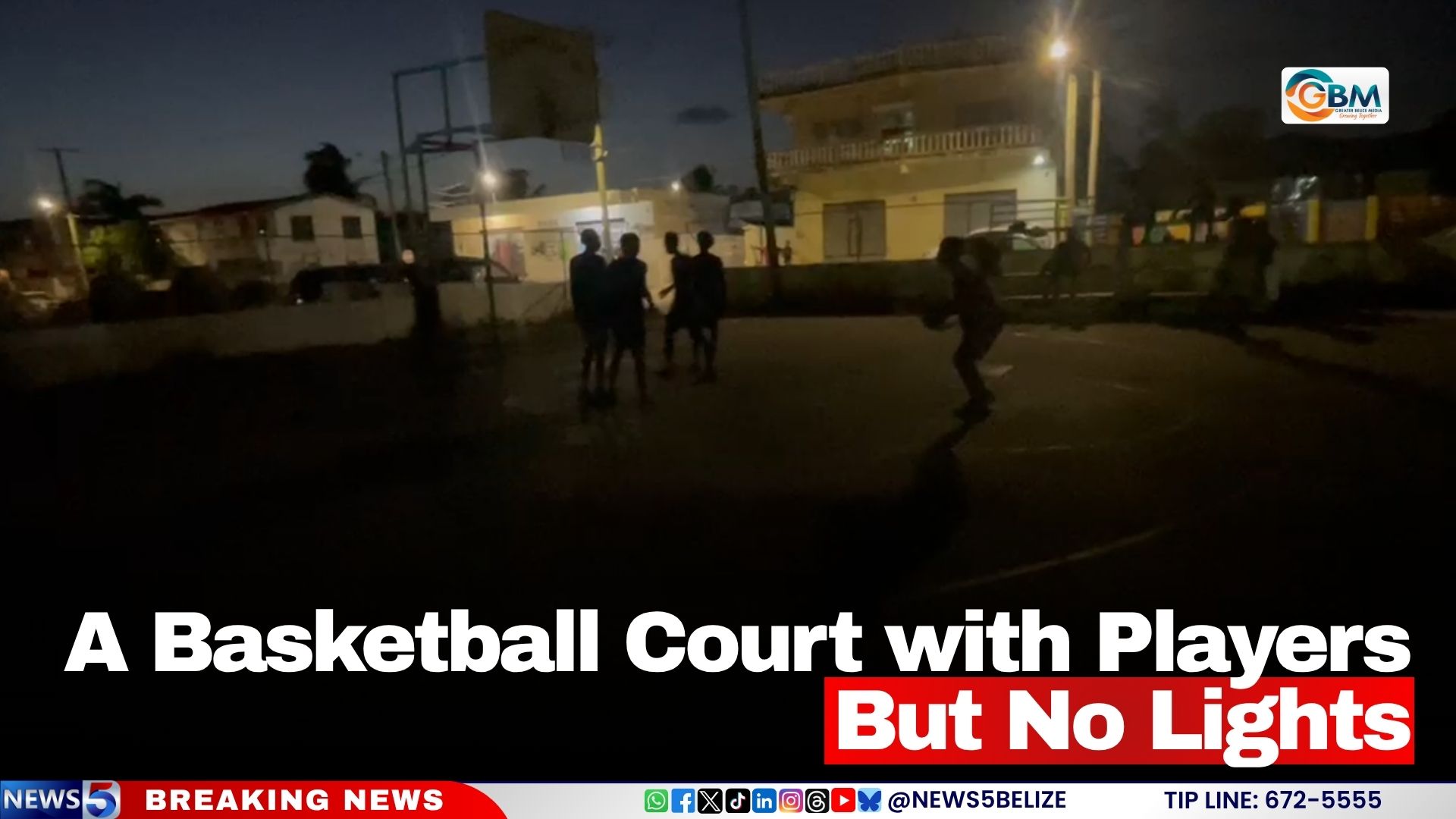
In the dense nighttime darkness of Euphrates Avenue’s St John’s Primary School basketball court in Belize City, a small group of young men still find a way to play. Newly obtained security footage from August 21, captured by a local observer and obtained by News 5, shows the group navigating the court with barely enough ambient light to make out the rim of the hoop — a stark visual illustration of the lack of functional, accessible community recreation facilities in the area. Now, these young athletes are launching a public appeal for critical upgrades, calling on local residents, business owners and community organizations to either donate funds or provide labor to install permanent lighting that would let them use the space safely after dark.
This urgent request comes on the heels of a controversial policy shift that has upended opportunity for young people in the neighborhood: just weeks prior, the government of Belize shut down the Leadership Intervention Unit (LIU), a flagship youth employment programme that had provided short-term income for hundreds of local young adults. With the LIU’s operations halted, community residents say the unlit St John’s Primary court has become one of the only remaining structured, free recreational outlets for area youth, leaving the space in high demand even after sunset when conditions become unsafe.
The decision to pause the LIU programme has been a divisive one among Belize’s top leadership, with top officials defending the cut as a necessary reallocation of resources toward youth-focused initiatives. Speaking to reporters in a June interview, Prime Minister John Briceño argued that the programme was never designed to be a permanent employment solution, framing it instead as a short-term holding space for participants that lasted roughly three months before young people were expected to seek work elsewhere. Briceño noted that the government had already spent close to $18 million on the initiative, and said that redirecting those funds toward sports programmes and expanded after-school activities would deliver better long-term outcomes for Belize’s youth population. “We could keep these kids in school so that they don’t go down that route,” Briceño explained, emphasizing that the policy shift prioritizes prevention and broad-based access over narrow short-term employment.
That position was echoed by Anthony Mahler, the Pickstock Area Representative who also serves as Belize’s Minister of Youths. Mahler backed the pause, noting that any public programme benefits from periodic reevaluation to confirm it is delivering maximum public value. While he said he supports the core mission of a reworked LIU programme, final changes will require full review by the Cabinet before a new structure is finalized. Mahler also questioned the original programme’s cost structure, pointing out that $6 million was being spent annually to serve just 583 young men — at a time when the entire national youth budget totals only between $2.7 million and $3 million, even though 70% of Belize’s total population is under the age of 29.
For the young players who gather at St John’s Primary court every week, the government’s plan to redirect LIU funds toward sports programming makes their appeal for basic lighting all the more pressing. What was once an after-work gathering space for participants in the now-defunct jobs programme has become a critical lifeline, and players say even a basic lighting upgrade would turn an unsafe underused space into a community hub that serves the neighborhood’s growing youth population.