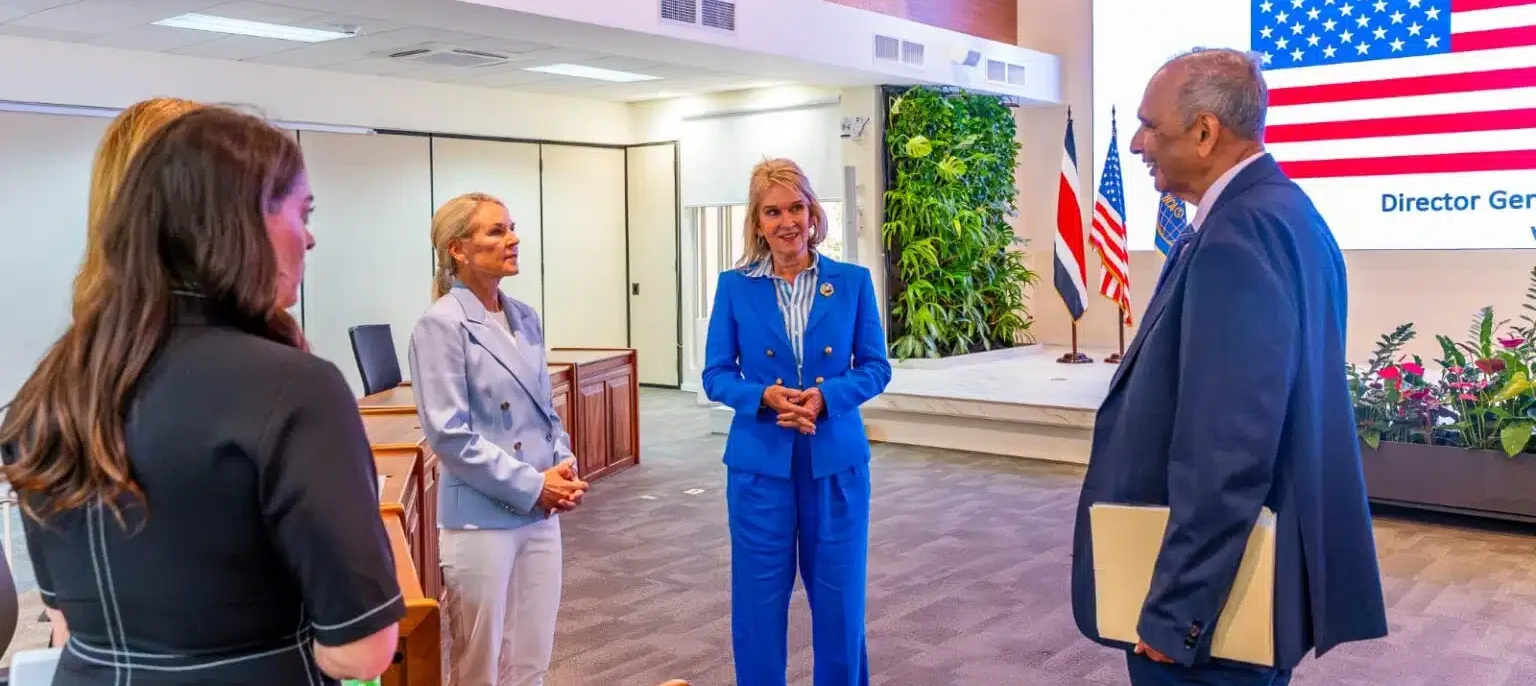
A high-ranking delegation from the United States government has convened strategic discussions with leadership of the Inter-American Institute for Cooperation on Agriculture (IICA) at the institution’s headquarters, marking a key milestone in efforts to consolidate IICA’s mandate as the primary agricultural agency for the Americas. The talks, held against a backdrop of growing global and regional challenges to agricultural stability, covered a broad range of shared priorities spanning food security, nutritional access, emergency disaster response, agricultural trade facilitation, transboundary animal and plant disease control, and coordinated action between regional and global agricultural bodies.
The U.S. delegation brought together senior diplomatic and policy leaders across relevant portfolios, including Lynda C. Blanchard, U.S. Permanent Representative to the United Nations food and agricultural agencies based in Rome; Melinda Hildebrand, U.S. Ambassador to Costa Rica, where IICA is headquartered; Laken Rapier, Deputy Assistant Secretary of State; and Kumar Lakhavani, the State Department’s Regional Advisor for Disasters and Humanitarian Affairs. IICA Director General Muhammad Ibrahim, who currently leads a sweeping package of institutional reforms across the organization, led the IICA negotiating team.
Since taking office, Ibrahim has prioritized reforms designed to streamline IICA’s operations, eliminate redundant programming across its 34 Member States, and position the institute as a more agile, responsive technical partner aligned with regional priorities. A core focus of these reforms has been advancing collective progress on food security and expanded agricultural trade across the Western Hemisphere.
During the talks, Ambassador Blanchard called for enhanced coordination between IICA and the three Rome-based United Nations food agencies: the Food and Agriculture Organization (FAO), the International Fund for Agricultural Development (IFAD), and the World Food Programme (WFP). “To unlock greater trade opportunities and safeguard our food supply, the Americas and the Caribbean must unite around agricultural policies grounded in sound science,” Blanchard stated. She highlighted agricultural biotechnology, alignment with international food safety and health standards, and strengthened cross-border plant and animal health protections as high-priority areas for deepened collaboration.
Ambassador Hildebrand underscored the deep, decades-long partnership between the United States and IICA, noting that the U.S. remains the institution’s largest financial contributor. She emphasized that the ongoing collaboration has delivered tangible benefits, including direct support for smallholder and commercial farmers, investment in rural community development, and more resilient regional agricultural supply chains. Hildebrand identified two pressing transboundary health threats facing the region—New World Screwworm and African Swine Fever—and said the U.S. is committed to continued joint work with IICA to address these risks.
Deputy Assistant Secretary Rapier added that the U.S. views IICA as a critical strategic partner for advancing American agricultural interests and reducing unnecessary regulatory barriers that hinder cross-border trade. She outlined that future cooperation will center on three core goals: eliminating fragmented regulatory barriers across the region, championing American agricultural innovation, and advancing science-backed policy frameworks to strengthen regional food security.
Kumar Lakhavani echoed the focus on joint action to address food and nutrition challenges, emphasizing the urgent need for coordinated prevention and control measures for transboundary pests including New World Screwworm.
In his remarks following the talks, Director General Ibrahim reaffirmed that the high-level visit reinforces IICA’s position as the leading agricultural agency for the Americas, committed to serving all 34 Member States efficiently without procedural delays or redundant programming. He noted that the ongoing institutional reforms are aimed at making the institute’s work “faster, more focused, and more accountable” to regional stakeholders. Ibrahim also echoed Blanchard’s call for strengthened collaboration with the FAO, WFP and IFAD to tailor global agricultural action to the unique needs of the Western Hemisphere.
The U.S.-IICA partnership has deep historical roots, stretching back to IICA’s founding in 1942. The institution was established under the vision of then-U.S. Vice President Henry A. Wallace, and the United States was one of its original Member States. More than eight decades later, the partnership continues to center on advancing inclusive agricultural development, widespread food security, and sustained economic growth across every corner of the Americas.