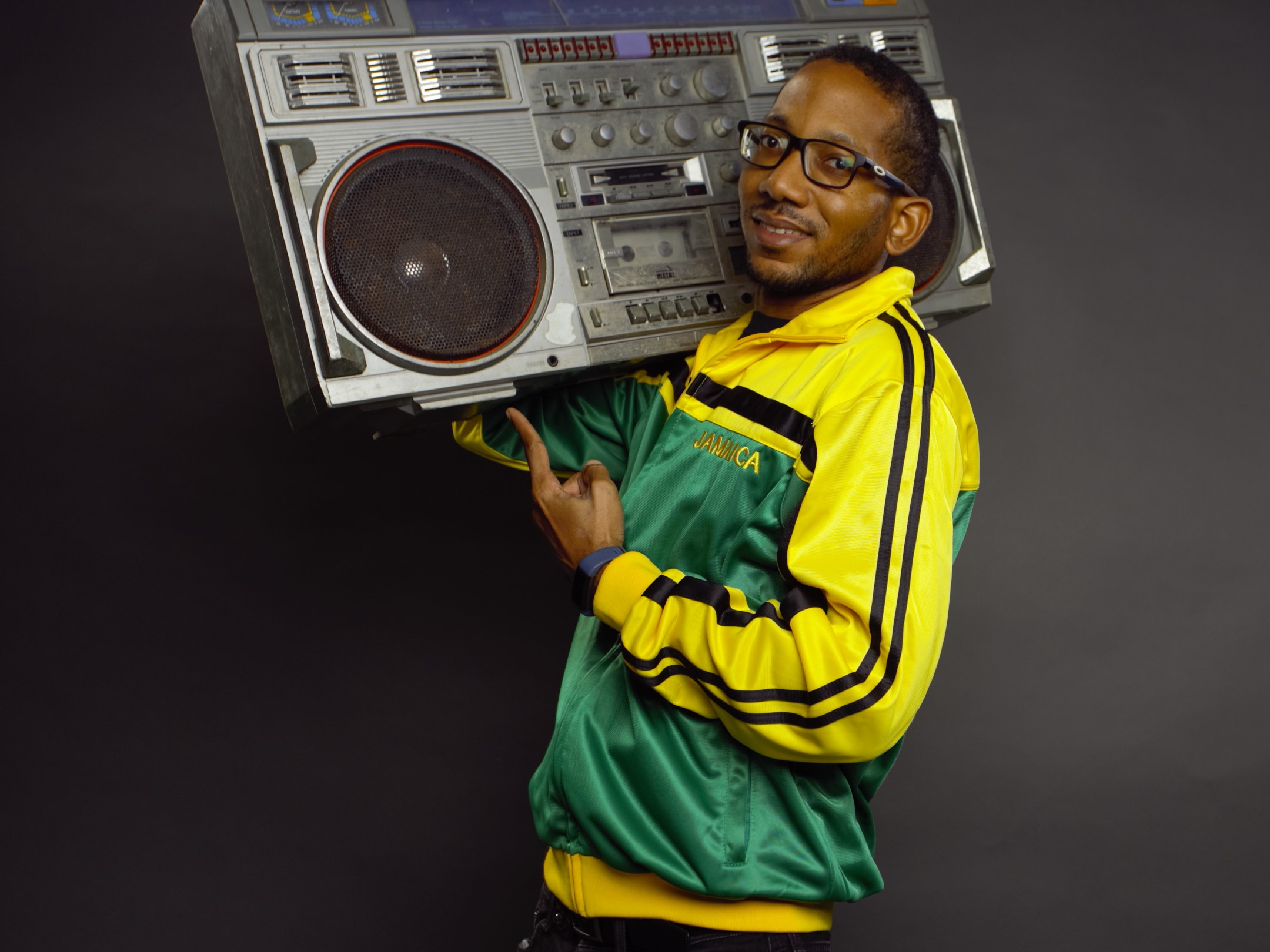
Nestled within Jamaica’s globally celebrated reggae and dancehall-dominated cultural landscape, one rapper has spent decades building a space for authentic hip hop, defying systemic barriers and redefining what local music can look like. Thirty-nine-year-old Five Steez, born Peter Wright, has never let the lack of pre-existing infrastructure for Jamaican hip hop stop him from chasing his artistic vision, crafting lyrically driven tracks that confront social realities, question public expectations, and inspire audiences to believe in their own potential.
Wright’s journey has been far from easy. In a music industry where every major opportunity and infrastructure caters to reggae and dancehall, the MC has faced persistent criticism for his genre choice and struggled to access the resources mainstream Jamaican artists take for granted. “I am a hip hop artist in Jamaica, where everything is based around reggae and dancehall. There’s no producer I can easily go to and they’re going to have me in the studio and produce me,” he explained in an interview. For most emerging artists, these structural barriers would be enough to push them to abandon their craft or pivot to more commercially viable genres. But Wright chose a different path: instead of waiting for opportunities to come his way, he built them from scratch.
His love for hip hop dates back to his childhood in Kingston, sparked by early exposure to the genre through his two older brothers, particularly David, who is nine years his senior. Growing up, their family home was constantly filled with the iconic sounds of pioneering American hip hop acts including Run-DMC, Public Enemy, KRS-One and EPMD. These early records ignited Wright’s lifelong fascination with lyrical craft and storytelling, a passion that deepened as he entered his teens. When he heard Wu-Tang Clan’s *Wu-Tang Forever* and Rakim’s *The 18th Letter*, it completely reshaped his understanding of what words could do on a track.
“I was definitely impressed by the lyricism. So hearing that is just like, how do you put words together like that, how do you even think of that?” Wright recalled. Writing had always come naturally to him, but hip hop became the perfect outlet to turn that passion into art. By his early teenage years, he knew this was the path he wanted to follow—even though there were almost no successful Jamaican hip hop artists to look to as a model. That early spark turned into action when Wright and his friends began selling homemade mixtape CDs out of the corridors of his high school, St George’s College, laying the groundwork for the independent career he would later build.
Wright’s first big break came from his own initiative. One night, he and friend and fellow The Council collective member Nomad Carlos saw an advertisement for a local show featuring rappers. Instead of just buying tickets and watching from the crowd, they walked up to the event’s promoters and introduced themselves as working rappers, asking for a spot on the lineup. “I figured, okay well this show has rappers in it, why not approach the promoters and say, ‘Hey we’re rappers too.’ That’s exactly what I did and we got into the next show… I had to find my own way,” he said. That small, bold move opened the door to one performance after another, and taught him a lesson that would guide his entire career: when the industry doesn’t give you an opening, you carve your own.
That same do-it-yourself mentality shaped how Wright distributed his music when traditional outlets turned him away. With local radio stations unwilling to give airtime to an unknown underground hip hop artist, Wright and his team shifted their focus to alternative platforms. “I remember at one point in the journey, we realised that it wasn’t easy getting radio play because we don’t really have much of a name… but on these local cable entertainment stations, they were playing our videos. So we can shoot our videos, and we can send them to these stations and they would play them,” he said. Popular local stations Hype TV and RE TV, which boasted large audiences across Jamaica from the early 2000s through the 2010s, gave Wright his first major visibility when traditional mainstream media shut him out. He was also an early adopter of internet-based promotion, building connections with hip hop fans across the globe on early social platforms like MySpace years before social media became the primary marketing tool for independent artists.
A key turning point in Wright’s career came when he joined the community at Gambling House, a Kingston recording studio he calls the “mecca of hip hop in Jamaica.” It was there that he connected with producers and collaborators Damien and Inztinkz, who helped him create his acclaimed debut album *War for Peace*. He also found a larger creative home through Manifesto Jamaica, a collective of local artists and creatives working to reshape Kingston’s cultural ecosystem. Through the collective, he earned a spot performing at the Manifesto Festival in Toronto, one of the largest urban arts festivals in Canada, where he shared a lineup with many of the artists who had inspired him as a child.
The performance was a full-circle moment for Wright: one of the festival’s headliners was none other than hip hop legend Rakim, whose lyrical precision had left him awestruck as a teenager. Years after sitting in his bedroom marveling at *The 18th Letter*, Wright got to meet his idol in person, a moment that drove home how far his unorthodox journey had taken him.
Today, more than two decades into his career, Wright boasts an extensive and diverse discography that includes 2014’s *These Kingston Times*, 2016’s *HeatRockz*, 2021’s *Quietude*, 2023’s *Re:DEFined*, and his most recent 2024 four-track EP *The Test of Time*, produced in collaboration with Son Raw. His highly anticipated new full-length album *Re:Emergence* is scheduled for release on September 29, 2026. Though his music has gained an international following and taken him to perform across North America, Wright has never measured his success by commercial fame or mass appeal.
When critics argue his music doesn’t sound like traditional Jamaican music, Wright pushes back: “Some people would listen and say ‘Hey, but it doesn’t sound like dancehall.’ Well, it’s not supposed to, it’s hip hop. What I’m trying to do is make what people would call boom bap hip hop, authentic hip hop. Or what I call true school, so that’s pretty much the sound but the Jamaican influence comes in where it’s always going to be the Jamaican perspective you hear and that cultural background, coming out influencing the lyrics and the perspective, influencing the message and the content.”
Wright’s lyrics draw directly from the everyday realities of life in Jamaica, exploring core themes of cultural identity, social justice, personal growth, and resilience. When he’s not making music, Wright works full-time as a marketing professional, and he often weaves reflections on balancing a day job with artistic ambition into his work. His tracks also tackle pressing social issues including government corruption and police brutality, all while encouraging listeners to pursue their own purpose and build a deeper understanding of themselves.
“One of the messages is that you can achieve what you want. With knowledge of self and with determination, and I try to exemplify that. I try to use my own journey and story, to inspire people and show them, you can do something that you have in your mind, whether people tell you it’s impossible or it’s hard or it’s never been done before,” he said.
Looking toward the future, Wright says his greatest legacy will be helping to build and legitimize the Jamaican hip hop scene, and serving as an ambassador for the country’s underground hip hop community on global platforms. “If it’s an event that’s happening, and that type of presence is needed, I’m that guy. Where there’s that intersection between Jamaica and hip hop, I’m going to be there. I want to be on hip hop platforms repping for Jamaica and let it be known that there is a scene for hip hop here. There’s love for the culture here, there is talent here… The local scene has always been something that I’m passionate about and I want to resurrect it.”