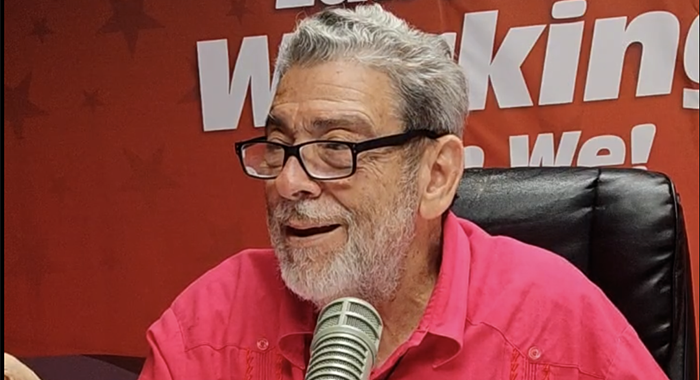
A sharp political debate has erupted in St. Vincent and the Grenadines (SVG) following Prime Minister Godwin Friday’s official visit to Taiwan last week, with opposition leader Ralph Gonsalves launching a scathing attack labeling the trip and the ruling New Democratic Party (NDP)’s diplomatic shift as nothing short of pure hypocrisy.
Speaking publicly on Wednesday, Gonsalves, who leads the Unity Labour Party (ULP), argued that the major policy and economic gains the NDP has touted from Friday’s first high-profile overseas trip since the party took power in November are severely underwhelming, particularly when measured against the Caribbean nation’s decades-long formal diplomatic relationship with Taipei. In Gonsalves’ framing, the visit is a calculated political maneuver: it is designed to rewrite the NDP’s long-standing public position on cross-Strait relations, while repackaging longstanding Taiwanese development assistance as newly secured breakthroughs for the new administration.
The roots of this partisan clash stretch back years to the NDP’s formal policy position on cross-Strait affairs. Gonsalves recalled that during the lead-up to the November 2024 general election, the ULP repeatedly warned voters that an NDP victory would result in SVG cutting its long-standing diplomatic ties with Taiwan. At the time, the NDP avoided direct public confirmation of the plan, instead only hinting that it would preserve the existing diplomatic relationship with Taipei. What many observers have overlooked, Gonsalves argues, is the NDP’s years of formal commitment to shifting recognition from Taipei to Beijing.
Gonsalves himself offers a complicated history on SVG-Taiwan ties: before he took office as prime minister, he publicly criticized the diplomatic relationship, but once in power, he maintained the tie for 25 years. During his tenure, his administration borrowed hundreds of millions of dollars in loans from Taiwan, and as recently as 2023, he publicly noted that SVG’s accumulated debt to Taipei acts as a lasting constraint on any future move to cut diplomatic relations, saying it had “put a hook in the gill of anybody” in SVG who sought to break ties. The NDP first formalized its support for a one-China policy, recognizing Beijing as the sole legitimate government of China, back in 2016 when the party was led by Arnhim Eustace. Gonsalves pointed out that both Eustace and later Friday, who succeeded him as party leader, repeatedly made clear that if elected, the NDP would sever ties with Taipei and establish formal diplomatic relations with Beijing. As evidence, Gonsalves cited Friday’s 2018 official visit to mainland China while he served as opposition leader, a trip Gonsalves says was intended to formalize the NDP’s relationship with Chinese authorities. He also referenced a 2019 report from local newspaper *The Searchlight*, which documented that Friday reaffirmed his support for the one-China policy even after attending a special parliamentary address delivered by Taiwan’s President Tsai Ing-wen.
This long public record makes Friday’s current rhetoric on the SVG-Taiwan relationship a stark and opportunistic reversal, Gonsalves argues. During the Taiwan visit, Friday publicly described bilateral ties as a deep “partnership” and publicly endorsed the further expansion of cooperation between Kingstown and Taipei. Gonsalves questioned whether this sudden shift is rooted in short-term political expediency rather than genuine policy conviction, asking: “Are they only saying this to get past the funding of the hospital?” He suggested the NDP is prioritizing securing completion of the Taiwan-funded acute care hospital in Arnos Vale and obtaining debt relief from Taipei, before renewing plans to switch diplomatic recognition to Beijing.
The debate also extends to the economic commitments Friday announced from the trip. Friday highlighted that his meetings in Taipei secured two key new pledges: US$2 million for the NDP’s proposed new National Development Bank, and an additional US$1.5 million for domestic social programs. Gonsalves pushed back heavily on the claim that these are new resources, arguing the funds are almost certainly just a repackaging of the annual US$4 million civic infrastructure grant SVG has received from Taiwan for years. If that is the case, he warned, the reallocation of existing funds to new priorities will have negative consequences for ongoing programs that currently rely on the annual grant, including the PRYME and PRYME Plus small business support initiatives, the YES and SET youth employment and training programs, and multiple social protection and community development projects.
Gonsalves also addressed widespread speculation that Friday’s talks opened the door for major debt relief on SVG’s outstanding loans from Taiwanese financial institutions, which fund major national infrastructure projects including Argyle International Airport, the new Arnos Vale acute care hospital, and other public works. He explained that any meaningful debt relief is far more structurally complex and politically sensitive than the NDP has implied. He noted that Taiwan’s loans to SVG typically carry interest rates pegged to the Secured Overnight Financing Rate (SOFR) plus additional margins, but his own administration negotiated interest caps to protect SVG’s public finances, including a 3.5% maximum rate on the US$120 million hospital loan secured during his tenure. Beyond domestic financial considerations, Gonsalves pointed out that Taipei faces a major political obstacle to granting widespread debt relief to SVG: if it offers concessions to Kingstown alone, it will almost certainly face identical demands from all of its other 11 remaining diplomatic allies around the world, creating a cascade of pressure it cannot easily accommodate.
In a striking closing point on the politics of cross-Strait relations, Gonsalves argued that both Taipei and Beijing, as rooted in the long history of Chinese civilization, have deep institutional memory and will not be fooled by short-term, opportunistic political maneuvers from SVG’s new government. “They thought they could have gone and fooled the Taiwanese,” he said of Friday’s delegation. “The Taiwanese are representatives of an ancient civilization… You can’t trick them. You can’t fool them. You can’t ‘mama guy’ them. You can’t blackmail them. Same thing with the mainland Chinese government … always remember these ancient civilizations. There are some fellers who just hurry come up … and they think they could hide their hypocritical past and mama guy people and trick people. No, no, no, no, no.”
Gonsalves positioned his own tenure as a model of consistent, principled diplomacy, noting that he maintained formal diplomatic relations with Taiwan throughout his 25 years in office, while still pursuing pragmatic engagement with Beijing in multilateral forums including the Caribbean Development Bank, the World Bank, the International Monetary Fund, the United Nations, and the G77. Instead of a formal one-China policy, he said he advanced what he calls a “one Chinese civilization” framework, which allows for multiple political entities within the broader shared cultural sphere to coexist peacefully.
The former prime minister also turned criticism toward local media coverage of Friday’s visit, calling out reporting from iWitness News in particular. The outlet’s founder, Kenton Chance, currently serves as SVG’s appointed ambassador to Taiwan. Gonsalves criticized that iWitness News headlines portrayed standard, routine diplomatic courtesies — including military honors and a state banquet — as historic, unprecedented triumphs, and framed all negotiations on debt, trade promotion, and technical vocational education and training (TVET) cooperation in exaggerated, glowing terms. He questioned how Chance can simultaneously fulfill his official diplomatic duties to the state and act as a public propagandist for the ruling NDP, and challenged Chance to publicly deny he wrote the favorable pieces in question. It is worth noting that Gonsalves did not address the fact that similar favorable coverage ran in multiple other local media outlets, nor did he provide concrete evidence that Chance personally authored the headlines in question. Gonsalves also noted that every head of government who makes an official visit to Taiwan receives the same level of ceremonial treatment Friday received, meaning the courtesies are not a unique win for the new administration.
Closing his remarks, Gonsalves emphasized that for small developing states like SVG, diplomatic credibility and policy consistency are critical assets, regardless of external pressure from larger global powers. “We’re small, but you can’t tell me who I must have relations with,” he said, pushing back against external interference in SVG’s diplomatic choices. “And you can’t hold it against me if I have relations with [Taiwan], just like America can’t hold it against me because we have relations with Cuba.”