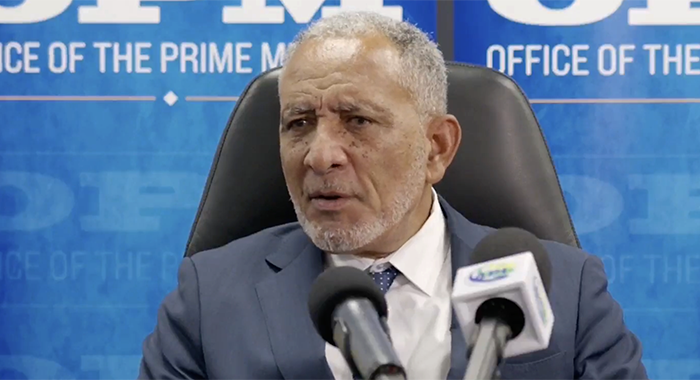
St. Vincent and the Grenadines Prime Minister Godwin Friday has launched urgent, coordinated action to curb a sharp, unacceptable rise in gun violence across the nation, convening a high-level security summit with the country’s top law enforcement leaders to map out a strategic response.
Speaking to reporters in Kingstown Tuesday, shortly after concluding an official visit to Taiwan, Friday disclosed that the closed-door meeting — held roughly two weeks prior on the island of Bequia — brought together the highest-ranking command of the Royal St. Vincent and the Grenadines Police Force, senior Coast Guard leadership, Deputy Prime Minister and Minister of National Security St. Clair Leacock, and Leacock’s permanent secretary. The gathering centered on the growing public anxiety over the spike in shootings and widespread feelings of insecurity that have shaken communities in recent weeks.
To signal a clear shift in the government’s approach to public safety, Friday confirmed that his administration has already implemented leadership reshuffling at the very top of the national police force. On Monday, Trevor “Buju” Bailey was appointed acting Commissioner of Police, replacing Enville Williams who is currently on seven months of paid leave. Junior Simmons will serve as acting Deputy Commissioner, while Brenton Smith has taken on the role of acting Assistant Commissioner. These leadership changes took effect immediately after a violent weekend that saw three separate shooting incidents in Kingstown leave two women wounded, followed by a fatal shooting early Tuesday that left one man dead in an abandoned building directly across from His Majesty’s Prison on Kingstown’s White Chapel Road.
Friday openly acknowledged that the string of violent attacks has amplified public fear and placed his administration’s security record under intense public scrutiny. While he reaffirmed the government’s full commitment to directly confronting the national crime crisis, he warned that translating policy commitments into tangible, visible public safety improvements will require time.
Among the most pressing issues discussed at the Bequia summit, the prime minister highlighted the unregulated flow of illegal firearms into the country as a particularly urgent threat. “We don’t manufacture them here, yet anybody who wants a gun seems to be able to get one. This has to end,” he stated. Friday added that law enforcement already holds intelligence on key entry points for these illegal weapons, and the government is now finalizing a targeted plan to crack down on smuggling networks, prioritizing strengthened border control and interdiction of illegal gun shipments. He declined to share sensitive operational details, but stressed that halting the inflow of illegal firearms is a non-negotiable core priority.
For Friday, guaranteeing public safety is the most fundamental obligation a government owes its citizens. “The first thing that a government owes its citizens is security,” he said, expanding on this core principle: “We are responsible for creating an environment where these violent incidents don’t happen, and that if they do occur, perpetrators are quickly apprehended, prosecuted, and jailed.”
The prime minister also emphasized that solving the long-standing crime crisis will require more than just law enforcement action — it demands a whole-of-society approach. He announced plans to convene a national dialogue with political leaders across the aisle and civil society stakeholders at an appropriate time to align on a unified national strategy to tackle violence. “We can’t allow a situation where people are afraid to leave their homes. How can a country function that way?” he noted, underscoring the high stakes of the current crisis.
When asked about his past criticism of the previous administration’s handling of rising crime during his time in opposition, Friday pushed back against claims of inconsistent rhetoric. “When I speak in opposition, I don’t speak with a forked tongue,” he said. “What I said then, I stand by now; it is just shaped by the different facts and circumstances of holding office.” He did acknowledge that timelines for progress he outlined while in opposition may need adjustment, and pledged to be transparent with the public if deadlines shift: “If the timeline changes, I will come to the public and explain why, and reasonable people will understand that.” On the question of accountability, he was unambiguous: “You asked if we are responsible. Of course we are. We hold the office of national security, so we are responsible for building a safe society.”
Friday also pointed to systemic impunity for violent offenders as one of the most damaging weaknesses in the current security system. Restoring public trust, he argued, depends on establishing a consistent track record of arrests, prosecutions, and convictions for serious violent crimes — something the public has not consistently seen in recent years.
International assistance, including security support from Taiwan, will play a supporting role in the national strategy, but Friday stressed that all foreign aid must be aligned directly with St. Vincent and the Grenadines’ domestic priorities. During his recent visit to Taiwan, security cooperation was discussed, with Taipei already providing some equipment and hosting training for Vincentian law enforcement officers. However, Friday argued that ad hoc donations of surplus equipment — such as secondhand vehicles or extra bulletproof vests — while useful, do not address the most urgent needs of the current crime-fighting plan. “We have to be clear: these are our priorities, this is our national plan, how can your support help us meet these goals?” he said. He expressed confidence that Taiwan will align its support with the nation’s formal strategy once it is finalized, and emphasized that the government will not relent until the crisis is resolved: “Until the problem is gone, we don’t back off. This isn’t a six-month quick fix; we stick with it until we get results.”
Ultimately, Friday said his mission as prime minister is to acknowledge the public’s widespread fear of violence and deliver decisive action to restore safety. He added that voters will ultimately judge his administration on whether it delivers on its promises: reducing violent crime, stemming the flow of illegal guns, strengthening policing institutions, and ending the culture of impunity that has allowed violent offenders to act without consequence.