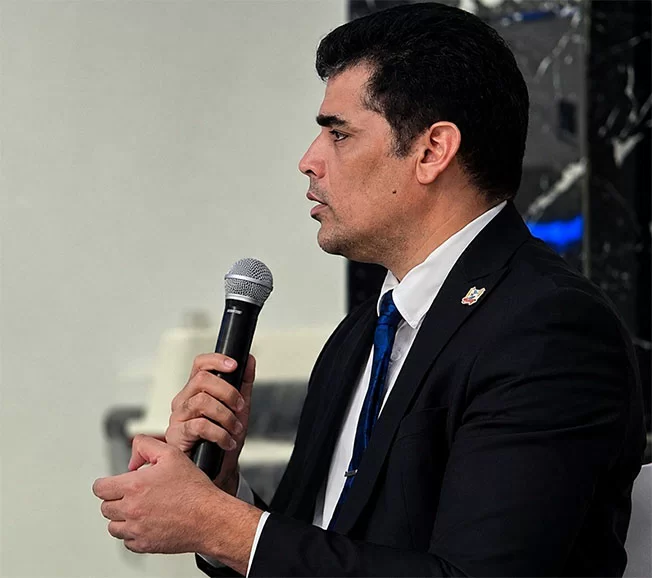
In a public address delivered Sunday evening at a suicide prevention event hosted by the Suriname chapter of the Global Indian Organisation (GIO), Ashwin Adhin, Speaker of the National Assembly of Suriname, announced a landmark push to embed suicide prevention into national law, arguing that voluntary policy plans and government programs have failed to reverse the country’s decades-long status as a high suicide-risk nation.
Adhin, who opened the event by highlighting alarming recent police data showing a sharp upward trend in suicides and suicide attempts, revealed he will introduce a private member’s initiative bill that legally mandates the government to implement sustained structural interventions, set publicly trackable measurable targets, and submit annual public accountability reports to parliament. Data presented at the event showed 22 cases of suicide and suicide attempts were recorded in June 2026, a sharp increase from 12 reported in April and 14 in May.
“A policy plan binds no one; a law binds everyone,” Adhin told attendees, emphasizing that current non-binding approaches have left prevention efforts vulnerable to shifting political priorities and inconsistent implementation across successive governments. He stressed that Suriname has consistently ranked among countries with suicide rates far above the global average, and every statistic represents a shattered family and a preventable loss of life.
During his presentation, Adhin noted that Suriname’s existing legal framework already addresses assisted suicide, with Article 354 of the country’s penal code criminalizing incitement or assistance to suicide while decriminalizing suicide attempts themselves. Adhin called this existing approach a sound foundation, explaining that the law does not punish people in crisis but instead directs them toward life-saving care. The proposed new legislation will build on this framework by formalizing the government’s obligation to act.
Responding to existing parliamentary calls for a national suicide prevention program, Adhin acknowledged the urgency of coordinated action but argued that standalone programs are insufficient. “Suriname does not lack plans, it lacks consistent execution,” he said. He added that codifying suicide prevention in law will insulate efforts from changes in government and ad-hoc policy decisions, ensuring sustained focus on the crisis.
Adhin pointed to successful suicide prevention policy reforms in other countries to support his proposal. He noted that Japan embedded its national suicide prevention strategy in law in 2006 and subsequently recorded a significant long-term reduction in national suicide rates. Sri Lanka achieved measurable progress by banning the most toxic agricultural pesticides, a common method of suicide in the country, and neighboring Guyana has already enacted its own Suicide Prevention Act in 2022.
Adhin commended the current Surinamese government for making crisis hotline 114 a permanent, 24-hour service, noting that people in acute crisis must have access to immediate support at any time of day or night.
Beyond legislative reform, Adhin stressed the critical importance of early recognition of suicide warning signs in communities. He noted that at-risk people are not always visibly emotionally distressed, warning that withdrawn, quiet individuals often face unrecognized acute risk, with hopelessness being one of the clearest early indicators. Adhin added that acute suicidal impulses are often short-lived, meaning timely intervention during a crisis can save a life. He also referenced teachings from the Bhagavad Gita, framing the ending of life as not a solution to underlying suffering.
The GIO event also featured remarks from Deputy Minister of Public Health, Welfare and Labor Raj Jadnanansing, Indian Ambassador to Suriname Subhash Gupta, National Assembly member Dew Sharman, clinical psychologist Sila Kisoensingh, and former police commissioner Gisla Poeran, and concluded with a public panel discussion on the way forward for suicide prevention in Suriname.
As the bill enters its preparatory phase, Adhin has opened a public consultation process: civil society organizations, mental health experts and other stakeholders are invited to submit feedback on the 10 core principles outlined in his preliminary consultation document to the Office of the Speaker of the National Assembly, marked “Input Suicide Prevention Act.”