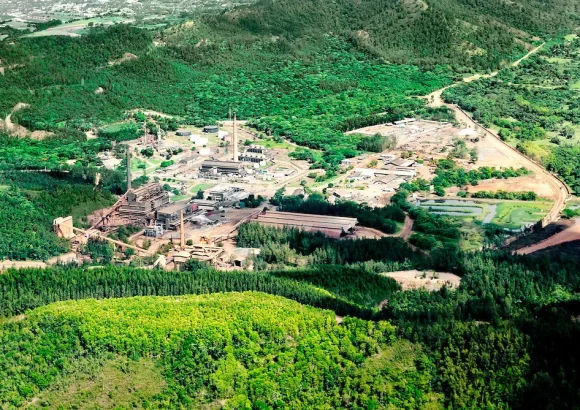
In a landmark ruling that brings to a close a nearly 70-year-long contractual relationship between the Dominican government and mining operator Falconbridge Dominicana (Falcondo), the nation’s Superior Administrative Court (TSA) has formally revoked the company’s concession contracts for the Quisqueya I mining site. The sprawling concession spans 22,392 hectares of land across the La Vega and Monseñor Nouel provinces, making its termination one of the most significant mining sector legal decisions in recent Dominican history.
The TSA’s Second Chamber handed down the final ruling on August 12, responding to a legal challenge first filed in July 2025 by the Patrimonial Fund of Reformed Companies (FONPER), which brought the action on behalf of the Dominican State. The original lawsuit outlined multiple serious violations of the concession agreement, including breaches related to mining operation protocols, unmet economic and labor obligations, and a consistent failure to submit mandatory technical reports required under Dominican national mining law.
Court documents confirm multiple key findings that underpinned the final decision. First, operations at the Quisqueya I site have been completely halted since November 17, 2023. In addition to this prolonged shutdown, the court documented that Falcondo failed to turn in required semiannual operational progress reports for 2023, 2024, and 2025, and also neglected to submit mandatory annual operational reports for the 2023 and 2024 calendar years.
The TSA emphasized that the violations cut to the core of the concession agreement’s essential obligations. Specifically, the contract requires the concession holder to actively and effectively exploit the licensed mineral resources, and to maintain consistent, transparent communication with government regulators by updating them on all mining activities. After reviewing the evidence, the court determined that the extended period of inactivity and accumulated serious violations provided clear justification for terminating the contracts, and rejected all counterarguments from Falcondo that sought to dismiss the state’s case.
The court’s decision arrives against a backdrop of already widespread economic and labor disruption stemming from Falcondo’s operational shutdown. In 2024 alone, more than 900 workers were laid off from the company. Former employees whose original contracts were set to run through March 2026 have reported that the company owes them approximately 300 million Dominican pesos in unpaid wages and benefits. Local contractors, suppliers, and small businesses operating in Monseñor Nouel have also reported massive unpaid bills and significant economic losses tied directly to the company’s closure.
Notably, the TSA ruling is legally separate from Falcondo’s ongoing commercial restructuring process, which is being carried out under the Dominican Republic’s Law 141-15 on the Restructuring and Liquidation of Companies and Individual Merchants. That restructuring proceeding, which was initiated by the company’s creditors, will continue as an independent legal process to resolve Falcondo’s outstanding debts and remaining liabilities.