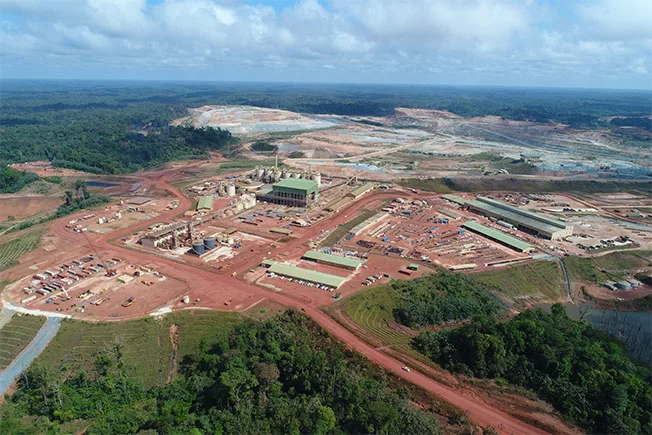
Newmont Suriname has announced that the total economic contribution of its Merian gold mine to the Surinamese economy reached approximately $634 million in 2025, marking a 17% increase compared to 2024 figures. The company released the updated data on Monday, clarifying that the total contribution does not solely consist of revenue directed to the Surinamese government, with more than half of the sum allocated to local and external supply chain partners.
Breaking down the $634 million total, the largest single line item is $345 million in payments to suppliers and contracted service providers, followed by $78 million in employee salaries. Combined income and payroll taxes paid by the operation amount to $79 million, with an additional $48 million in royalties directed to the state, bringing total government tax and royalty revenue to $127 million. Newmont has not yet provided a separate breakdown of how much of the $79 million tax figure is attributable to corporate income tax versus payroll withholding.
As a 25% co-owner of the Merian mine, alongside Newmont’s 75% controlling stake, the state-owned energy firm Staatsolie received $84 million in net profit share for 2025. This dividend payment is separate from taxes and royalties paid to the government, bringing the total of state-linked earnings from the project to $211 million, though not all of this sum enters the national government’s general treasury.
According to Newmont’s disclosure, 75% of the total economic value generated by Merian mining operations remained within Suriname’s domestic economy in 2025. A total of 308 Surinamese suppliers and contractors were part of the mine’s supply chain last year, though the company did not specify what share of the $345 million in supply chain payments went to these domestic businesses. The mine directly employs approximately 1,277 workers, and Newmont says it continues to invest in upskilling and professional development for its local workforce.
The release of Merian’s 2025 economic data comes as the Surinamese government undertakes a broad regulatory overhaul of the country’s gold mining sector. President Jennifer Simons has ordered a temporary pause on issuing new gold mining concessions and processing existing concession extension requests, as the administration works to build a clearer picture of current sector conditions and strengthen regulatory oversight and transparency across the industry.
Beyond maximizing economic returns, the regulatory review is centered on protecting residential and traditional territories of Indigenous and Tribal communities, safeguarding ecologically sensitive natural areas, and mitigating the environmental harm caused by unregulated gold extraction. In response to these policy priorities, Newmont says its Merian operations adhere to the principle of Free, Prior and Informed Consent (FPIC) when engaging with Indigenous and Tribal communities, with a commitment to open dialogue, full transparency, and inclusive participation in local decision-making processes.
Newmont has also outlined a dedicated strategy to support formalization of Suriname’s artisanal and small-scale mining sector, focused on delivering technical assistance, building local regulatory capacity, developing alternative livelihood options for small-scale miners, and reducing mercury use in artisanal extraction. The company says it is exploring pathways to bring more unregulated small-scale operations into formal compliance with existing national mining laws.
Currently, the Merian gold mine is projected to remain in operation until 2040, with Newmont reporting that it is actively exploring additional reserve expansion opportunities that could extend the mine’s operational lifespan beyond the current timeline.