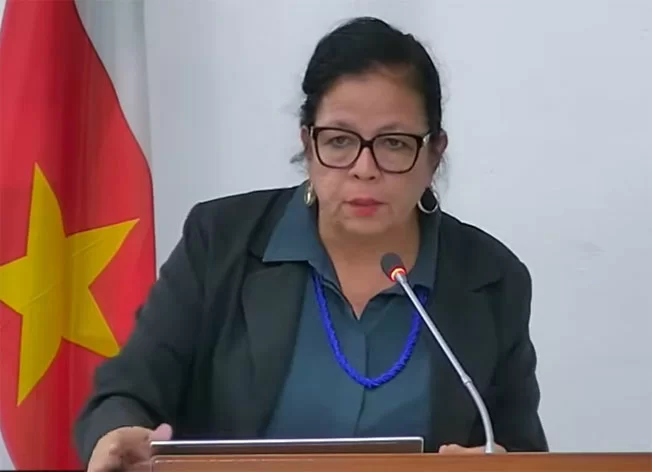
As Suriname moves forward with plans to regulate its emerging virtual assets sector, a senior parliamentarian has highlighted critical pre-implementation gaps that could leave new oversight rules toothless if left unaddressed. Jennifer Vreedzaam, a member of the National Assembly (DNA) from the National Democratic Party (NDP) and part of the special drafting committee reviewing the proposed *Virtual Asset Service Providers Supervision Bill*, laid out her concerns during plenary debate on Friday.
At the core of Vreedzaam’s argument is the need for balanced regulation: she acknowledges that formal oversight of the crypto and virtual assets space is a necessary step to align Suriname’s regulatory framework with global Financial Action Task Force (FATF) standards, protect the country’s broader financial system from illicit activity, and create space for responsible digital innovation. Under the draft bill, virtual asset service providers would be required to implement robust risk management systems, business continuity protocols for technical outages, strict security standards for digital partners and IT vendors, and regular independent audits. These requirements, Vreedzaam notes, are foundational to building a safe, transparent sector.
However, she warns that two key threats could undermine the entire effort: insufficient capacity for the lead regulator, the Central Bank of Suriname (CBvS), and overregulation that risks squeezing small and emerging providers out of the market. The bill assigns CBvS full responsibility for supervising the new sector, a mandate that adds an entirely new line of work to the central bank’s existing responsibilities. Vreedzaam points out that the draft legislation does not clearly outline how much additional staffing, operational budget, and specialized technical infrastructure will be allocated to this new role.
Of particular concern is blockchain analysis, a core capability needed to track virtual asset transactions and flag suspicious or fraudulent activity. Without dedicated expertise and specialized tools to carry out this work, Vreedzaam argues, effective supervision will be impossible. “Without sufficient funding and qualified personnel, this supervision will remain nothing more than a dead letter on paper,” she said. To address this gap, she has proposed mandatory annual reporting to the National Assembly on CBvS’s staffing levels, allocated budget, and completed oversight investigations for the virtual assets sector, to keep capacity building on track.
Vreedzaam also warns that overly stringent requirements could disproportionately harm small, early-stage fintech companies. The costs of legal compliance, administrative overhead, and advanced security systems create a far heavier relative burden for smaller providers than for large established firms, and she has called for clarity on how the draft framework will support this segment of the market to avoid stifling innovation.
Beyond regulatory capacity, Vreedzaam has identified multiple gaps in legal protection and transparency that need refinement. She notes that while the draft bill mentions the right to objection and appeal for providers, it fails to clearly specify which body service providers can turn to when they dispute a decision made by CBvS. Several criteria for rejecting license applications are also overly broadly worded, she argues, creating room for arbitrary decision-making. The proposed framework also currently lacks a consumer compensation scheme to protect users if a licensed virtual asset provider declares bankruptcy.
To improve transparency for everyday users, Vreedzaam is pushing for the creation of a public, searchable register of all licensed virtual asset service providers, listing each provider’s official name, registered address, license status and service classification. This would allow consumers and businesses to independently verify that they are working with a regulated, supervised entity. She has also proposed adding statutory whistleblower protections for individuals who report misconduct at virtual asset providers directly to the central bank, to encourage accountability.
Given the rapid pace of technological change in the digital assets space, Vreedzaam argues that the regulatory framework needs to be flexible enough to evolve alongside the sector. She has proposed adding a mandatory evaluation clause to the bill that would require a full review of the law’s effectiveness after two years, with a public report submitted to the National Assembly to guide adjustments. She also suggested creating controlled regulatory sandboxes, where firms can test new fintech products and services under limited supervision. This approach would allow regulators to build on-the-ground experience before locking new developments into permanent regulation.
In her closing assessment, Vreedzaam framed the draft bill as a necessary, broadly sound first step to regulate the sector and bring Suriname into compliance with global FATF standards. She praised the bill’s core strengths: its mandatory licensing requirement and formalized enforcement powers for regulators. Still, she emphasized that the biggest risks to the framework’s success lie in unaddressed gaps in implementation capacity and insufficient legal protections for both providers and consumers, which must be resolved before the bill is finalized.