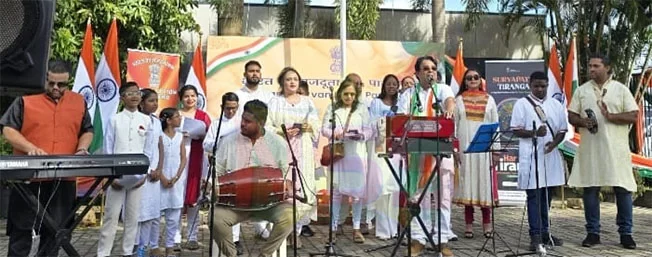
On the occasion of India’s 80th anniversary of independence, a long-standing Surinamese cultural institution dedicated to preserving Indo-Surinamese heritage has received a special recognition from the Indian Embassy in Paramaribo, marking a meaningful milestone for decades of cultural preservation work.
The De Kries Ramkhelawan Music Institute Foundation (KRMI), which has spent more than 40 years passing down traditional vocal music, performance art, and cultural heritage to younger generations of Surinamese, was honored during the embassy’s independence day celebrations. Founder Kries Ramkhelawan, who took the stage alongside the institute’s young students during the event’s cultural performance, called the honor a tremendous validation of the foundation’s four-decade mission.
Indian Ambassador to Suriname Subhash Gupta presented the foundation with an official Certificate of Participation in recognition of its acclaimed musical performance during the 80th Independence Day commemorations. Photos from the event captured the formal handover of the certificate between Ambassador Gupta and Ramkhelawan.
For Ramkhelawan, this recognition carries extra weight because of the deep, centuries-old historical and cultural ties that bind Suriname and India. Speaking to local outlet Starnieuws, he explained that Indo-Surinamese communities have carefully preserved countless Indian traditions, customs, and cultural practices dating back to 1873. These traditions, ranging from folk music and vocal styles to traditional clothing and culinary practices, have been passed intact through successive generations of the diaspora.
The historical connection between the two nations traces back to June 5, 1873, when the first group of indentured laborers from British-ruled India arrived on Suriname’s shores. More than 150 years later, the cultural footprint of that migration remains a visible, core part of Suriname’s diverse national society. India’s Ministry of External Affairs has repeatedly described bilateral ties with Suriname as close and warm, with historical migration and the resulting people-to-people and cultural bonds forming the foundation of the modern relationship.
Beyond recognizing decades of preservation work, the honor also reflects the evolving nature of Suriname-India cultural relations. Ramkhelawan noted that the relationship today extends far beyond preserving historical traditions: the Indian Embassy actively creates and supports new opportunities for Surinamese young people to engage with India across sectors including higher education, information technology, visual arts, and music.
India runs multiple dedicated international programming initiatives for youth from the global Indian diaspora, and Suriname participants regularly benefit from these opportunities. The Indian Technical and Economic Cooperation (ITEC) program, one of India’s longest-running international development initiatives, offers training and capacity building opportunities for professionals from partner countries including Suriname. The Know India Programme, meanwhile, gives young people of Indian descent living abroad the chance to experience contemporary India firsthand, building connections between the diaspora and modern Indian society.
For KRMI, the recognition fits perfectly into the institute’s longstanding mission. For more than 40 years, the foundation has provided structured vocal and musical education that goes far beyond technical skill: its core goal is to pass intergenerational cultural heritage to young Surinamese. Ramkhelawan emphasized that the honor is not just for the institution, but for every student and staff member who has contributed to its work over decades. “It is a beautiful gesture of appreciation from India to our students and team,” he said.
India marked its 80th Independence Day on August 15, 2026, commemorating the end of British colonial rule in 1947. For Suriname’s large Indo-Surinamese community, the annual celebration carries a unique, extra meaning rooted in shared history. The cultural traditions brought by 19th century Indian immigrants have evolved organically in Suriname over generations, while becoming an integral part of the country’s broader multicultural national identity.
Looking ahead, Ramkhelawan stressed that young people hold the key to keeping this cross-cultural connection alive. Their work goes beyond just preserving traditional music and customs: it also means embracing the new opportunities for exchange, collaboration, and growth that the deepening relationship between Suriname and India continues to create.