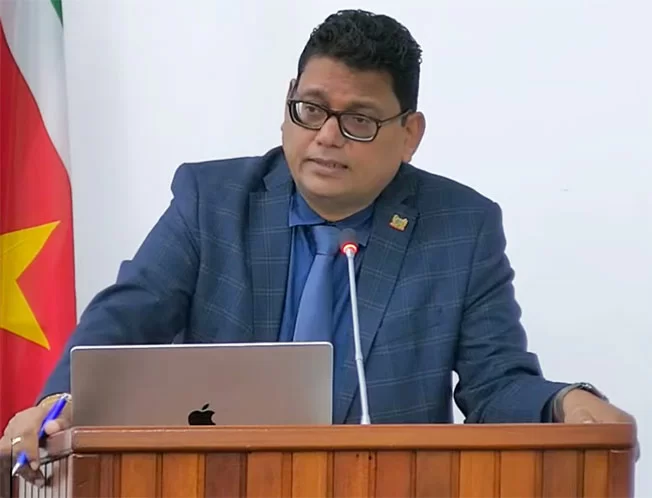
As the global adoption of virtual assets like cryptocurrencies and stablecoins accelerates, Suriname’s top political figure has laid out a roadmap for sensible domestic regulation that avoids the pitfalls of over-restrictive oversight. On August 16, Asis Gajadien, leader of the ruling VHP party’s parliamentary faction and a member of the legislative report committee, presented key proposed amendments to the country’s draft bill on supervision of virtual asset service providers during debates in the National Assembly.
Gajadien opened by stressing that there is no debate within his faction about the fundamental need for regulation. Virtual assets have already become an integrated part of the global financial system, bringing new opportunities alongside well-documented risks ranging from fraud and money laundering to terrorist financing. Citing on-the-ground observations, Gajadien estimates that roughly 30% of certain domestic trade and import transactions in Suriname are currently settled using stablecoins such as Tether (USDT), though he noted that no official study has yet quantified the exact size of the country’s crypto market, and called on the government to release more clarity on the sector’s scale.
While the VHP supports introducing formal rules for the sector, Gajadien warned against a one-size-fits-all heavy-handed oversight framework that would stifle innovation and push small local providers out of the market. Suriname is required to meet global anti-money laundering and counter-terrorist financing standards set by the Financial Action Task Force (FATF), but Gajadien emphasized that these global rules do not mandate identical strict oversight for all types of service providers regardless of their size and scope of activity.
“A small local Surinamese provider with only a handful of clients should not be held to the same strict standards as a large global crypto trading platform,” Gajadien argued. He pushed for a clear risk-based and proportionate oversight system, where the stringency of regulation is adjusted based on the size of the firm, number of clients, total assets under management, and the specific risk profile of its activities. For example, a company that provides custody services for digital assets faces fundamentally different risks than a brokerage, exchange, or technology firm that only develops underlying blockchain infrastructure, and these differences should be reflected in regulation, he said.
Gajadien also criticized the draft bill for granting excessive rule-making authority to the Central Bank of Suriname (CBvS) through post-legislation guidelines. He argued that all core regulatory standards should be set directly by legislators in the text of the law itself, pointing to past problems with previous oversight laws that arose when regulatory powers were not clearly defined from the start.
Among his other key proposed amendments, Gajadien called for clearer classification of which instruments qualify as virtual assets. He noted that digital loyalty points, gift cards, vouchers, and event tickets that use blockchain technology do not need to be automatically categorized as regulated virtual assets. By contrast, stablecoins deserve targeted, stricter specific rules that do not apply to volatile cryptocurrencies like Bitcoin. Gajadien proposed that stablecoin issuers claiming full backing by reserve assets such as U.S. dollars should be required to hold sufficient liquid reserves, keep these reserves segregated from operating assets, submit to independent audits, and guarantee token holders the ability to redeem their tokens in a timely manner.
For existing crypto businesses already operating in Suriname when the law comes into force, Gajadien proposed a clear transition arrangement: any existing provider that registers on time and submits a full license application within 12 months should be allowed to continue operations until a final decision on their application is issued, with the CBvS only permitted to intervene early if the firm poses an immediate serious risk to consumers or financial stability. He also questioned the draft’s ban on sole proprietors and individual entrepreneurs entering the sector, noting that FATF does not require any specific legal structure for service providers, and called for the draft’s proposed 51% ownership rule for qualified stakeholders to be either scrapped or completely redesigned.
A standout proposal from Gajadien is the inclusion of a regulatory sandbox in the legislation, which would allow innovative fintech firms to test new products and services under controlled, limited conditions for a set period. The CBvS would be able to set parameters for the sandbox around duration, maximum number of clients, total activity size, and consumer protection requirements. Gajadien noted that this framework would allow Suriname to nurture new fintech innovation without relaxing anti-money laundering controls or other risk management rules. He also added that stronger explicit rules for consumer protection and cybersecurity are needed, requiring providers to implement adequate security for crypto wallets and private keys, maintain business continuity plans, and establish mandatory reporting procedures for severe ICT security incidents.
Finally, Gajadien drew attention to the potential uneven playing field between domestic Surinamese crypto firms and large foreign crypto platforms. Local providers will be required to pay licensing and regulatory fees, maintain minimum capital reserves, hire independent auditors, and submit regular reports to the CBvS, but it remains unclear how these same requirements can be enforced on foreign platforms that serve Surinamese customers via the internet. He asked the government to clarify how the CBvS plans to implement technical oversight of these cross-border platforms, what blockchain analysis expertise the central bank currently holds, and what investments in new systems and staff training will be required to carry out effective supervision.
Gajadien concluded by advocating for a simpler initial regulatory framework that can be expanded incrementally as the market evolves. “Suriname should start with cautious, measured regulation, and build out oversight over time based on market developments and practical experience,” he said. “The goal of this law should not be to create as many rules as possible. It should be to build a workable system that manages financial risks while leaving room for innovation and local entrepreneurship.”