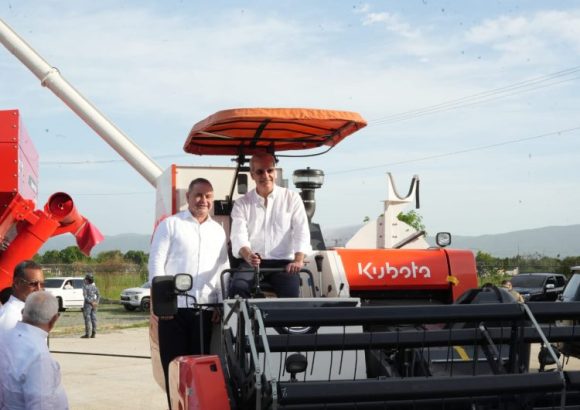
In a landmark move to upgrade the Dominican Republic’s agricultural sector, the national government has officially launched the National Mechanization Program (Pronamec), a transformative initiative backed by an investment of more than 200 million Dominican pesos. The program was developed to tackle long-standing challenges in the sector, from outdated production practices and soaring operational costs to heavy reliance on imported foreign labor, aligning with the government’s broader goal of agricultural modernization.
President Luis Abinader presided over the launch ceremony held in San Juan, the region selected to host the program’s first phase, which will kick off with mechanization demonstration plots. After the initial pilot in San Juan, the initiative will roll out to six additional key agricultural regions across the country: Las Matas de Santa Cruz, Valverde, La Vega, Constanza and Arenoso. In each of these expansion areas, local producers will gain access to hands-on training and opportunities to test specialized agricultural machinery tailored to the unique crop varieties and geographic conditions of their regions.
Francisco Oliverio Espaillat Bencosme, the country’s Minister of Agriculture, outlined that Pronamec will center its efforts on three core strategic pillars: workforce training, accessible financing, and national expansion of mechanized services. To build a skilled local workforce capable of operating and maintaining new equipment, the government has partnered with the Dominican Institute of Technical Professional Training (Infotep) and authorized agricultural equipment distributors to train certified machinery operators and maintenance mechanics.
For small and medium-sized agricultural producers, who have traditionally been locked out of large equipment investments due to high upfront costs, the program has coordinated with the Agricultural Bank, Bandex, and leading private financial institutions to roll out flexible, low-cost financing options for machinery purchases. To further reduce barriers for small-scale operators, the program will also promote cooperative and associative equipment sharing models, allowing multiple small producers to split the cost of purchasing and maintaining machinery, cutting individual overhead significantly.
Over the long term, Pronamec will expand its reach to every corner of the Dominican Republic by modernizing the existing National Seed Production Program (Prosema) and scaling up specialized machinery services offered through the Ministry of Agriculture. Unlike piecemeal mechanization efforts that only target one stage of production, the new initiative will cover every link of the agricultural production chain, from initial land preparation and planting to ongoing crop management, harvesting, and post-harvest processing.
Espaillat Bencosme emphasized that widespread mechanization will also directly address two of the most pressing crises facing Dominican agriculture today: persistent labor shortages and steadily rising production costs. The ministry has set clear, ambitious mechanization targets for the country’s major crops: staple grain and legume crops including rice, corn, sorghum and beans are projected to reach approximately 90% mechanization, while commercial fruit crops including plantains and bananas will target a mechanization rate exceeding 60%.
“This initiative is more than an investment in machinery—it is an investment in agricultural productivity, national food security, technological advancement, and the long-term future of Dominican farming,” Espaillat Bencosme said. Official data cited by the minister underscores the outsized importance of the agricultural sector to the Dominican national economy: agriculture contributes approximately 5.6% of the country’s total gross domestic product, accounts for 8.8% of all national employment, and makes up 11.8% of the country’s total annual exports.