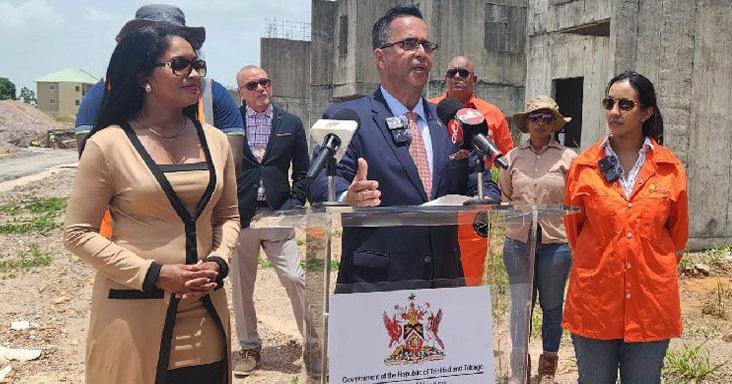
During a recent on-site inspection of the troubled Ridgeview Heights housing development in Bon Air North, Trinidad and Tobago’s Minister of Housing Phillip Alexander has revealed staggering financial mismanagement that has left taxpayers on the hook for hundreds of millions of dollars in losses, prompting the state-owned Housing Development Corporation (HDC) to pursue legal avenues to recover misspent funds.
According to Alexander, the previous administration, led by former Housing Minister Camille Robinson-Regis, oversaw catastrophic cost overruns and substandard construction that have left the project in ruins. The core issue centers on massive mismatches between construction costs and the actual market value of the completed residential units. Alexander explained that even the highest-quality finished units at the development can only fetch a maximum market price of $600,000 apiece — yet the prior administration locked the HDC into a contract that set initial construction costs at $1.2 million per unit. This marked a 100% markup over the units’ actual salable value, and subsequent cost overruns pushed the average price per completed townhouse to nearly $1.5 million, almost three times the properties’ market worth.
Across the entire 204-unit development — which comprises 52 townhouses and 152 apartments — the scale of losses is staggering. For every unit sold at the $600,000 market rate, taxpayers are forced to cover an additional $800,000 to $900,000 in overrun costs, Alexander said. When combined with losses from 50 partially completed units, the total public funds lost on the project top $165 million, he confirmed. The former administration reached a termination agreement with the project contractor that saw the HDC pay for 75% of the unfinished units, despite the fact that the properties were only 50% complete, leaving all of that pre-payment as a total write-off for public coffers.
Beyond the financial disaster, Alexander also exposed shocking construction defects that leave many units unsafe for occupancy. Many of the completed structures were built directly on the land surface without proper foundational anchoring, meaning they are structurally unstable and at risk of catastrophic failure, even in moderate weather. “They could blow away. We have no idea how many of them are like that,” Alexander told reporters. Most of the development also lacks basic critical infrastructure, including plumbing, electrical systems, sewer lines, and drainage networks, rendering the vast majority of the site unusable. As a result of these extreme defects, all the existing partially and fully completed structures at the development will have to be demolished, adding another unplanned cost that will once again be paid by taxpayers.
Alexander placed full blame for the stalled, failed project on the previous administration, noting that the current government has spent the past year working to salvage what it can from the mess it inherited. This scandal joins a growing list of prior problematic public housing projects that have faced official scrutiny, with Alexander comparing the Ridgeview Heights disaster to two earlier high-profile problematic developments: Trestrail and Las Alturas. He noted that the huge losses uncovered at this project are a key reason the current government has delayed handing over inherited housing units to qualifying applicants, as all prior projects are now being re-inspected to confirm they meet safety and construction standards before occupancy is approved.
As of this report, the HDC board has formally launched a review of the mismanagement and has retained legal counsel to explore all possible avenues to recover the lost public funds. Local media outlet The Express attempted to reach former minister Robinson-Regis for comment on the allegations, but did not receive a response by press time.