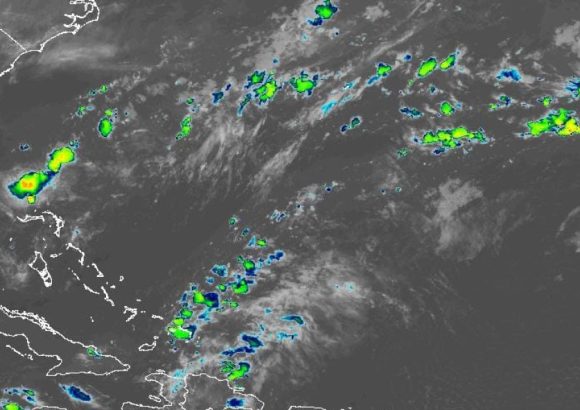
The Dominican Institute of Meteorology (Indomet) announced Friday that it has activated continuous surveillance protocols for two separate clusters of scattered thunderstorms and heavy downpours, both linked to tropical waves moving across the Atlantic Ocean. The agency is prioritizing monitoring of the systems due to their potential to organize and strengthen into cyclonic formations over the coming days.
The first of the two disturbance systems is currently positioned less than 1,000 kilometers east of the Lesser Antilles. Forecasters have revised its odds of cyclonic development downward, now placing a 30% probability of organization within the next two to seven days, down from earlier higher projections.
The second weather system is located hundreds of kilometers southwest of the Cape Verde Islands off the western coast of Africa. For this system, meteorologists assign a 30% chance of cyclonic formation within the next 48 hours, with that probability rising to 50% when looking at the full seven-day forecast window.
Indomet officials confirmed that the agency will maintain constant updates on the trajectory and organization of both systems as they move across the Atlantic, adjusting forecasts as new data becomes available to keep Dominican residents and regional stakeholders informed.
Looking ahead to Saturday’s weather across the Dominican Republic, conditions will be shaped by a different atmospheric feature: an air mass carrying light to moderate levels of Saharan dust. This air mass is interacting with lower humidity levels across the region, as a slow-moving trough continues its gradual westward shift.
These combined atmospheric conditions are expected to produce mostly clear to partly overcast skies across most of the Dominican Republic, with high hot temperatures forecast for most communities. Widespread rainfall is not anticipated for the bulk of the country, with only isolated, scattered showers expected to develop during the warm afternoon hours. The limited afternoon rain is forecast to be concentrated mostly in the Central Mountain Range and along the nation’s border region.