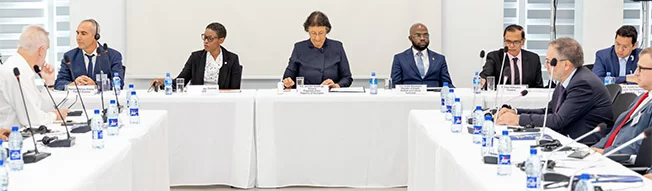
The South American nation of Suriname, the first country in the Amazon region to secure WHO certification of malaria-free status, cannot afford to relax its public health efforts, President Jennifer Simons has warned. Speaking at the opening of a two-day subregional malaria elimination summit hosted in Paramaribo at the Ministry of Public Health, Welfare and Labor headquarters, Simons emphasized that malaria-free status is not an end point, but a permanent commitment that requires daily active monitoring.
Organized jointly by the Pan American Health Organization (PAHO) and the World Health Organization (WHO), the Subregional Meeting on Malaria Elimination in the Guiana Shield brings together health leaders from across the region to coordinate cross-border strategies to sustain elimination gains. While Suriname’s achievement represents a historic public health milestone for the Amazon basin, Simons stressed that complacency could reverse years of progress. “Today we look back on this effort with joy and pride, and we celebrate our result. But now we face a new, equally critical challenge,” the president told attendees.
Simons highlighted two ongoing high-risk factors that threaten to reintroduce malaria to Suriname: heavy cross-border population movement and unregulated activities in remote gold mining regions. Malaria does not respect national boundaries, she noted, with frequent movement of communities and workers across Suriname’s borders with Brazil, Guyana, and French Guiana creating constant transmission risks. To mitigate these threats, the president called for deeper cross-regional collaboration, enhanced routine surveillance systems, and targeted deployment of diagnostic services and medical care directly to remote mining sites where exposure risks are highest.
Gold mining regions remain a top priority for sustained surveillance, Simons added, as these remote, often mobile work sites can easily become breeding grounds for malaria resurgence if left unmonitored. She argued that sustained malaria elimination requires an integrated, multi-sector approach that aligns public health, natural resource management, and national security policy. This means close coordination between Suriname’s ministries of health, natural resources, and justice and security, with prioritization of public health access even for workers in remote mining concessions. Public health education for at-risk communities must also remain a top priority, with programs from different government and non-government actors aligned to avoid gaps in coverage. “Our population is only guaranteed protection against malaria if we maintain these approaches, keep constant coordination, and align program delivery across sectors,” Simons said.
Beyond protecting its own malaria-free status, Suriname is committed to supporting neighboring countries to achieve full elimination, the president confirmed. The country’s national malaria program has been designated a Regional Centre of Excellence, which will allow Suriname to train field workers and clinicians from across the Guiana Shield region, sharing its hard-won experience to accelerate elimination efforts across South America. To uphold this regional leadership role, Simons noted that Suriname must continue investing in its own rural health infrastructure, with the country’s Medical Mission service playing a central role in ongoing surveillance in remote inland areas.
Simons also proposed the development of a shared regional digital alert platform to enable faster sharing of malaria surveillance and outbreak data between bordering nations. “Let us work toward a regional digital surveillance and alert platform, bring care and diagnostics directly to gold fields, and align our monitoring efforts across borders,” she said. The two-day summit is designed to advance these coordination goals, aligning strategies among Guiana Shield nations to prevent the reintroduction of malaria to areas that have already eliminated the disease and speed up elimination efforts across the region. While Simons acknowledged that full regional elimination will not happen quickly, she pointed to Suriname’s success as proof that the goal is achievable with sustained commitment. “No one here can promise we will achieve this in a few months,” she said. “But because we have seen it work in Suriname, I know for certain that with continued effort and collaboration, it is absolutely within reach.”