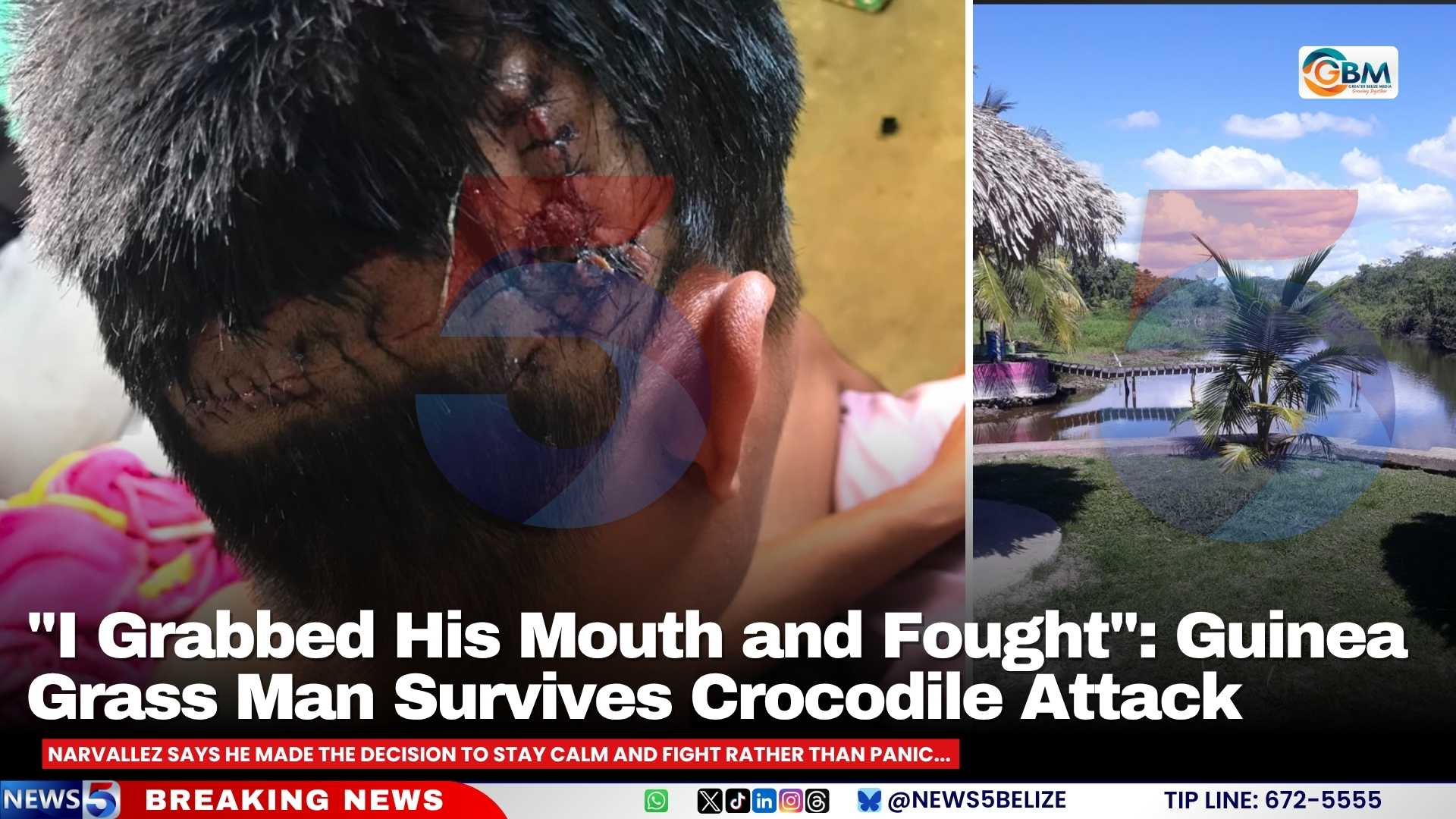
In the early hours of a Sunday morning in August 2026, a 29-year-old resident of Guinea Grass, Belize, walked away from a harrowing brush with death after a large crocodile attacked him while he swam at one of the village’s most frequented local recreation spots: New River Park.
Leomar Narvallez, the attack survivor, recounted that the encounter came completely without warning. He had been swimming alongside other visitors in the river when he suddenly felt a heavy, powerful clamp lock around his head. Before he could react, the crocodile began shaking its prey violently, a common predatory behavior to tear flesh from victims. “I was in the river swimming when something grabbed my head,” Narvallez described in the aftermath of the attack. “Then it started shaking me, just like crocodiles do when they bite you and try to tear you apart. It shook my head twice – I never saw this coming at all.”
Trapped underwater with his head still held firmly in the reptile’s jaws, Narvallez made a split-second decision that likely saved his life: instead of panicking, he would fight back. He pushed his hand against the crocodile’s teeth to work his head free of its grip, a struggle that lasted less than 10 seconds – six seconds, by his own count, with the entire attack wrapping up in under 20 seconds. Narvallez estimated the attacking crocodile measured between 9 and 10 feet long, and added that local reports had already confirmed a second, even larger crocodile living in the same stretch of river near the park.
“The crocodile got off my head, and I immediately jumped to grab a tire that was hanging from a rope over the water to pull myself up,” he said. By that point, he was bleeding heavily from the bite wounds on his head. When he first alerted his friends who were at the park, they did not immediately understand the severity of his injuries. It was only when they turned on a light and saw him spitting blood that they realized how grave the situation was.
Afraid the crocodile was still waiting nearby for another chance to attack, Narvallez told his friends not to approach him, and instead sent them to find a canoe. He clung to the tire for roughly 10 minutes, bleeding steadily, until relatives who lived close to the park arrived with a canoe to pull him to safety.
Narvallez was rushed immediately to Northern Regional Hospital for emergency care. Doctors closed his head wounds with approximately 28 stitches, and while his hands were badly bruised from the struggle, he suffered no other life-altering or critical injuries. He was released from the hospital the same day as the attack, and is now recovering at home.
Now, as he heals, Narvallez’s greatest priority is raising awareness of the ongoing danger at New River Park, a spot that local children visit regularly to swim and bathe throughout the day. He emphasized that once a crocodile has tasted human blood, it is far more likely to return to the same area to hunt again – and not everyone will be as lucky as he was to survive.
“I really want to leave this message: everyone needs to be extremely careful right now,” Narvallez said. “That crocodile has tasted blood, it will stay around this spot until authorities catch and remove it. More people could get attacked, and they might not get out alive. There are so many little kids who come here to bathe every morning, all through the day, sometimes until 6 p.m. This is an extremely dangerous situation. I want to spread this safety warning to everyone in the village, especially families – don’t let your children come here right now. If that crocodile catches a child, we can’t predict how bad it will end.”