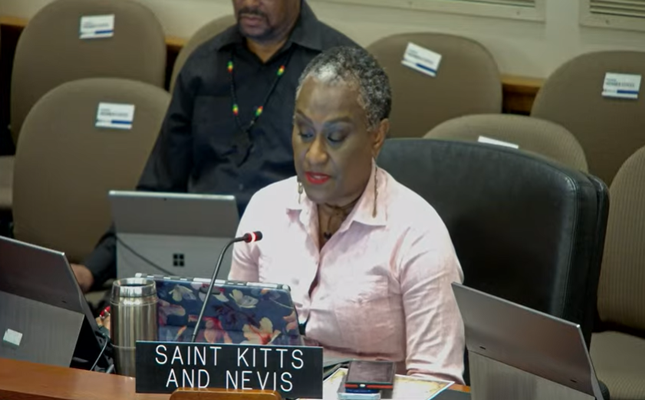
On August 12, 2026, ahead of the International Day of the World’s Indigenous Peoples, delegates from across the Western Hemisphere gathered in Washington, D.C. for a special convening of the Organization of American States (OAS) Permanent Council. Among the speakers, St. Kitts and Nevis made a forceful call for regional governments to move beyond symbolic recognition and deliver tangible, systemic protection for the inherent rights and enduring contributions of Indigenous peoples across the Americas.
Addressing the assembled council, Ambassador Jacinth Henry-Martin, St. Kitts and Nevis’ permanent representative to the OAS, pushed back against the common narrative that frames Indigenous communities as a relic of regional history. She emphasized that the knowledge, cultural traditions, and core values of Indigenous peoples remain deeply embedded in the present of the Americas, and are irreplaceable to building a just and sustainable future for the region.
While the large-scale Indigenous population that once inhabited St. Kitts and Nevis belongs to the islands’ ancestral history, Henry-Martin noted that the call for Indigenous rights carries profound meaning for the federation. Long before colonial powers renamed and claimed the islands, the Indigenous Kalinago people named St. Kitts *Liamuiga* – meaning “fertile land” – and Nevis *Oualie*, translating to “land of beautiful waters.”
Today, these original names continue to be used in St. Kitts and Nevis as a deliberate act of acknowledgment: the nation’s story does not begin with colonization, but with the Indigenous communities that first stewarded the land. Henry-Martin explained that these historic names act as a living bridge connecting past, present, and future generations to the islands’ natural heritage. They stand as proof that Indigenous language, culture, and collective memory can persist even through the upheaval and displacement of colonial rule.
The OAS special meeting was convened under the overarching theme “Roots that Sustain, Knowledge that Transforms, Rights, Water, Health, Culture and Innovation for a Shared Future.” Henry-Martin highlighted that this framing aligns perfectly with the symbolism of the Kalinago place names, which center the inherent connection between land, water, public health, cultural survival, and long-term sustainable innovation. She went on to celebrate the wide-ranging contributions of Indigenous peoples across the entire hemisphere, from preserving endangered languages and safeguarding global biodiversity to developing sustainable agricultural practices, passing down traditional health knowledge, and maintaining centuries-old systems of environmental stewardship.
Beyond recognition and celebration, however, the ambassador stressed that rhetorical commitment to Indigenous rights is insufficient. St. Kitts and Nevis formally backs expanded, enforceable protections for both individual and collective Indigenous rights across the Americas. These protections include the right to preserve cultural identity and heritage, meaningful participation in policy decisions that impact Indigenous communities, full freedom from systemic and social discrimination, and the self-determination to shape the future of Indigenous territories.
As the Western Hemisphere grapples with escalating crises including climate change, widespread water insecurity, and accelerating biodiversity loss, Henry-Martin argued that the generations of ecological and place-based knowledge held by Indigenous communities must be centered rather than sidelined or exploited without consent. She pointed to the American Declaration on the Rights of Indigenous Peoples as a critical foundational framework for the region, but added that governments must translate the declaration’s principles from formal policy statements into tangible improvements in the daily lives of Indigenous communities.
Closing her address, Henry-Martin issued a clear call to action for all OAS member states: to honor Indigenous peoples by upholding their inherent rights, centering their perspectives, and amplifying their voices in every decision that affects their communities and the future of the hemisphere.