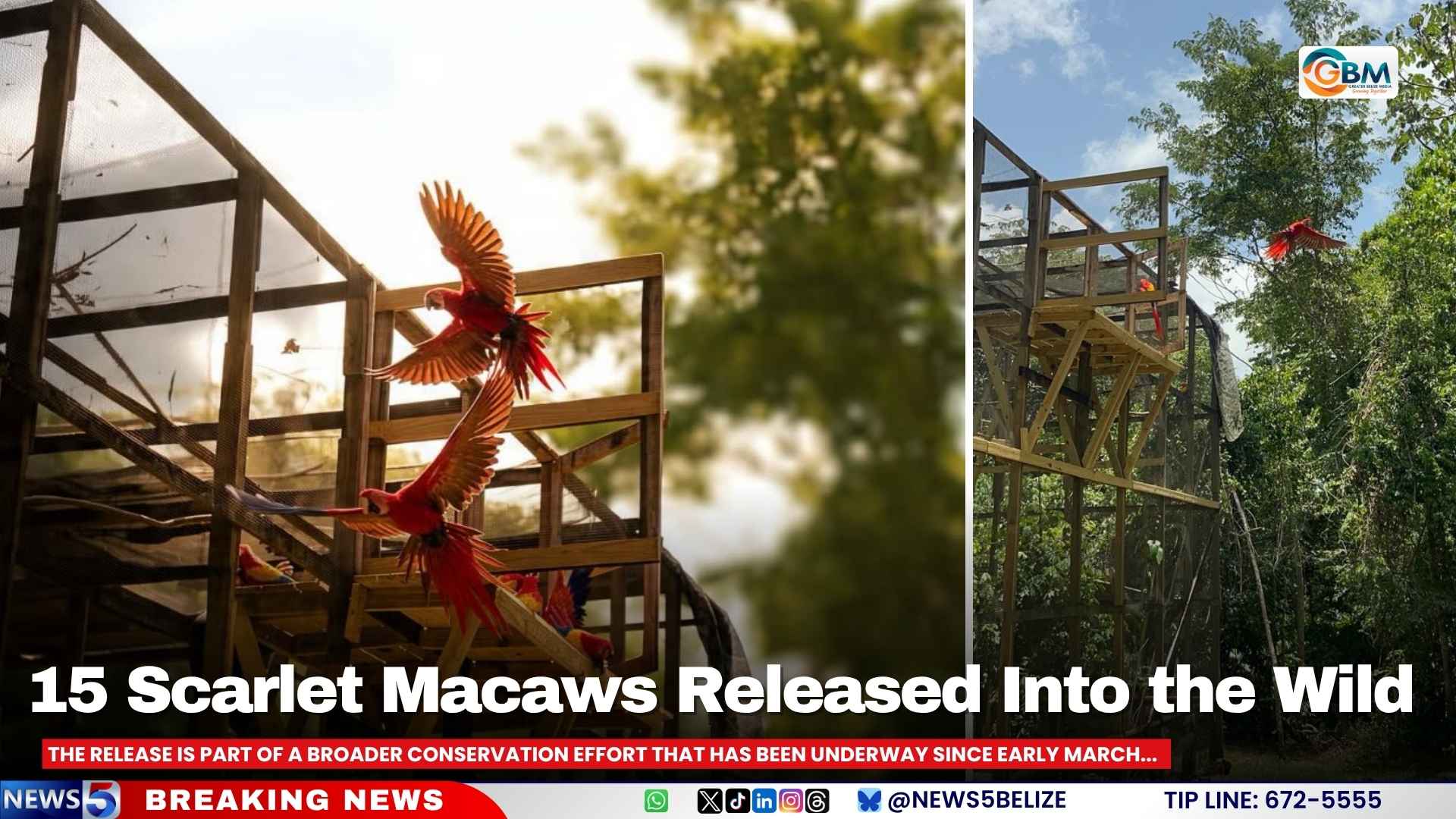
On a Monday morning in August 2026, a landmark moment for Central American biodiversity unfolded in Belize’s forests: 15 rescued scarlet macaws took their first independent flights into the wild, marking a major milestone for a years-long collaborative conservation push led by two local organizations. The release, carried out jointly by Friends for Conservation and Development (FCD) and Belize’s Forest Department, capped off an intensive rehabilitation process that began when the birds were pulled from high-risk survival situations.
Rescue interventions for Belize’s scarlet macaws are only authorized as a last resort, following strict protocols established by the Forest Department. Most triggers for rescue stem from scenarios that drastically raise the risk of poaching or death, such as three macaw chicks competing for space and resources in a single nesting cavity. After being pulled from these dangerous situations, each bird spent an average of 100 days receiving specialized care in a dedicated rehabilitation facility before release.
The rehabilitation process was carefully designed to prepare the macaws for full independence in their natural habitat. After initial feeding and medical care, the birds were transferred to large flight cages, where they built muscle mass, honed their flying skills, and regained the natural instincts needed to forage and avoid threats in the wild. When the release cage door swung open on Monday, the macaws first gathered at their familiar supply of fruit and nuts, before one by one venturing into the open forest. Some soared deep into the tree canopy immediately, while others lingered near the release site, testing their new freedom. For minutes after the release, the forest echoed with the macaws’ distinctive squawks as the flock settled into their new home.
This release is just one component of a broader, ongoing scarlet macaw conservation initiative that launched in early March 2026, when FCD’s Research Unit began systematic biological monitoring of wild macaw populations across Belize. The core of this effort is consistent, on-the-ground presence near macaw nesting cavities, a strategy that serves two key goals: tracking the growth and development of wild chicks, and deterring poachers who target young macaws before they are able to fly. To date, the program has supported 24 macaw chicks that have successfully fledged from their natural nesting sites.
Despite these gains, the conservation program continues to face significant challenges from the illegal wildlife trade. Already this year, two wild macaw chicks have been stolen by poachers, who are locally referred to as “guaqueros.” Stolen macaws are typically smuggled across the border into Guatemala for the illegal pet trade, a multi-million dollar black market that has decimated parrot populations across Central America. To counter this transnational criminal activity, FCD and Belize’s Forest Department have partnered with Guatemalan authorities to maintain a binational taskforce that shares intelligence and coordinates cross-border operations to disrupt trafficking networks. Even with this collaborative framework in place, conservation officials acknowledge that gaps remain: it is still nearly impossible to track the exact number of scarlet macaws lost to illegal trafficking each year, leaving long-term population projections uncertain.