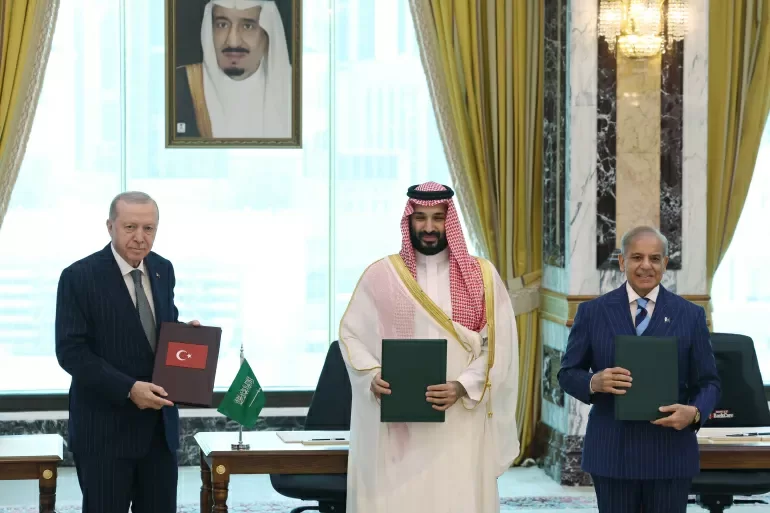
Against a backdrop of rising military volatility across the Middle East, three major Muslim-majority nations — Saudi Arabia, Turkey and Pakistan — have signed a landmark trilateral defence agreement that treats an armed attack on any one signatory as an attack on all three, Pakistan’s Ministry of Foreign Affairs has confirmed.
Dated August 7 and signed in the Saudi holy city of Mecca during a gathering of top leaders from the three countries, the landmark pact is officially named the Mecca Joint Defence Agreement. The deal deepens long-standing security coordination between the three nations at a moment of growing uncertainty for regional security.
The signing follows a diplomatic and spiritual visit to Mecca by Pakistani Prime Minister Shehbaz Sharif and Turkish President Recep Tayyip Erdogan, where the two leaders held closed-door talks with Saudi Crown Prince Mohammed bin Salman ahead of putting pen to paper on the agreement. The pact is framed as a symbolic demonstration of the three states’ shared commitment to strengthening collective security, and advancing peace, stability and shared prosperity across the Middle East and beyond.
Regional security has deteriorated sharply since a joint U.S.-Israeli offensive against Iran in February, which triggered a wave of retaliatory attacks by Iranian-aligned Houthi and pro-Iran militias targeting Saudi Arabia and its regional allies. These sustained attacks have put Saudi Arabia’s critical oil export infrastructure at risk, threaten to derail the kingdom’s ambitious Vision 2030 economic development agenda, and have sparked growing skepticism among Saudi leaders about the reliability of long-standing U.S. security guarantees for the region.
While neither Turkey nor Pakistan has faced direct attacks in the current wave of regional conflict, both governments have moved to address growing risks that escalating tensions could undermine their own national security and economic growth. The new defence agreement builds on decades of incremental military cooperation between the three nations: Pakistan has a history of training Saudi military personnel, Turkey and Pakistan have long exchanged arms and military expertise, and in 2023 Riyadh finalized a major multi-billion dollar contract to purchase advanced Turkish drones for its armed forces.
Security analysts widely view the new pact as the foundation for an emerging regional security architecture that unites three of the world’s most populous Muslim nations. The alliance combines unique strategic strengths: Pakistan boasts a nuclear deterrent and one of the world’s largest professional standing armies, Turkey fields advanced domestic weapons systems and holds a NATO membership, while Saudi Arabia brings vast financial and economic clout to the partnership.
Though the agreement is explicitly framed as a defensive pact, experts anticipate it will also catalyze expanded economic collaboration between the three signatories. Analysts note the pact is designed to balance deterrence against potential aggression with diplomatic outreach, with the ultimate goal of de-escalating regional tensions and laying the groundwork for long-term stability across the Middle East.