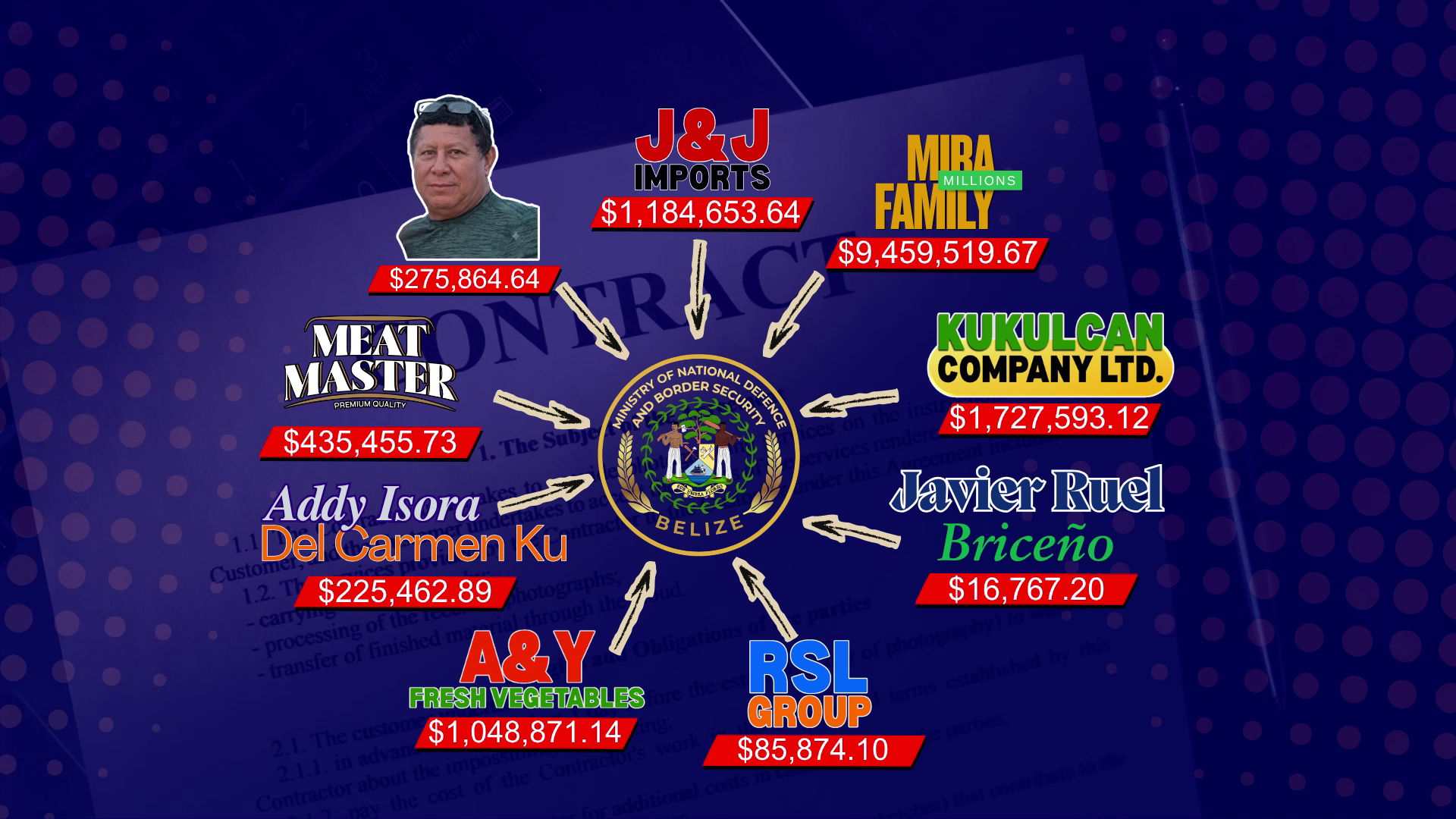
As thousands of questionable invoices undergo review at Belize’s Ministry of Defense, a previously released 2015-2016 audit report has cast new light on the ongoing scandal, revealing that the controversial practice of split payments – a tactic used to bypass official financial approval rules – is far from a new issue, and has been overlooked by successive government administrations for more than a decade.
The long-running loophole works by breaking large public expenditures into multiple smaller transactions, allowing public officials to avoid the higher-level approval required for payments above set thresholds. For Belize’s government agencies, any payment exceeding $10,000 requires sign-off from senior officials; for regional public health facilities including the Isabella Palma Polyclinic – the facility examined in the 2015-2016 audit – the threshold was just $3,000.
The 2015-2016 audit, led by then-Auditor General Dorothy Bradley, documented eight clear cases of split payments at the polyclinic, a small number compared to the thousands of suspicious invoices now being investigated at the defense ministry, but one that uses identical tactics. Examples cited in the decade-old report include a $4,819.32 restaurant invoice split into two separate checks worth $2,000 and $2,819.32, issued and cashed on the same day under the same invoice number. A second case split a $3,444.20 vendor quote into two transactions of $1,722 and $1,722.20, also processed on the same day.
Auditors confirmed this is the exact same strategy that has been uncovered at the Ministry of Defense over the past five years, raising urgent questions about why repeated warnings about the loophole were never acted on by consecutive governments.
In comments to reporters, Tracy Panton, leader of the opposition United Democratic Party, denied any knowledge of the practice during her time as a senior government official. “I served as the Chief Executive Officer in the Ministry of Tourism and Civil Aviation. As the Chief Executive Officer you serve as the accounting officer for that Ministry and I can say never during my tenure was there ever such a practice within the ministry of tourism and civil aviation,” Panton stated. “I am not aware that it was the practice in any other ministry, but if it was it was wrong and cannot continue.”
The Belize Chamber of Commerce and Industry (BCCI) is now citing the 2015 audit findings to back its claim that split payments represent a systemic pattern of corruption exploited by people in positions of power. William Neal, an Executive Councilor with the BCCI, argued that the problem extends beyond individual bad actors to weak institutional culture and vague accountability rules within government.
“The thing that is interesting is that you still have your technical people very often in the same position and whether the minister can give you approval by word of mouth and whether there needs to be documentation for you to actually follow through,” Neal explained. “What are the systems within the government system that actually means you have been authorized. Then you can abdicate your personal responsibility to say I have been instructed to do this and here is my documentation to do it. It is not the normal practice that somebody stands up and say, its not the process that somebody has to do it. So I think it how we put that system in place and put it on, not auto pilot but how it becomes the culture itself.”
Bradley’s 2015 report explicitly noted that split payments were deliberately used to get around existing financial regulations, suggesting a deliberate pattern of ignoring procurement and payment rules at public health facilities. The audit only recommended that government agencies strictly adhere to existing Financial Orders, and included no calls for individual officials to be held accountable for the rule-breaking.
Today, as current Auditor General Maria Rodriquez concludes her ongoing review of the defense ministry invoices, observers are waiting to see whether the current audit will break from the past and call for meaningful accountability, or repeat the toothless recommendations of a decade ago.