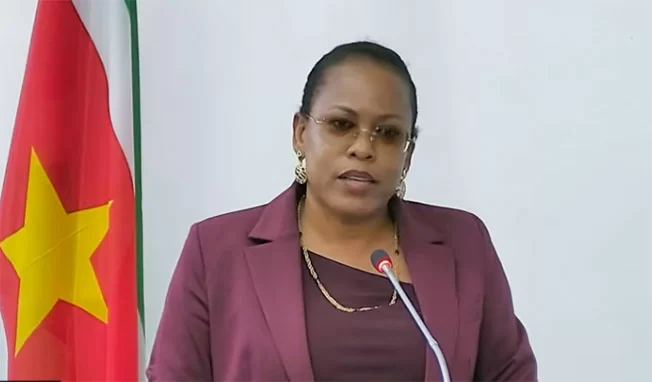
On August 6, female members of coalition caucuses in Suriname’s National Assembly announced they would return to their official parliamentary duties, but maintained their public protest against controversial, misogynistic remarks made by ruling VHP parliamentarian Cedric van Samson. Leading the group of protesting lawmakers, Rossellie Cotino of the opposition NDP delivered a formal letter to National Assembly Speaker Ashwin Adhin, calling for tightened parliamentary ethics rules and enforceable measures to combat gender-based discrimination within the legislature.
The protest first erupted on July 30, when all female lawmakers walked out of the assembly chamber in response to comments van Samson made during a radio interview regarding women in leadership roles. At the time, the lawmakers left the chamber to pressure van Samson to retract his statements and issue a formal public apology. Cotino emphasized that the group is demanding accountability for discriminatory, anti-women rhetoric that has damaged public perception of and trust in women’s political leadership. “We will not back down from this demand, because these comments harm not just sitting female lawmakers, but all women seeking to lead in our country,” Cotino stated in her address to the assembly.
Cotino expressed clear disappointment that van Samson has refused to issue an apology to date, even after widespread calls for accountability from national women’s rights organizations and other public groups. She also noted that while the VHP, van Samson’s own party, has publicly stated his comments are out of step with modern values, the party has not pushed its member to issue a formal apology.
The formal letter delivered to Speaker Adhin outlines four core demands from the protesting female lawmakers. First, the letter labels van Samson’s comments discriminatory, offensive, and fundamentally anti-women. It calls on the National Assembly to implement formal policy to prevent gender discrimination, adopt stricter ethical and professional conduct standards for all elected representatives, update the body’s standing orders of procedure to codify these protections, and enforce the equal treatment guarantees enshrined in Article 8 of Suriname’s constitution. In addition to these domestic steps, Cotino announced the group will soon contact the Inter-Parliamentary Union, the global intergovernmental body that promotes parliamentary integrity, gender equality, and standardized ethical codes for legislatures worldwide. “We are returning to the work we were elected to do, but we will never allow anyone to undermine women’s ambitions or their right to hold leadership positions,” Cotino added.
Responding to the protest, VHP caucus leader Asis Gajadien reiterated that his party publicly supports equal gender representation and women’s political rights, but argued that the body must avoid setting a constitutional precedent for penalizing statements made by lawmakers outside of official parliamentary proceedings. Gajadien called on the assembly leadership to handle the matter with extreme caution to avoid unintended institutional consequences.
Speaker Adhin responded that all sitting assembly members retain the constitutional right to raise social and political issues in the chamber, citing Article 54 of Suriname’s constitution, which protects freedom of discussion and criticism within state institutions.
The protesting female lawmakers have received cross-partisan support from multiple caucuses in the assembly. Ronny Asabina, the sole representative of the BEP party, expressed full solidarity with the group, describing van Samson’s comments as “unfit” and “unbecoming of an elected parliamentarian.” NDP caucus leader Rabin Parmessar commended the female lawmakers for choosing to resume their parliamentary duties after making their protest clear, reaffirming that Suriname’s constitutional principle prohibits all forms of discrimination, including gender discrimination. Steven Reyme of the A20 party also backed the female lawmakers’ position, noting he was raised by a single mother and highlighting that women have held critical leadership roles throughout religious history, from a Biblical perspective.