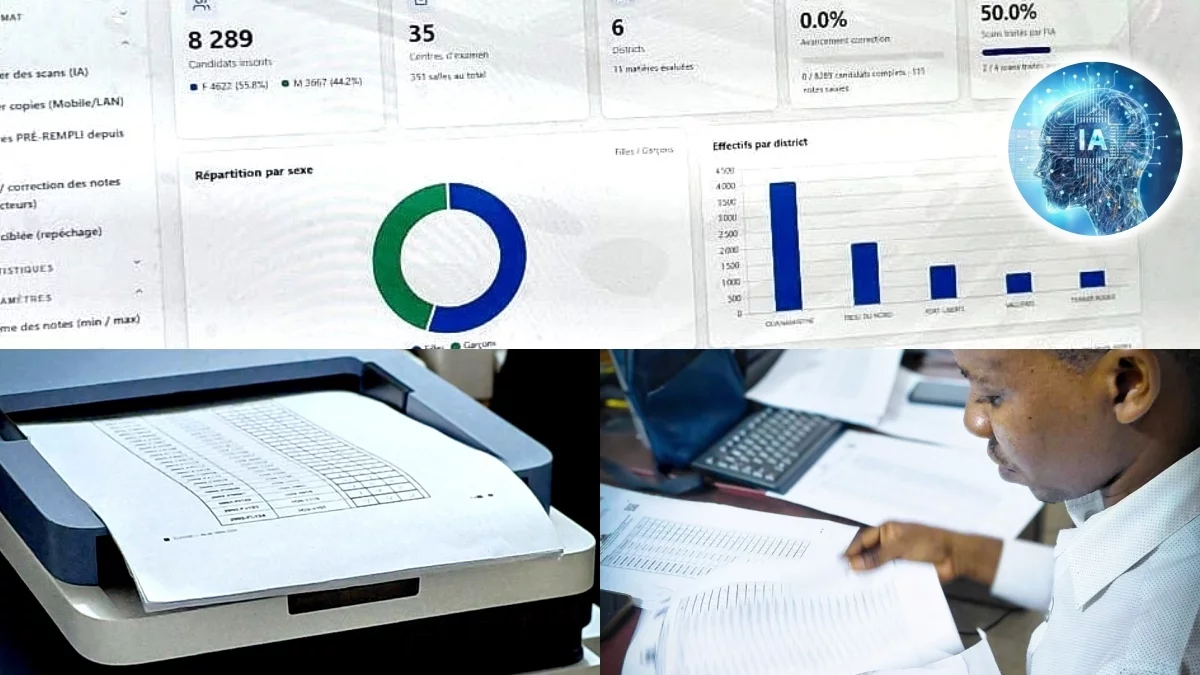
Haiti’s public education administration system has hit a new landmark in its digital modernization journey. Fresh off successful reforms that revolutionized the grading process for the country’s official 9th AF exams, the Northeast Departmental Directorate of Education (DDE-NE) has become one of the first regional education bodies in Haiti to integrate artificial intelligence into the quality assurance workflow for official state exam results, rolling out the new tool to uphold fairness in student assessments.
The core mission guiding this adoption is straightforward: to ensure every student receives a final grade that accurately reflects their own academic merit. In its new role, AI supports human education teams by powering data verification, flagging inconsistent datasets, identifying potential scoring or processing anomalies, and conducting comprehensive reviews before official results are formally validated.
Crucially, DDE-NE officials stress that the AI system is not designed to replace the education professionals that lead the exam process, including inspectors, data entry specialists and quality control analysts. Instead, it acts as a supplementary decision-support tool that boosts the accuracy, reliability and transparency of the entire assessment pipeline.
Even small scoring or processing errors can reshape a student’s academic trajectory, opening lasting gaps in access to higher education and future opportunity. For the DDE-NE, this risk justified turning to cutting-edge technology to protect every candidate’s right to a fair evaluation. Behind every exam script are months of dedicated study, significant family financial and personal sacrifices, and a young person’s hope for a more stable future. That stakes mean there is no room for procedural inaccuracies in result processing.
With the AI-powered system in place, every candidate’s result goes through multiple layers of enhanced checking, ensuring the final published grade aligns precisely with the work the student completed. The DDE-NE reaffirmed that all final decisions on results remain in the hands of trained education staff, while AI adds an extra layer of analytical capability that catches avoidable human error and strengthens public trust in the exam system.
In a statement accompanying the rollout, the DDE-NE framed the initiative as a blueprint for the future of Haitian education. The department noted that modern, responsible and innovative governance is the foundation of strong public schools, and that this innovation is rooted in one non-negotiable principle: equal fairness for every student.
“Our commitment is clear: no candidate should be penalized by an avoidable error. Every student has the right to an assessment that accurately reflects their work,” the statement read. “By putting artificial intelligence at the service of official examinations, we are making technology an instrument of educational fairness and public trust.”