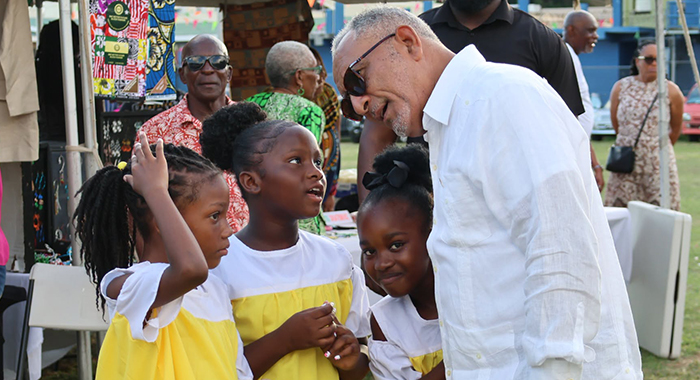
On Emancipation Day 2026, St. Vincent and the Grenadines (SVG) Prime Minister Godwin Friday delivered a landmark address to a national rally at Kingstown’s Independence Park, formerly known as Victoria Park. The event marked both the 192nd anniversary of the 1834 Emancipation Proclamation and the official launch of the country’s annual Independence Month, with Friday framing the historic end of chattel slavery as an ongoing project rather than a completed event.
Opening his remarks, Friday anchored modern social and economic challenges facing SVG within a centuries-long continuum of resistance, survival, and nation-building forged by Vincentians and their ancestors. “Laws can change in a day, but the fulfilment of justice, the full respecting of human dignity, and the work of nation building takes generations,” he told the assembled crowd, connecting pivotal moments across the nation’s history: the 1834 formal abolition of slavery across the British Empire, the 1838 end of the coercive apprenticeship system that delayed full freedom for formerly enslaved Vincentians, Garifuna resistance led by national hero Joseph Chatoyer, and the nation’s recent recovery from devastating hurricanes and volcanic eruptions. All of these moments, he argued, are interconnected chapters of a single national story of a people who refused to surrender in the face of hardship.
In a rebuke to narratives that treat emancipation as a finite historical event, Friday reminded attendees that while formal abolition was enacted in 1834, enslaved people in SVG were forced to work an additional four years of coerced labor before full legal freedom was secured. That reality, he said, should reframe how contemporary Vincentians understand emancipation: as unfinished work passed from one generation to the next. Though the enslaved people who built SVG’s foundations could never imagine the modern nation the country is today, Friday noted, they retained their humanity through unimaginable suffering, shaping the national identity that current generations inherit. “Today we acknowledge and celebrate that connection, and will not let the passing of time erase or distort it,” he added.
For 21st century Vincentians, Friday argued, emancipation requires more than remembrance: it demands active work to dismantle modern forms of inequality and constraint. Citing Bob Marley’s iconic lyric, “Emancipate yourselves from mental slavery, none but ourselves can free our minds,” the prime minister argued that removing physical chains of chattel slavery was only the first step toward building full, multi-dimensional freedom.
Friday identified the persistent contemporary barriers that hold the nation back: “chains of doubt and fear,” the self-limiting low expectations that stem from being labeled a small developing nation, systemic poverty, and the inherent economic vulnerability of small island states. Rejecting what he termed “small-island thinking,” he pushed back against the idea that geography can cap the ambition of the Vincentian people. “Our size as a country has never determined our worth. Our geography has never limited our potential. Success has never been measured by geography. It has always been measured by character, discipline, courage, and perseverance,” he said.
Framing the role of government as a catalyst for this new era of emancipation, Friday emphasized that the state’s core responsibility is to create pathways for citizens to overcome structural disadvantage, rather than perpetuating dependence. “Because true empowerment is its own form of emancipation. Emancipation requires the empowerment of our people,” he explained.
To advance that goal, Friday highlighted his administration’s signature proposal: the creation of a new national development bank, designed not just as a traditional financial institution, but as a policy tool for broad economic inclusion. The bank will act as “an instrument of opportunity and our people’s empowerment,” he said, providing accessible capital and support for local entrepreneurs to grow their businesses, for innovators to turn ideas into viable enterprises, and for small-scale producers including farmers, manufacturers, and creatives to pursue ambitions once considered out of reach. The prime minister stressed that progress depends on shared responsibility: state-led opportunity must be matched by citizen engagement, noting that “opportunity and responsibility go hand in hand.” Friday’s overarching “nation of game changers” vision, he added, centers on equipping all Vincentians to reach their full potential and lift the entire nation through collective progress.
Much of Friday’s address centered on youth, whom he identified as the next generation of leaders across sport, culture, business, and public life. He held up prominent successful Vincentians as inspiration: local business icon O.T. Mayers, legendary cultural figure Alston “Becket” Cyrus, and international athlete Shafiqua Maloney, all of whom have carried SVG’s reputation onto the global stage. “Somewhere among us today is another O.T. … another Alston ‘Becket’ Cyrus … another Shafiqua … and someone whose gift we cannot yet imagine,” he said. “You may actually know them; you just do not yet know what they are capable of becoming.”
The prime minister urged all Vincentians to reject the idea that birthplace should limit ambition. “Never allow the place where you were born to become the limit of what you believe you can become,” he said. “Be leaders in your own way. You know what is right and what is wrong. Choose to do what is right. Always do the right thing. That too is emancipation.” He added that rejecting corruption, shortcuts, and unethical behavior is itself a critical step in freeing the nation from modern “new chains.”
Grounding his forward-looking agenda in the nation’s Indigenous and cultural heritage, Friday highlighted community-led efforts to preserve Garifuna identity, pointing to language revitalization work with children in the northern community of Fancy as a model of intergenerational transmission of history. He warned against attempts to “erase or distort” SVG’s history of resistance, stressing that all children must learn the stories of Joseph Chatoyer, the Garifuna language, and the centuries of survival that shaped the nation.
As a call to action for Emancipation Month, Friday challenged attendees to actively pass history to the next generation: “Bring a child to an Emancipation Month activity. Share with them the stories you were told. Let them hear the drums, experience the dances, learn about Chatoyer and our ancestors … Be intentional. Pass on our history; be the reason it shall never be forgotten.”
Closing the address, Friday urged Vincentians to view both Emancipation and national Independence as ongoing responsibilities, not completed achievements. He commended event organizers, cultural workers, historians, and the Ministry of Youth, Sports and Culture for their work in deepening national consciousness of the country’s history. “The greatest tribute that we can pay to those who came before us is to live with confidence, with dignity, and belief in the freedom that they fought to secure,” he said.
Friday called on all citizens to reject division, negative stereotypes, and destructive ideologies, arguing that collective purpose and belief in shared strength are the only ways to honor the sacrifices of ancestors. “Every generation is called upon to leave its mark,” he said. “We inherited freedom. The best use of that inheritance is to expand it … Our ancestors taught us that we can do so much more than endure. They showed us that we could stand tall, think boldly, dream fearlessly, and build a nation worthy of all the sacrifice it has taken to get us here.”