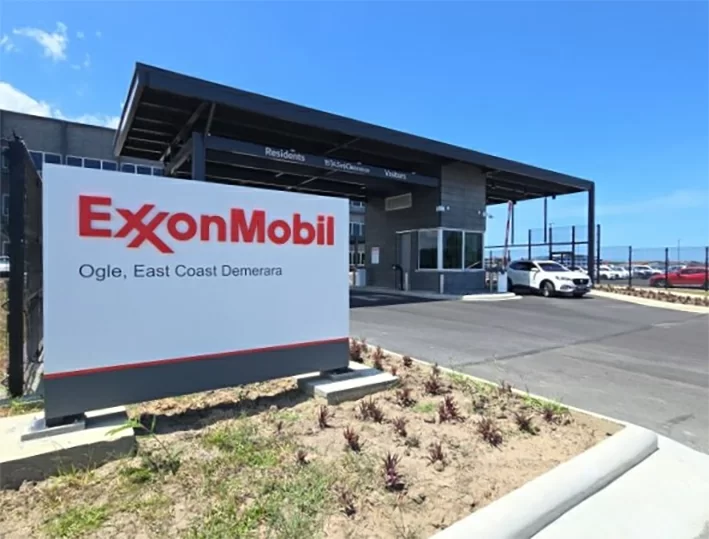
Energy giant ExxonMobil has hit a critical financial milestone years ahead of schedule in its massive oil and gas operations offshore Guyana, announcing Friday during its second-quarter earnings release that it has fully recouped more than $55 billion in exploration, development and operating costs for the Stabroek Block concession.
The accelerated payback is not only a landmark achievement for ExxonMobil and its project partners, but also a transformative turning point for the South American nation of Guyana. Going forward, a far larger share of future revenue from the project will flow directly as free cash flow to all stakeholders, rather than being diverted to recover initial capital outlays.
ExxonMobil executives attributed the faster-than-expected payback to a confluence of favorable factors: faster project delivery than original forecasts, lower-than-budgeted development costs, industry-leading operational performance, and sustained higher global oil prices than initial base projections.
“We have fully recovered the $55 billion in investment along with all associated operating costs,” stated Neil Hansen, ExxonMobil’s senior vice president and chief financial officer.
Under the terms of Guyana’s Production Sharing Agreement (PSA) governing the Stabroek Block, the ExxonMobil-led consortium is allowed to recover eligible exploration, development and operating costs from up to 75% of monthly oil output, a structure commonly referred to as “cost oil”. Once all eligible costs are recovered, remaining production — called “profit oil” — is split equally between the Government of Guyana and the consortium, after a 2% royalty deduction.
When development of the Stabroek Block first launched following major oil discoveries in the late 2010s, ExxonMobil projected full payback of initial investment would not occur until later this decade. But a combination of operational and market factors drastically compressed that timeline.
Darren Woods, ExxonMobil’s chairman and chief executive officer, explained that the company has delivered floating production storage and offloading (FPSO) vessels faster and at lower capital costs than originally planned, while consistent production levels have repeatedly outperformed expectations.
“Production units came online faster than we originally expected, at lower cost, and we’ve run those facilities above the base investment level,” Woods said. “On top of that, market prices have been higher than our base assumption. All of that means more cash comes in faster.”
Hansen added that even without the boost from higher-than-forecast oil prices, strong project delivery and operational performance alone would have cut roughly two years off the original payback timeline. He highlighted that the project’s FPSOs operate at more than 98% reliability, average production runs roughly 100,000 barrels per day above original base investment projections, and project execution stands as a benchmark for the global energy industry.
While the $55 billion in historical initial investment has now been fully recovered, Hansen clarified that cost recovery will not end entirely. New capital expenditures and operating costs for future project expansions — including additional FPSOs and field development projects — will still be added to the project’s “cost bank” and remain eligible for recovery under the PSA.
However, with the massive initial outlay already recouped and production already scaled to significant levels, the cost bank is extremely unlikely to return to the high levels seen in the project’s early development phase. “The reality is that we are still making new investments,” Hansen said. “As those investments and operating costs come in, they still go into the cost bank… but there is far less investment to recover now.”
This shift means a much larger share of all future revenue from the Stabroek Block will convert to free cash flow, rather than being used to pay down past capital investment. “We expect… now that we have fully recovered that significant initial investment, a larger share of our revenue will go to free cash flow instead of cost and investment recovery,” Hansen noted.
Asked whether investors should view this milestone as a definitive turning point for cash flow generation from the Guyana project, Hansen gave an unambiguous answer, according to Fueled Newsroom Guyana: “That is a very reasonable way to look at it. This is absolutely a turning point to free cash flow.”
While ExxonMobil’s share of production volume will dip slightly under the PSA structure once full cost recovery is complete, Hansen emphasized that the company prioritizes value over production volume. “For us, this is about value, not volume,” he said. “Even with a slight decline in allocated volume, our focus is on the value we have created for ourselves and for the Government of Guyana.”