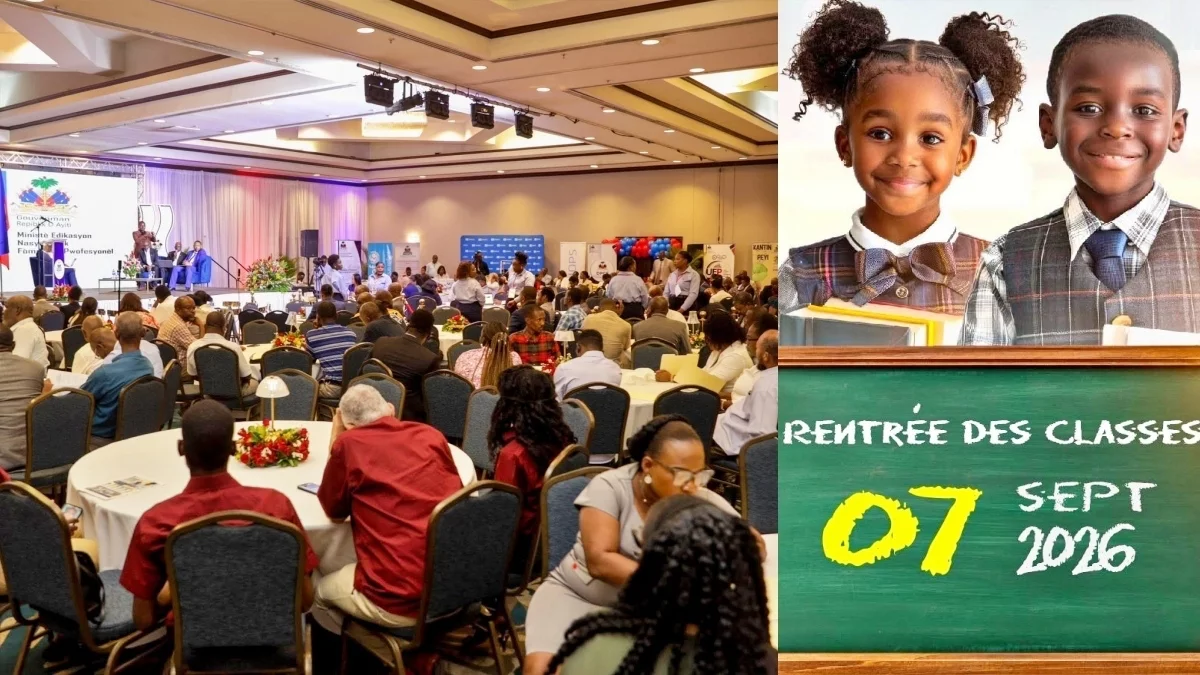
On July 31, 2026, key education stakeholders from across Haiti gathered in Pétion-ville for a high-stakes working session to finalize preparations for the upcoming 2026-2027 academic year. Leading the discussions, National Education Minister Vijonet Déméro used the opening address to lay out the government’s core goal: delivering a safe, inclusive start to classes for every student across the country, through coordinated action across all sectors.
Déméro used the event to formally confirm the official first day of the 2026-2027 school year as September 7, 2026. Beyond setting the start date, he framed the new academic year as a critical milestone in Haiti’s broader national reconstruction effort, emphasizing that investing in children’s education forms the foundational bedrock of a stable, prosperous future for the country.
“Our ambition is not limited to opening the school doors. It aims to fundamentally transform what happens inside the classrooms,” Déméro told attendees. He called for a widespread embrace of civic values across Haitian society and outlined urgent priorities for transforming the country’s long-stagnant education system. Key reforms he highlighted include full implementation of the national Curriculum Framework, ongoing updates to academic programs, and widespread integration of digital technology into daily teaching and learning.
To turn these goals into reality, the minister issued a unified call to action for all stakeholders. He urged technical and financial partners and fellow government officials to maintain and deepen collaborative resource alignment, called on Ministry of Education staff to maintain consistent on-the-ground presence, ethical management practices, and an unwavering focus on educational quality, and appealed to teachers’ unions to center the best interests of students above all other priorities. Extending an invitation for constructive dialogue, Déméro concluded his remarks by calling for an end to division, stating “Let’s join forces. Let us silence our divisions and place the future of our children in Haiti above all other considerations.” He also reaffirmed the Haitian government’s full solidarity with families of school-aged children.
Speaking alongside Déméro at the opening of the working session, Interior Minister Paul Antoine Bien-Aimé provided key assurances to attendees that schools currently occupied by internally displaced persons will be cleared and returned to educational use in time for the start of the academic year. He also highlighted the newly established Municipal Education Commission, noting that Haiti’s Constitution designates national education authorities and local governments as co-managers of public education, making the commission a critical step toward more effective shared governance. He called on all elected officials across the country to fully commit to supporting the new body.
Over the course of the day, participants including technical directors from the Ministry of National Education and representatives from domestic and international education cooperation partners held detailed panel discussions on a wide range of preparation priorities. Topics covered included the ongoing curriculum reform effort, expanded and improved teacher training programs, production and equitable distribution of textbooks, construction and rehabilitation of damaged school infrastructure, distribution of classroom furniture, school supplies and student uniforms, direct cash assistance for low-income families, expansion and improvement of school canteen programs, installation of solar energy and broadband internet systems in school facilities, and the development of new digital campuses at Haitian high schools and Departmental Public Universities (UPDs).
All planned initiatives for the 2026-2027 academic year are structured around a four-pillar roadmap developed by the Ministry of Education to guide preparations. The four core pillars are: 1. Infrastructure, logistics, and security; 2. Social support and assistance to vulnerable families; 3. Curriculum reform, digital integration, and teacher training; and 4. Governance, social dialogue, and stakeholder communication.
The Pétion-ville working session drew a broad cross-section of Haitian education leadership, including Secretary of State for Literacy Adelson Lorgeat, Ministry of Education Director General Osny Jean Marie, National Office for Partnership in Education (ONAPE) Director General Stéphanie Paultre, Institute for Social Welfare and Research (IBESR) Director General Arielle Jeanty Villedrouin, Interministerial Committee for Territorial Planning (CIAT) Executive Secretary Marie-Christine Stephenson, Ministry of Education inspectors general and senior officials, leaders of multiple Haitian teachers’ unions, and representatives from dozens of national and international institutions active in Haiti’s education sector.