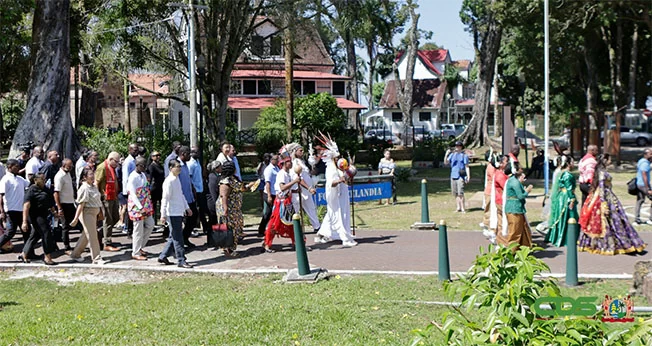
On August 1, Suriname launched a landmark new national initiative with the official opening of its first-ever Heritage Month, an event designed to center the country’s collective past, celebrate its abundant cultural richness, and build a unified vision for its shared future. The opening ceremony unfolded in two symbolic stages: it began at the Queen Wilhelmina monument adjacent to Fort Zeelandia, where government officials, foreign diplomats, and cultural sector representatives gathered before undertaking a ceremonial walk to Palmentuin. This stroll was intentionally staged to represent the journey from honoring historical memory to fostering connection, cultural exchange, and national solidarity. President Jennifer Simons, hailed by event host Clifton Braam as the founding visionary behind Heritage Month, led the official opening and unveiled the initiative’s official logo, with plans to embed the annual celebration as a permanent fixture across the country’s education, cultural, and community spheres.
The overarching theme for this inaugural edition of Heritage Month is “However we came together, this is how we move forward together” — a framing that reflects the nation’s commitment to embracing its full, complex history to strengthen collective purpose. In her keynote address, President Simons emphasized that Heritage Month is far more than a series of cultural events; it is intended to grow into a lasting, cross-sector program that brings together education institutions, academic researchers, and government policymakers to deepen public understanding of Suriname’s shared history and narrow persistent social and regional divides. “Suriname is not just home to diversity — we are diversity,” the head of state stated. She shared her hope that the initiative will help all Surinamese grow increasingly aware of their shared responsibility to one another, adding, “I hope that all Surinamese will increasingly recognize that we are our brother’s keeper.”
Organized around four sequential core themes — origins of ancestral communities, the journey of Suriname’s forebears, centuries of coexistence across groups, and documenting progress for future generations — the Heritage Month program is designed to both reflect on the past and actively build a cohesive shared national identity, according to the Suriname Communication Service. Minister of Internal Affairs Marinus Bee noted that cultural heritage is a living, evolving reality, visible in the daily lives of families, the multiplicity of languages spoken across the country, long-held traditions, and vibrant local communities. Bee stressed that entrepreneurs, artists, and the tourism sector all play critical roles in preserving and promoting Suriname’s unique national identity. “Heritage Month is not a nostalgic look backward,” he explained. “It is an invitation to look forward, to build bridges between young and old, between urban centers and rural districts, between the past and the future.”
Minister of Education, Science and Culture Dirk Currie underscored the critical importance of documenting Suriname’s history from the perspective of its own people, rather than outside narratives. He noted that education and academic research must ensure that younger generations not only learn where Suriname comes from, but also understand how its diverse modern society took shape. Currie also highlighted the underrecognized economic value of cultural heritage: by growing the creative sector, supporting traditional crafts, and expanding cultural tourism, heritage preservation can both protect cultural identity and drive new job creation and inclusive economic growth. “A large part of our history was written by the people who enslaved us,” Currie said. “That has to change.”
Rachel Pinas, chair of the presidential working group for Heritage Month, called the opening a historic turning point for the nation. She explained that August 1 was intentionally selected as the launch date to ensure the initiative creates space to honor Suriname’s full history, including its Indigenous roots, colonial era, the experience of chattel slavery, indentured contract labor, and all subsequent waves of migration. Pinas referenced Article 8 of Suriname’s constitution, which enshrines equality and bans discrimination, noting that Heritage Month is intended to reinforce these foundational values and ultimately secure a permanent, structural place in national education and community life. “Today we are making history,” Pinas emphasized. “With the opening of the first Heritage Month, the Republic of Suriname makes a deliberate choice to embrace our shared history as the foundation for our shared future.”
The first Heritage Month will run from August 1 through August 31. Throughout the month, community and national events will be hosted across every region of the country, focused on celebrating Suriname’s tangible and intangible cultural heritage, highlighting its extraordinary cultural diversity, and deepening public understanding of its collective shared history.