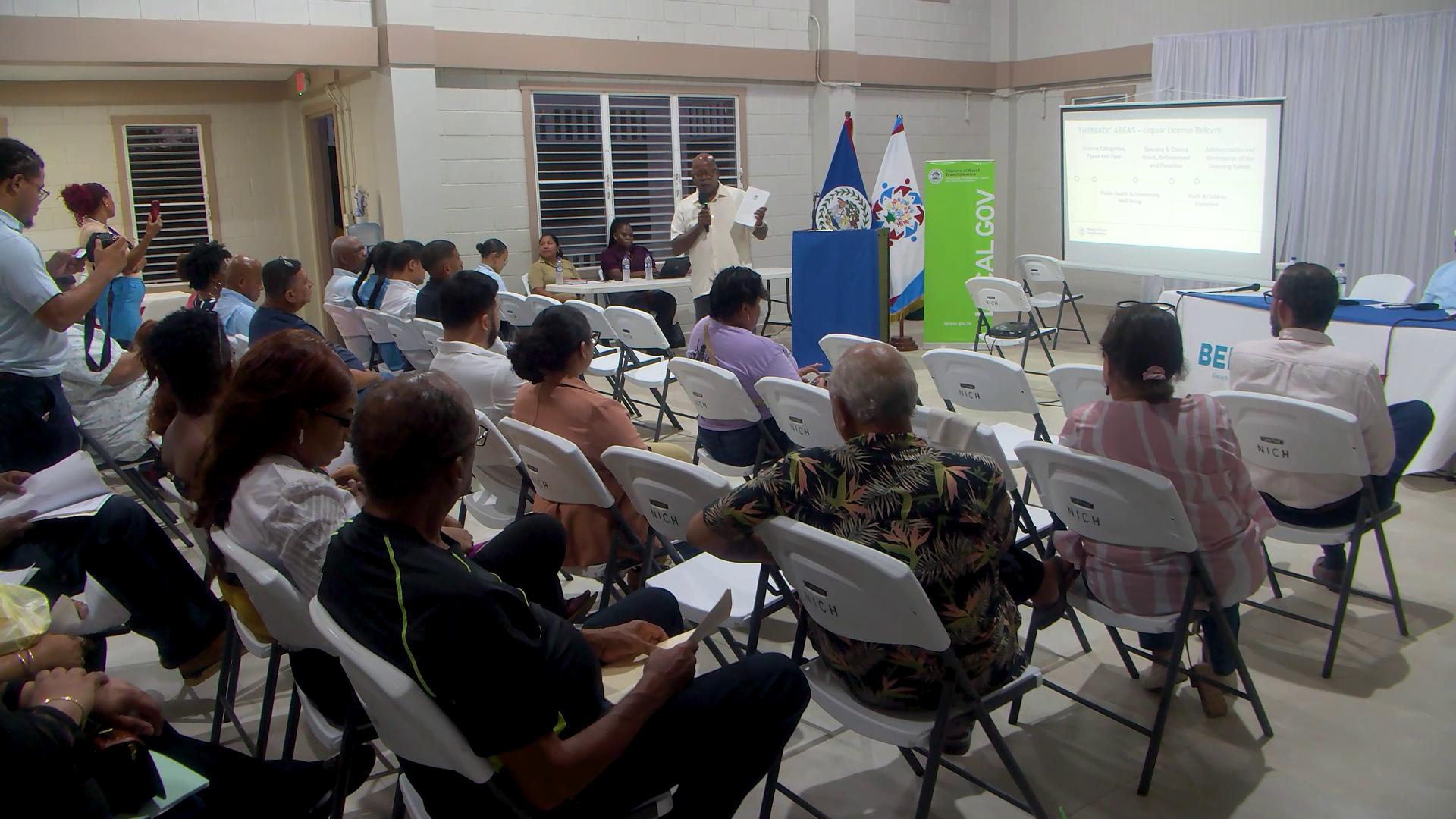
As Belize’s urban landscape and nightlife economy have evolved dramatically over recent decades, with residential neighborhoods expanding around existing bars, clubs, and liquor-selling outlets, the nation’s outdated liquor regulatory framework has failed to keep up with shifting community needs. In response, the Belizean government has launched a public consultation process to modernize the century-adjacent rules, with proposed reforms covering key areas including licensing protocols, noise management, operating hours, and regulatory structure. But at the first public consultation held Tuesday night at Belize City’s House of Culture, local residents made clear their top priority is not what the new law says — it is who will guarantee the new rules are actually enforced.
The consultation, covered by News Five reporter Shane Williams, centered on one of the most pressing community concerns: the dangerous overconcentration of liquor-selling establishments near educational institutions. Standing outside Belize City’s All-Saints Primary School, which has served hundreds of children aged 5 to 13 since its founding in 1958, Williams noted that more than five licensed alcohol vendors operate within a short walk of the school grounds. A local resident from the Kings Park neighborhood confirmed that at least five alcohol-serving clubs sit within 100 feet of the school, a persistent complaint from local families. He added that even after a shooting incident two weeks prior at a popular Bayman area nightlife spot, the venue has continued operations as if no event occurred.
Belize City Mayor Bernard Wagner explained that many of the problematic existing licenses were issued decades ago, long before current land use patterns developed. Today, the city council has enacted a formal policy rejecting new liquor license applications for locations near schools and houses of worship. “For new applications that come before the board, in respect to schools and churches, we keep those context in mind and try to ensure we don’t grant any liquor licenses in those areas,” Wagner explained. “Of course, you have established businesses that have been there for some time. Any changes to legislation will require us to figure out how to grandfather these existing operations into the new framework.”
While proximity to sensitive community sites remained a core concern, most attendees quickly shifted the conversation to what they called the far bigger issue: systemic failure to enforce existing liquor regulations. A Wilson Street resident shared a harrowing personal experience to illustrate the gap between law and practice. His 99-year-old grandmother lives in an upstairs unit of his home, and he described a recent night when loud bass from a nearby nightclub blared nonstop until 4 a.m. “I went to bed at nine, woke up at four, and the music was still playing — I could hear it clearly from my bed,” he recalled. “I took a video, called the police, and they said there was nothing they could do because the club had a permit. When I went down to the club myself after 4 a.m. to ask to see their after-hours permit, police already on site pulled pepper spray and warned me to step away.”
This experience struck a chord with other attendees, many of whom shared similar stories of intimidation after reporting regulatory violations. One Kings Park resident noted he had repeatedly reported violations to local authorities and even received direct threats from license holders for speaking out, saying “I’m not afraid to say it because I received threats from somebody that they will do me harm, but I care less.”
Some business owners also criticized the draft reforms for being one-sided. Linsford Rosado, owner of local open-air nightlife venue Thirsty Thursdays, argued the proposed changes focus almost exclusively on bars and nightclubs while ignoring a longstanding unaddressed issue: unregulated liquor sales to minors at small neighborhood shops. “The reform seems to be one-sided. I haven’t heard anything about the shops that sell liquor even to minors,” Rosado said. “As you walk into any shop in Belize, the first thing you see is alcohol. This is not just a nighttime problem — it’s a daytime problem, it’s a Sunday problem, because liquor is being sold hand over fist in every small shop across the country.”
Officials from the Ministry of Local Government noted that feedback collected from public consultations across Belize will be used to refine the final comprehensive reform package. The stated goal of the update is to create a modern regulatory system that strikes a fair balance between supporting the growth of the local hospitality and nightlife industry and protecting the quality of life for residents living near licensed establishments.