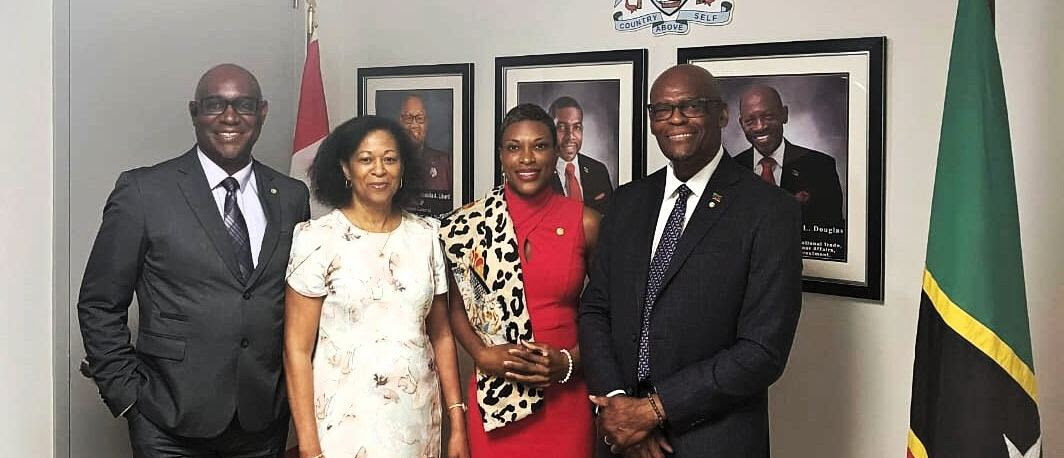
In a key milestone for the reform of the Eastern Caribbean Liaison Service (ECLS) Programme, a delegation from the Organisation of Eastern Caribbean States (OECS) Commission completed a week-long series of high-level negotiations in Canada focused on advancing the initiative’s transition to a updated governance structure.
Led by Dr. Kisha Grant, the OECS Chief of Staff and Head of Strategic Diplomacy, the official mission ran from July 5 to 12, 2026, bringing together a wide range of key stakeholders from across the Caribbean region and Canadian government. Over the course of the visit, Grant held targeted discussions with ECLS Canada-based office staff, senior leaders from Employment and Social Development Canada (ESDC) — including representatives from Canada’s Temporary Foreign Worker Programme — and diplomatic representatives from OECS member states, including consuls general and high commissioners.
Central to the talks was the dual goal of preserving the ECLS Programme’s ability to advance the shared economic and labor interests of OECS member nations, while aligning operations with Canada’s changing diplomatic designation rules. Participants also delved into actionable strategies to strengthen governance protocols, boost day-to-day operational efficiency, and shore up the programme’s long-term financial and institutional sustainability.
The ongoing transition is anchored in a formal regularization framework that was previously approved by the OECS Authority, and is overseen by the ECLS Transition Committee, a governing body established in 2025. The committee draws representation from Saint Vincent and the Grenadines, the ECLS leadership, and senior OECS Commission officials to ensure balanced, inclusive decision-making throughout the restructuring process.
Beyond the transition logistics, stakeholders also used the mission to explore expansion opportunities that would open the programme up to more workers from OECS member states, while deepening collaborative ties between all participating governments. The delegation also conducted an on-site review of the proposed new location for the ECLS Canadian office and carried out a comprehensive assessment of the programme’s current daily operations to identify areas for improvement.
In reflections on the outcomes of the mission, Dr. Grant emphasized that the in-person gathering provided an unprecedented opportunity to align all stakeholders at a critical juncture for the programme’s evolution. “The discussions reinforced our shared commitment to ensuring that ECLS continues to serve as a strong and sustainable OECS pillar while meeting Canada’s requirements. Perhaps most importantly, the mission reinforced something we should never lose sight of — that behind every discussion and every decision are hundreds of workers and families across our Member States whose lives continue to be positively impacted by this Programme each year,” Grant noted.
A core highlight of the mission was the delegation’s meeting with current ECLS participating workers, including several who have returned to take up Canadian employment through the programme for more than two decades. Describing the interaction as particularly meaningful, Grant added: “Their experiences are a powerful reminder that the ECLS Programme is one of the OECS Commission’s most tangible and enduring success stories. Behind every placement is a family, a community and a future being strengthened through meaningful employment opportunities.”
Looking ahead, the OECS Commission confirmed it will continue coordinated work with the ECLS Transition Committee, OECS member state governments, and Canadian regulatory authorities to roll out the next phase of the governance transition, while working to amplify the programme’s positive long-term impact across the Eastern Caribbean region.