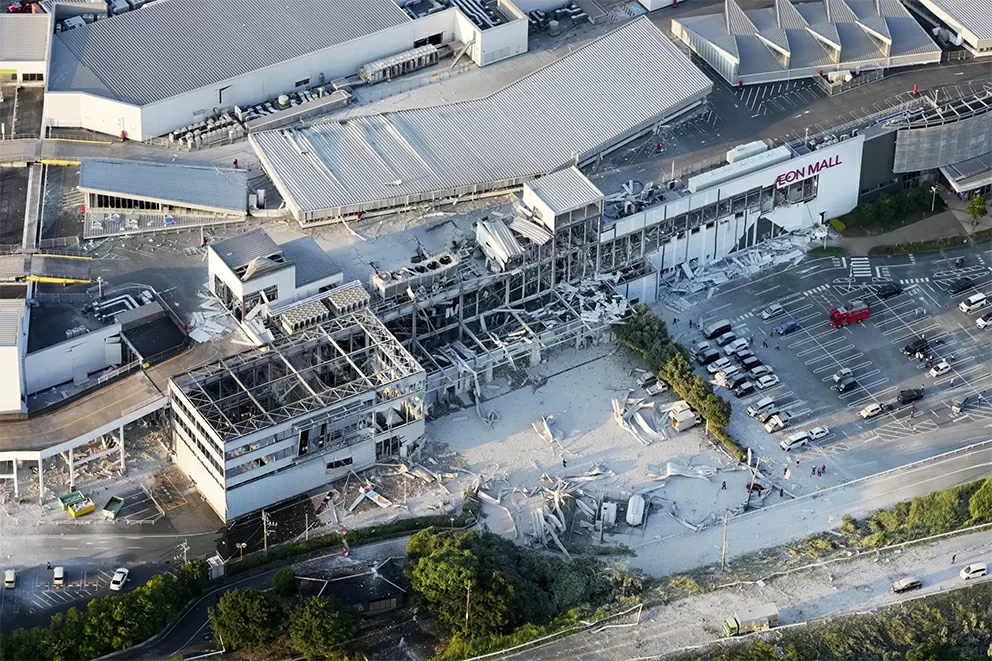
On a Tuesday in late July, a powerful 7.1-magnitude earthquake rocked the Kumamoto region on Japan’s southern island of Kyushu, leaving at least 18 people dead — including one foreign migrant worker — and at least 62 injured, six of whom are in critical condition. By Wednesday, Japanese soldiers and emergency rescue teams had launched urgent search operations across flattened residential buildings and damaged commercial centers, scrambling to locate any trapped survivors as authorities warn the death toll is likely to climb amid ongoing counts of missing people.
One of the hardest-hit sites was the Aeon Mall shopping complex in the city of Kashima, which was packed with thousands of shoppers when the tremor struck. Roughly 3,000 visitors were successfully evacuated to the mall’s parking lot before a gas explosion ripped through an unused section of the building that still held working staff. Part of the mall’s second floor collapsed in the blast, and an unknown number of people remain unaccounted for at the site. Nineteen-year-old Fumika Ono, who was shopping with her older sister when the ground began to shake, described the chaotic scene: “Children started screaming and products went flying through the air.” Ono managed to escape the structure unharmed, she said.
Rescue operations are being compounded by dangerous sweltering heat across the region, which adds strain to crews conducting manual searches through rubble. The disaster has also damaged cultural heritage sites: in the Nuyamazu district, the main entrance gates of a 16th-century Buddhist temple, which had only been fully restored five years ago, completely collapsed during the quake. Deputy head priest Yuki Kiyozumi said she was forced to crawl across the ground to escape the violent shaking, and as she cleared away broken decorative ornaments, she expressed doubt the historic gates could be rebuilt. At a nearby Nippon Paper Industries factory, the collapse of a tall chimney killed five workers, while seven others were pulled alive from the wreckage; four more remain missing at the facility.
Among the confirmed fatalities is a Vietnamese technical intern trainee, who arrived in Japan only this past January. He was killed when a construction crane collapsed onto him during the tremor. Seven other Vietnamese trainees made it out safely, though one Vietnamese woman married to a local worker was injured when a falling wall struck her.
As of Wednesday, nearly 35,000 households across the affected region remain without electricity, and roughly 15,000 have no access to running water. More than 8,800 displaced residents have taken shelter in over 400 emergency evacuation centers, where crews are rushing to install additional power infrastructure to run air conditioning units that counter the extreme heat. Aerial footage of the hardest-hit neighborhoods shows entire homes reduced to rubble, with some structures sliding downhill into nearby rivers.
Japan’s Self-Defense Forces have deployed thousands of personnel to the region, joined by hundreds of emergency responders including fire crews from Taiwan, to support the ongoing search and rescue mission. Japanese Prime Minister Sanae Takaichi has described the operation as a “race against the clock” to reach trapped people before it is too late. She announced that the national government is arranging to ship emergency food and relief supplies to impacted communities, and extended official condolences to the families of victims. High-speed bullet train services through the region remain suspended as infrastructure inspections continue. While Aso Kumamoto Airport reopened to limited traffic on Wednesday, a number of scheduled flights were canceled as a precaution against potential aftershocks.
This is not the first major deadly earthquake to strike Kumamoto in recent memory: a 2016 quake in the same region killed at least 50 people and destroyed thousands of structures. Japan is one of the most seismically active countries in the world, located along the Pacific Ring of Fire where a large share of the world’s earthquakes and volcanic eruptions occur.