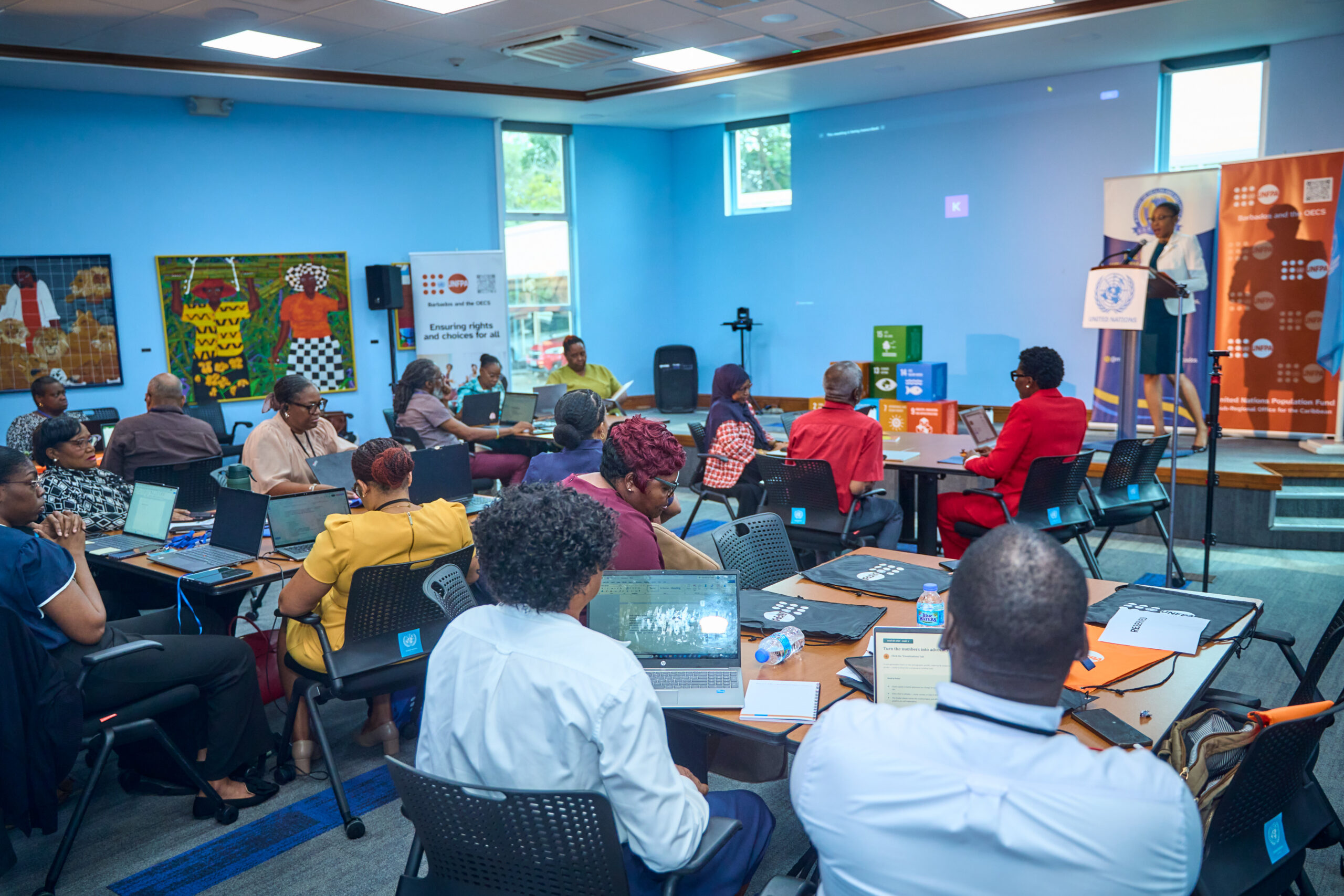
Against a backdrop of rising global instability and growing regional uncertainty, Barbados has launched a landmark collaborative initiative to safeguard critical sexual and reproductive health services for vulnerable populations when disasters or humanitarian crises strike. Led jointly by the United Nations Population Fund (UNFPA) and Barbados’ Ministry of Health and Wellness, the effort kicked off this week with a two-day Minimum Initial Service Package (MISP) Readiness Assessment and Action Planning Workshop, held at United Nations House in Hastings, bringing together public health leaders, emergency response teams and representatives from cross-sector key agencies.
Barbados’ Chief Medical Officer Dr. Kenneth George used the opening address to warn against overconfidence, noting that while the island nation has not faced a large-scale humanitarian disaster in recent years, this track record is no excuse for complacency. “Disasters can strike anywhere, even here in Barbados,” George emphasized. “Our recent period without major crises does not justify inaction – if anything, it demands increased vigilance and proactive preparedness.”
Pointing to mounting global disruptions and ongoing regional challenges, including the protracted humanitarian situation in Venezuela, George stressed that emergencies can escalate rapidly with little warning. While food, clean water and emergency shelter are universally recognized as immediate post-disaster priorities, he argued that sexual and reproductive health care is too often sidelined despite its life-saving importance.
“Consider a pregnant woman going into labor mid-disaster, or a young girl seeking protection from gender-based violence in an overcrowded emergency shelter,” George said. “Sexual and reproductive health is not a luxury during a crisis. It is a life-saving priority and a fundamental human right.”
Global health data underscores the stakes of this work. The World Health Organization estimates that two-thirds of all preventable maternal deaths and 45 percent of newborn deaths occur in regions impacted by conflict or natural disasters. Dr. George explained that UNFPA research has repeatedly shown that timely, prioritized reproductive health services in crises reduce preventable mortality, cut disability rates, lower the risk of unintended pregnancies, and improve support for survivors of gender-based violence. Without coordinated, cross-agency preparedness, he added, years of hard-won progress in improving maternal and child health outcomes can be lost in an instant. That makes the current workshop a critical step to protect those gains.
De-Jane Gibbons, UNFPA Liaison Officer for Barbados and the Organisation of Eastern Caribbean States (OECS), echoed that sentiment, noting that emergencies inherently amplify the risk of sexual violence and unintended pregnancies, making advance preparedness non-negotiable. “It is our shared collective responsibility to ensure that childbirth does not become a life-threatening experience simply because of crisis conditions or a shortage of essential supplies,” she said.
The workshop is structured to deliver actionable, country-specific outcomes. On its first day, participants conducted a comprehensive review of Barbados’ current response capacity, existing service delivery frameworks, and inter-agency coordination mechanisms, with a focus on identifying unaddressed gaps and weaknesses. On the second day, attendees will turn those assessment findings into a concrete national action plan, using scenario-based response exercises to test existing national capabilities and map out exactly what resources will be needed to fill gaps.
Gibbons emphasized that long-term success will depend on sustained cross-sector collaboration, noting that key stakeholders including the Queen Elizabeth Hospital, national polyclinics, the Bureau of Gender Affairs, the Department of Emergency Management, the Caribbean Disaster Emergency Management Agency (CDEMA), and other regional partners will all need to work in lockstep to ensure that vulnerable populations can access uninterrupted essential care, even when crisis hits.