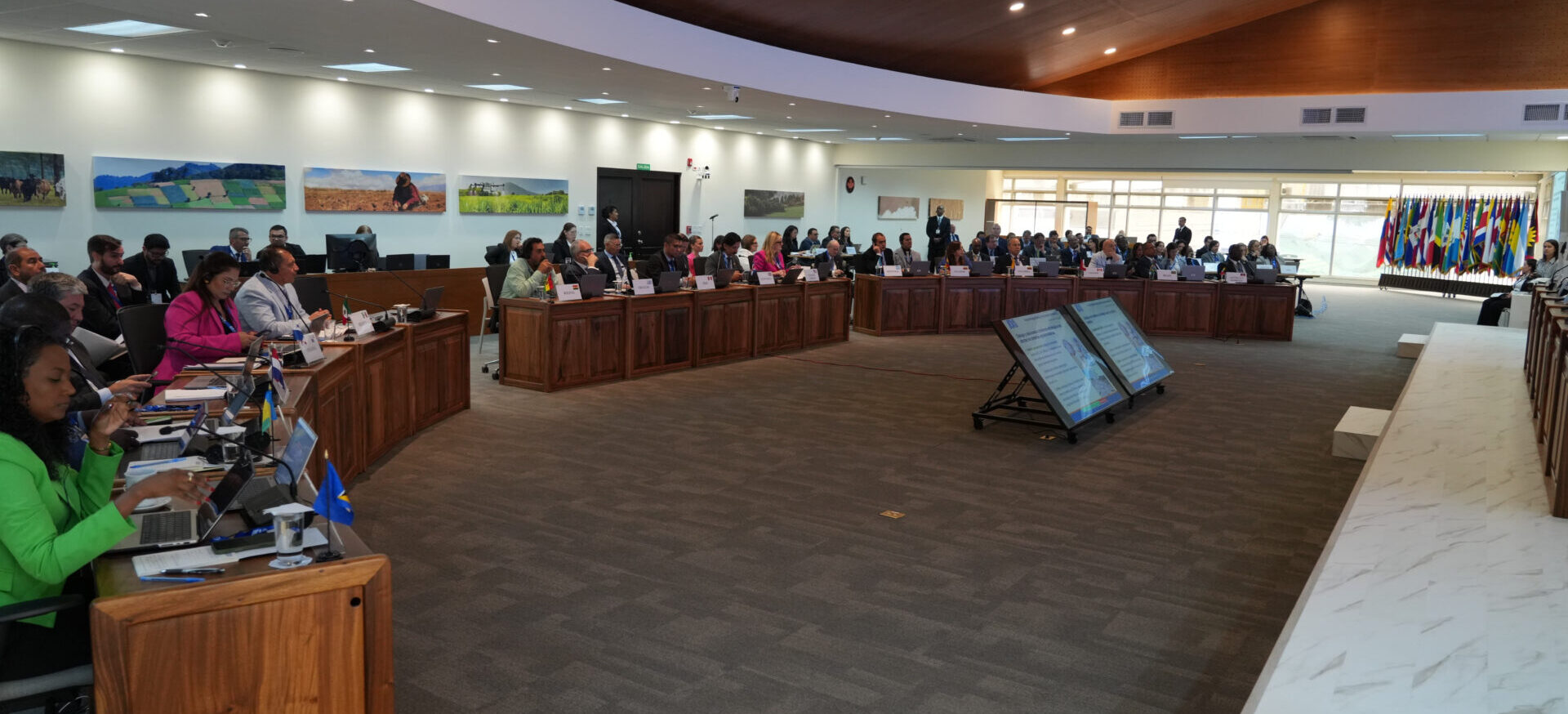
Senior agricultural leaders from across the Americas have launched a coordinated pushback against a pending European Union regulation targeting pesticide residue limits in imported crops, warning the draft rule risks erecting unjustified trade barriers that could endanger global food stability and disproportionately harm small-scale producers.
The unified condemnation came out of the Inter-American Institute for Cooperation on Agriculture (IICA) Executive Committee’s annual gathering in San José, Costa Rica, where cabinet-level agriculture ministers and senior government officials voted unanimously to approve a formal resolution demanding all global agri-food trade rules adhere to three core principles: transparency, grounding in robust scientific evidence, and alignment with established international standards. The resolution, IICA confirmed in an official press statement following the meeting, will be transmitted to the World Trade Organization (WTO) by committee chair Roberto Linares, who also serves as Panama’s Minister of Agricultural Development.
Delegates used the gathering to stress that if enacted in its current form, the EU’s proposed maximum residue limits (MRLs) regulation for crop protection products will function as an effective non-tariff barrier to agricultural imports from the Western Hemisphere. The resolution reaffirmed all participating nations’ unwavering support for the WTO’s rules-based multilateral trading system, which has served as the foundation of predictable global food commerce for decades.
In a breakdown of the regulation’s potential impacts, IICA outlined that exporters across the hemisphere would be forced to overhaul longstanding, science-based pest management protocols to meet the EU’s new requirements. Smallholder farmers, the institute warned, would shoulder the heaviest burden, as they lack the financial and technical resources to quickly adapt their production practices to shifting regulatory demands.
A wide range of key export commodities face significant disruption should the rule take effect, including high-value fresh produce such as bananas, citrus fruits, mangoes, pineapples, peppers and tomatoes, as well as major cash crops like coffee, cocoa and sugarcane. Bulk commodities including soybeans, maize, cotton, and even beef exports would also feel negative impacts, according to delegates. For the United States alone, the U.S. Department of Agriculture’s Foreign Agricultural Service calculates that affected products account for more than $5.4 billion in annual exports to the EU.
The conversation was initiated by Paraguay’s delegation, which has long pushed back against non-tariff barriers to hemispheric agricultural exports. Ambassador Julio Duarte Van Humbeck, speaking for Paraguay, noted that “Our country, like many others across the hemisphere, produces food for the world that meets multilateral standards of quality, animal and plant health, and food safety. However, our producers continue to face non-tariff barriers that affect exports. These are justified on environmental, sanitary, and phytosanitary grounds, but in most cases they restrict trade more than necessary and are not based on science.”
He added that the growing trend of prioritizing political expediency over established scientific consensus in trade regulation is deeply alarming: “It is concerning that political arguments are prevailing over scientific ones. This undermines predictability, erodes trust, and has the potential to negatively affect exports from our hemisphere, with serious economic implications.”
Paraguay’s call for a unified response earned broad backing from all participating nations, who agreed that the responsible, science-guided use of pesticides remains an irreplaceable tool for controlling crop diseases and pests, while sustaining the efficient agricultural production needed to feed a growing global population.
Senior U.S. Department of Agriculture official Michelle Bekkering, Deputy Under Secretary for Trade and Foreign Agricultural Affairs, confirmed Washington’s full backing of the resolution, emphasizing that the opposition is not an attempt at confrontation, but a defense of farming households across the hemisphere. “If our farmers are required to adapt to standards that lack scientific justification, they will face higher costs and greater uncertainty. This is not an abstract debate,” Bekkering said.
Mexico also joined the chorus of criticism, with Santiago Ruy Sánchez de Orellana, international affairs coordinator for Mexico’s Secretariat of Agriculture and Rural Development, noting that “We recognize the European Union’s right to update its phytosanitary regulatory framework, provided that it is based on scientific evidence.”
Brazil’s Vice Minister of Agriculture and Livestock Cleber Soares echoed that position, stressing that American nations have developed their own functional regulatory systems that deserve global respect. “It is crucial that any measure be based on evidence, as we stated at the recent CAS meeting in Bolivia,” Soares said.
Canada also shared the widespread concern, with Aleksandar Jotanovic of Canada’s Ministry of Agriculture and Agri-Food explaining that “Like many of IICA’s Member States, we are suppliers of food to the EU and share these concerns. This regulation could have undesirable effects not only on trade, but also on food security and on producers’ adoption of agricultural innovations. Canada appreciates IICA’s efforts to build consensus around rules that are consistent with WTO agreements and the Codex.”
The IICA meeting’s discussion builds on recent unified pushback from the Southern Agricultural Council (CAS), a bloc of South American nations including Argentina, Bolivia, Brazil, Chile, Paraguay and Uruguay. That group previously issued a warning that the proposed EU measures would reduce predictability in global food trade and weaken the entire multilateral trading system. IICA acts as the technical secretariat for the CAS.