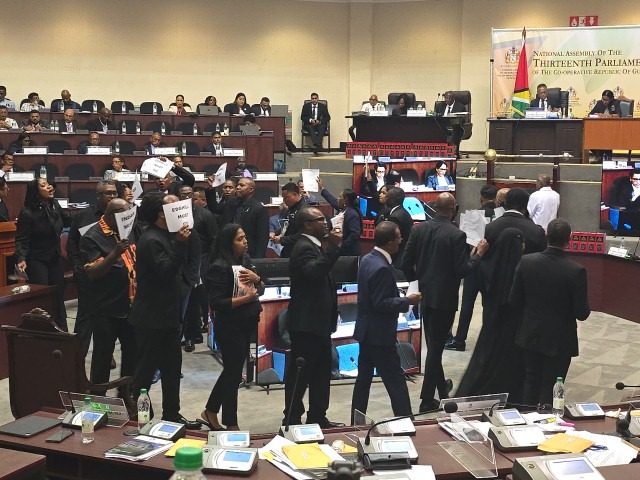
On Monday, July 27 2026, Guyana’s National Assembly descended into chaotic disruption as a unified bloc of opposition lawmakers staged a mass protest to demand bipartisan concessions for an independent public inquiry into the sinking of the MV Barima ferry, a disaster that has left an estimated 100 people dead off the country’s Essequibo Coast.
The July 18 sinking, which claimed the lives of scores of people—including more than 20 children, a majority of whom were Indigenous Amerindians—has sparked escalating anger at the ruling government over what critics call systemic neglect and a lack of accountability. The tragedy has put senior cabinet members under intense pressure to step down to make way for an unobstructed investigation.
Led by the three main opposition groups—We Invest in Nationhood (WIN), A Partnership for National Unity (APNU) and Forward Guyana Movement (FGM)—all opposition parliamentarians boycotted scheduled government business, including consideration of a GY$54.89 billion supplementary budget request and debate on the Guyana Development Bank Bill. When Speaker Manzoor Nadir called on opposition legislators to submit pre-scheduled questions to cabinet ministers, the lawmakers refused to respond.
Opposition Leader Azruddin Mohamed rejected the Speaker’s offer of a five-minute address to the 65-seat chamber over the tragedy, telling reporters ahead of the sitting that the opposition would not stand by and allow what he called “wicked, deceitful and treacherous” conduct to violate the rights of affected Guyanese citizens. “We’ve had the biggest tragedy in Guyana, and no one should expect that business must go on as usual,” explained APNU parliamentary leader Dr. Terrence Campbell, confirming the opposition was acting as a unified bloc to force the government to abandon its routine agenda and prioritize the inquiry. “We are signalling to the government that it cannot be business as usual,” he added.
Protesting lawmakers chanted demands for the resignations of two senior cabinet members: Public Works Minister Juan Edghill and Deodat Indar, the minister responsible for Guyana’s Maritime Administration (MARAD). The demonstrators banged on parliamentary tables and advanced toward the lectern where Attorney General Anil Nandlall was delivering a statement on the government’s response to the sinking on behalf of President Irfaan Ali and Prime Minister Mark Phillips, who was also present to outline the official timeline of events following the initial distress call.
Nadir twice suspended the parliamentary sitting to open dialogue with the opposition, but the demonstrators refused to end their disruption. Each time the sitting resumed, opposition lawmakers closed in on government leaders at the lectern, forcing ruling party parliamentarians to form a protective shield around Nandlall and Phillips. Parliament’s Sergeant-at-Arms and two assistants were eventually called in to establish a buffer between the protesting opposition and the prime minister. Opposition legislators also occupied seating reserved for cabinet ministers during the budget consideration process, forcing the Speaker to reassign the ministers to alternate seats, while ruling party lawmakers positioned themselves around the chamber to anticipate further direct action from protesters.
When Edghill left the Arthur Chung Conference Centre, which hosts the National Assembly sittings, he told reporters he would address calls for his resignation “at the appropriate time” as a small group of female supporters stood with him to offer comfort.
The unrest was not limited to the parliamentary chamber. Outside the conference centre in Liliendaal, a small group of civilian protesters gathered to picket in solidarity with the opposition’s demands. Among them were Annette Ferguson, a former APNU+Alliance For Change parliamentarian, and prominent Indigenous Amerindian rights activist Laura George. George extended the opposition’s resignation calls to two Indigenous Amerindian cabinet ministers, Sarah Brown and Pauline Sukhai, noting that the majority of the ferry sinking victims were Indigenous people.
“We lost more than 23 Guyanese children whose futures were taken away,” George told Demerara Waves, adding that the two Indigenous ministers cannot claim exemption from accountability for the tragedy. “As part of cabinet, we have Indigenous ministers. They also must be held accountable so I don’t want them to feel they are protected and insulated from this call for accountability. They are as culpable for this neglect of Indigenous Peoples—also as Indigenous women and mothers—so the call is for them to resign.” George also pointed to a striking lack of government action ahead of the disaster, noting that cabinet has met more than 300 times since 2020, yet the approval to launch the ferry for commercial service was never brought up for public discussion or scrutiny.
Despite the widespread opposition protest and external public pressure, the ruling government has pushed forward with its scheduled legislative agenda, refusing to concede to demands for a bipartisan agreement on the terms of reference for the public inquiry before continuing other parliamentary business.